On getting older

A lovely poem on getting older:

Men at forty
Learn to close softly
The doors to rooms they will not be
Coming back to.

At rest on a stair landing,
They feel it moving
Beneath them now like the deck of a ship,
Though the swell is gentle.

And deep in mirrors
They rediscover
The face of the boy as he practices tying
His father’s tie there in secret

And the face of that father,
Still warm with the mystery of lather.
They are more fathers than sons themselves now.
Something is filling them, something

That is like the twilight sound
Of the crickets, immense,
Filling the woods at the foot of the slope
Behind their mortgaged houses.

Donald Justice Men at Forty

At times it is necessary to let go of the past as one moves on in life. Doing so, the ground may not feel so solid; it moves, as the poet says, “like the deck of a ship”. However, that movement is gentle, partly because of the wisdom, experience and skills built up over the years. There is something beautiful about the use of the word “softly” at the end of the second line. Moving on can be done with full acceptance, with a face turned toward future adventures, with an understanding of the passing of time.

Mindfulness meditation and alcoholism

A new report suggests that mindfulness meditation may be a useful tool that helps alcoholics in their fight against addiction.

Dr. Aleksandra Zgierska, assistant professor of family medicine at the University of Wisconsin School of Medicine and Public Health, led a 16-week pilot clinical trial with 19 participants recruited from addiction treatment clinics. He initially met with some scepticism as to the possibility of people in recovery from recent addiction being able to meditate

“When we started the project, it was met with some concern,” she says. “Some people said ‘You’re going to have alcoholics meditate?’ That’s why we did the pilot study—to show that it could be possible and helpful for them. We thought meditation could teach people new skills to cope with life challenges and create an emotional and intellectual “platform” to tackle not just drinking by itself, but also other problems that may increase relapse risk.”

The trial showed that meditation was possible and could be a useful supplemetary tool for people alongside conventional treatments. Because of the trial results she is now conducting a larger study.

Her work was supported by Michael Waupoose, program manager for Gateway Recovery, an addiction treatment center, who suggests that meditation may assist in those moments of increased anxiety which would normally trigger the urge to drink:

“Mindfulness meditation would teach that person how to be present in that situation, how to be conscious of what’s happening to their body, and how to deal with it without reacting to it automatically. It teaches people how to be conscious of their feelings or thoughts without having to follow them all the way through.”

Friday Work – and life sometimes

I was sad all day, and why not.

There I was, books piled
on both sides of the table, paper stacked up, words
falling off my tongue.

The robins had been a long time singing, and now it was beginning to rain.

What are we sure of?
Happiness isn’t a town on a map,
or an early arrival, or a job well done, but good work
ongoing.

Then it began raining hard, and the flowers in the yard
were full of lively fragrance.

You have had days like this, no doubt. And wasn’t it
wonderful, finally, to leave the room? Ah, what a
moment!

As for myself, I swung the door open. And there was
the wordless, singing world. And I ran for my life.

Mary Oliver, Work Sometimes

Being Seen

In some of the tribes in Natal, in South Africa, the words used for saying hello, for greeting, are sawu bona, which means “I see you”. The other person responds by saying sikkhona “I am here”. As a greeting it affirms the real presence of the other, by letting them know that they are seen, and allows them to be fully present.

I know that, at a deep level, one of my needs is to be seen and acknowledged. I – like everyone, I suppose – want to have the freedom to reveal my true self, to relax, and not to be worried about the other’s response. “Seeing” does not mean cognitive recognition; rather it is rooted in the heart and is the awareness of my deepest self and my deepest needs are felt by another person. I need someone who has the space to see me and who is able to hold what they see.

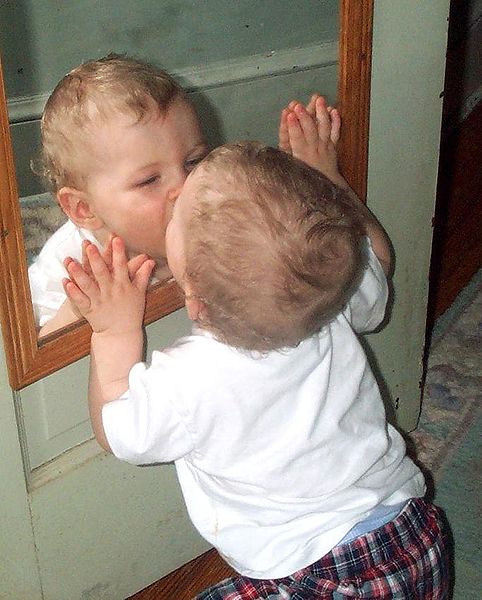
This process begins when we are babies. The young baby needs to be seen and acknowledged by its parents, and when this does not happen it can cause great distress. We are born with a need for mirroring – for having what is happening in us seen and mirrored back to us. The English Psychologist Winnicott wrote that the parent needs to have enough space – and not be caught up in their own needs – so that this mirroring reflects back to the child an accurate picture of what the child is feeling inside. This allows the child feels that its needs are being taken care of and gives the child enough trust in the safety of the world to want to see more of it. In this way the child can minimize any anxiety about the threat of the world and develop independence in exploring it:

It is only under these conditions that the infant can have an experience that feels real. A large number of such experiences form the basis for a life that has reality in it rather than futility. The individual who has discovered the capacity to be alone is constantly able to rediscover the personal impulse and the personal inpulse is not wasted because the state of being alone is something which always implies…. that someone else is there
The Capacity to be Alone

However, when the child does not feel its needs being seen and reflected back, or that the caregiver is not attuned, it learns to become more cautious in order to protect itself from the inconsistency of the carer. The child can learn then that it is dangerous to let its true self be seen and that it should to keep its needs hidden. The capacity to be alone is not as strongly developed and this can lead in later life to an dependence on external activities, such as work, or to an instability in relationships. There may be links here with the practice of meditation. If it develops the capacity to be alone with ourselves it has the potential to heal some of these early life experiences.

Many babies, however, do have to have a long experience of not getting getting back what they are giving. They look and they do not see themselves…The baby gets settled in to the idea that when he or she looks, what is seen is the mother’s face. The mother’s face is not then a mirror.
Play and Reality

It would seem from this that real listening, real mirroring, is one of the greatest gifts we can offer to another person. If we can attune to what is really going on inside them, and not let our needs and our internal chatter predominate, then we allow them to be fully themselves and they can grow.

A soft day

In Ireland the term ” a soft day” is used to describe a day with very light rain. Traditionally people would say “It’s a soft day, thank God”, even if it had been raining for weeks and was miserably cold …which probably demonstrates that – or maybe explains why – the Irish are entirely mad. Today, there has been gentle snow falling all day, an alpine equivalent of the Irish soft rain. It falls gently, persistently, on top of the snow already lying on the garden, without a sound, snow on snow.

When we practice we try and take a light touch, not taking ourselves too seriously. We also try to lightly use the breath as an anchor, not thinking of the breath but gently dropping in on it, like the gentle touch of this soft snow. We also soften our posture as we sit, not needing to force or strain, as sitting is dropping into the natural and gentle calm that exists inside us. We just let ourselves settle gently.

It is good to work in this way; It is so easy to be harsh with ourselves, in practice and in life.

Worrying

The roots of the word “worry” comes from an old Anglo-Saxon word, Wyrgan. It originally meant to strangle, choke, or tear at the throat with teeth. It was used of animals who would attack other animals, such as dogs biting the throat of sheep. We can still see this use when we speak of a cat worrying a mouse. Cats play with their prey before they kill it, sometimes throwing it up in the air or slapping it back when it seems about to escape.

Yesterday morning, bright and early, our cat Barney proudly brought a big mouse into the house and let it free in the hall. Having safely confined Barney in another part of the house I was surprised to see the mouse sitting on a shoe, licking itself, apparantly unbothered. Without too much difficulty I managed to catch him in a plastic container and release him outside, much to Barney’s disappointment.

Our modern use of the word worry started out life in a similar way to this animal meaning, as “to cause mental anguish”. It later developed into its more common modern days sense of “to feel mental anguish”. Reflecting on the early morning cat and mouse tale, I felt that the original sense has much to tell us. We frequently worry ourselves, cause ourselves mental anguish. We have a lot of input into the process, and can sometimes return to an issue, just like a cat playing with a mouse. We can generate negative thoughts, imagine catastrophies, increasing our anxiety by developing scenarios which may never actually occur. In this way we “play” with a situation which may be simply registering in the body as a physical feeling and refuse to let it just be that.

As one meditation teacher reminded us, we should always notice the “add-ons” – the stories we bring to an experience. We may be feeling nervous about starting out on a new process, but then we add on stories about our worth or how our past has developed. We may be shy making friends, but then we add on a commentary as to how we will never be happy. We may have made a mistake and then exaggerate it into something that reflects our whole life and conduct.

One way to do this is to try and stay in the present, with the raw experience of the situation, and not add to it by remembering past qualities or mistakes, or move to the future by picturing certain outcomes. We can try and stop “playing” with our problem, like the cat does with the mouse, stop returning to it again and again, stop worrying it. We can try and let the situation just be, rather than returning to it, mistakingly thinking that this is a better way to “fix it”. We can let it go free.

We need to examine that notion of “fixing” ……. We need to question our concepts about how we want things to be and what we want people to become. If we can let go of some of that, we can see more clearly what we can and cannot do. We can learn not to obsess about all the problems we cannot solve, but to sort through them to find the one or two things we can actually do that might be helpful. It is better to do one small helpful thing than punish yourself for the many things beyond your power and ability to change or affect. Some problems can be solved, some cannot, and some are best left unsolved.

Judy Lief, The problem with problems