Changing the colour of your day

Depending on who you believe, either yesterday, the 17th, or next Monday, the 24th is “Blue Monday” – the most depressing day of the year. This fact was based on rather dubious “scientific” evidence and was originally part of an advertisement campaign by a Travel company hoping to encourage the early booking of summer holidays. However, the notion has found its way onto  reputable news services and even gotten some support in mental health circles. Indeed, one of them has gone so far as to say that, given the economic climate, 2011 is gloomy enough to merit  having two Blue Mondays, this week and next week.

It is an idea that fits into one understanding of happiness, namely, that most of our happiness depends on our circumstances. Because January is normally cloudy, and people spent too much money at New Year, and being back at work reveals that nothing has changed in their lives, therefore this must mean unhappiness. We have a deep-rooted instinct to seek happiness out there, either in a perfect job or career, a perfect relationship or friendship, a perfect place to live. If we accept this and because most of us have some level of imperfection in at least one of these areas, which was not magically resolved this over the holiday period,  we are bound to hit a wall of depression.

However, research has shown that only a small part of our happiness comes from these types of external conditions.  The models of happiness we get in the media tend to be happiness-in-the-perfect life, the perfect relationship, all white with no shades of grey.  However, normal human life and happiness is always relative, and never unchangingly absolute.  Furthermore, modern society tends to favour the disposal of situations or people whom we no longer have time for or have gotten complicated or difficult. Seeing this we frequently fall in to the trap of comparing our life to outside models, finding it lacking and thinking a quick fix is the answer. When this is not forthcoming we get disappointed and down, not realizing that  happiness is possible even when things are not perfect, if we know where to seek it.

What meditation practice reveals is that most emotional agitation and suffering is, in fact,  caused by the mind, not by external circumstances and certainly not by something as arbitrary as a date in January.  It is part of the human condition to frequently feel – and not just on January 17th – that life is not offering us enough, or that we are not doing enough in it, or that we are under pressure with what we have to do. Some level of difficulty occurs to everyone from time to time, and it does not mean that something has gone wrong. Mental impression cross the mind frequently, and our happiness depends on how we work with them.  Rather than chasing after happiness, meditation practice trains the mind to turn to whatever is happening at any particular moment, and to rest in that. Over time we gradually we get the strength to sit with the thoughts without getting hooked in them.  As the old saying goes, difficulties may be inevitable – such as the weather or the blues on an January morning – but it is how our mind deals with this that determines what colour the day turn out.

Everything is material for the seed of happiness, if you look into it with inquisitiveness and curiosity. The future is completely open, and we are writing it moment to moment. There always is the potential to create an environment of blame — or one that is conducive to loving-kindness.

Pema Chodron

Supporting the Geneva Hospice Project

La Maison de Tara was set up in Geneva in 2007 with the goal of establishing a Hospice to provide patients and their family with care and support during the last days of life. It is currently in the process of fundraising and training volunteers with the intention of opening in the later part of this year. I am delighted that Mindfulness is part of their extensive one year training and that I will be doing that with them.  You can click on the logo on the side of the page to find out more details about and support this very worthwhile project.

Deepening your Practice 2:Become an observer

Sit where it is quiet and close your eyes: the natural inclination to make contact will bring up mental images characterized by feelings. These will most likely be taken as aspects of yourself and you’ll find various reactions occurring and you will get busy,  sitting still. However, the practice of sitting quietly with your eyes closed in meditation is useful in that, with steady attention, you can realize that all of this mental stuff is something that can be watched, and that it is therefore a series of objects – not the subject, the self. You only experience contact because of feelings and perceiving something. And since what is felt or perceived must always be an object, how can you ever contact a true subject, or self? This understanding in itself takes some of the drama out of the show, and the mind stops feeding on contact, it steps back into balance and quiets down.

Ajahn Sucitto, Turning the Wheel of Truth

Growing old but not growing hard

There are different ways of saying the same thing when we speak about being mindful. We can say, as Jon Kabat Zinn frequently does,  that we try to stay just in this moment, because this moment is the only moment we have to work with, as we “are  only alive in this moment”. Or we can say that we try to approach each experience with a “beginner’s mind” or the “eyes of a child“-  always fresh, not stuck in our preconceived ideas. Or we can pay attention to what is happening in the body and in the mind at any given time. Or simply we stay with this breath, and then the next breath, and the next breath.

All of these say the same thing. We define ourselves in each moment as something new, something fresh. We welcome each moment like a child – experiencing each new event in life as directly as possible without always mediating it through our thinking about it. The more I work with this,  the more I realize that life is best seen as a series of experiences, which arise one at a time and then pass away immediately. We can experience great freedom and compassion when we see things this way – a series of moments of consciousness arising in succession. What we present to the world as something solid – our ongoing “identity” – is in actual fact subjective events experienced in the mind and the body. We like to tell our life story as a coherent narrative. What we notice when we sit in meditation is that we frequently go back to the story we are telling about our life, embellishing it, with its villains and victims. To us it constitutes a solid reality, but it is worth reflecting on what elements we have chosen to solidify.

For example, by which elements from our past do we allow ourselves be defined today? Research shows that the brain has a preference for storing and recalling negative experiences, bringing them to the mind in thoughts about ourselves and the reliability of others,  and as an emotional tone towards events. Hurts or disappointments from the past can feel so real, and leave a mark in such as way that they can dominate the mind in a solid fashion, and cause us to identify with them. Because of this,  the story we tell about ourselves today can be strongly coloured by the negative events and words of the past, even those which happened when we were very young and which now have an influence deep within our cells.

If you look at it more closely, this negative identification is often fixed in nature – almost frozen and solid – and it resists attempts to approach it by signalling anxiety. Thus we can have a tendency to stay the same through time, not to heal past hurts, not to look forward but to be hooked in the past. If the event is recent or can be recalled clearly, then moving on is tough because the hurt,  pain and sense of betrayal caused reminds the mind that it is not safe to go back, even in our thoughts.

Now,  it is right to have regret about past actions, when we have been in the wrong or hurt others. But it is also good to distinguish between the emotions connected to an event in the past and the way they influence our sense of self in the present – producing self-judgements which are experienced now as lack of self-esteem or worthlessness. We tend to place great importance on some experiences, thus making someone or something from the past responsible for our present life. So it is good to let go of some of the solidity we put into thoughts and emotions from the past, and see them as energies that arise and can pass away. In other words, we can stop getting lost in what happened  and simply learn to observe the effects in this present moment. As Charlotte Joko Beck reminds us in Everyday Zen , there is a big difference between saying “He (or she) really let me down” and “Having a thought that he (or she) really let me down“.

If we stay with the first way of seeing things, we allow situations harden and define us. We attach some of our  identity to them  – and the narrative that accompanies them – and become stuck. If we work with the second way of seeing things, we remain fluid and soft, and let go more easily. We have more energy and space to see each new moment freshly. We are here, now, not trapped in our story. It stops us wasting time in this short life on regrets and opens us up to the fulness of life as it is available to us.

Another factor we cultivate in the transformative process of meditation is attention to this very moment. We make the choice, moment by moment, to be fully here. Attending to our present-moment mind and body is a way of being tender toward self, toward other, and toward the world. This quality of attention is inherent in our ability to love. Coming back to the present moment takes some effort but the effort is very light. The instruction is to “touch and go.” We touch thoughts by acknowledging them as thinking and then we let them go. It’s a way of relaxing our struggle, like touching a bubble with a feather.

Pema Chodron

This week, reduce stress at work: 1: Do Less

Three posts on how to shift your relationship with work, stay more mindful, and reduce stress.  My father used to say that hard work never killed anyone, and he was right: some degree of being kept occupied by work is good for our creative energies. Furthermore,  work allows us make a contribution to the world. However, modern work is frequently driven by non- stop deadlines and busyness. This can spread into our whole day by the fact that we are in constant connection through emails 24/7,  notifying us of work to be done or forgotten. If we refuse to buy into this constant activity we are made to feel guilty or disloyal.

As Marc Lesser says: Our daily incessant busyness – too much to do and not enough time; the pressure to produce a to-do list and tick off items by each day’s end – seems to decide the direction and quality of our existence for us. But if we approach our days in a different way, we can consciously change this out-of-control pattern. It requires only the courage to do less.

He goes on to give three thoughts on how to begin doing less. They are our starting points for reflection on balance in work:

1. We do less by taking the time to rest mentally and physically in between or outside of our usual activities, perhaps instituting a regular practice of meditation, retreats, breaks, and reflection.

2. We do less by pausing in the midst of activities: mindfulness practice (such as coming in touch with our breath in between reading or sending emails) and walking meditation are two examples.

3. We do less by identifying and reducing unnecessary activities. In this case, “unnecessary” means those things that are not in alignment with what we want to accomplish.

Marc Lesser, Accomplishing More by Doing Less

The child’s energy

We need to rediscover the energy that was in us as a child, before we got caught up in our roles and masks. This freedom,  that comes from deep within, is needed to cross the obstacles that face us and overcome the limitations which our fears impose upon us.  We sometimes have to dare to reach out. If not, we stay trapped where we are, divided,  unable to reach beyond the hurt or the problem we find ourselves in.

As once the winged energy of delight
carried you over childhood’s dark abysses,
now beyond your own life build the great
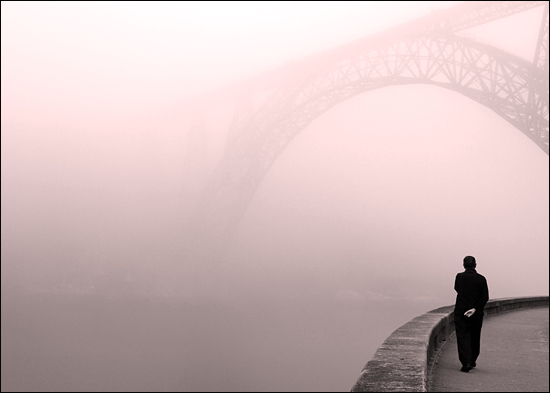
arch of unimagined bridges.

Rilke