Walking through this world

A final post this week with connection to Saint Francis of Assisi, this time a poem about an imagined walk through the world. We walk quickly, to get to our destination. We keep our eyes on ourselves and our own concerns. Our fears keep us turned in on ourselves, comparing our life to what we think it should be.  What if we walked slowly this weekend, noticing, paying attention.…..

I think God might be a little prejudiced.
For once He asked me to join Him on a walk through this world,
and we gazed into every heart on this earth,
and I noticed He lingered a bit longer
before any face that was weeping,
and before any eyes that were laughing.
And sometimes when we passed a soul in worship
God too would kneel down.
I have come to learn: God adores His creation.

Taken from Mala of the Heart: 108 Sacred Poems

Always commenting, observing, judging

It continually strikes me how difficult it is just to allow things be, and not add on a layer of commentary or anticipation about them. Maybe it is because our brains are disposed toward negative experiences and are always vigilant for possible threats, as Rick Hanson’s excellent book, The Buddha’s Brain tells us. So we are disposed to have a background hum of anxiety, and find it hard to just relax.  This means we create scenarios about potential futures, some of which never actually happen. Whatever the reason,  I was made aware of it this morning in a phonecall which left me troubled.

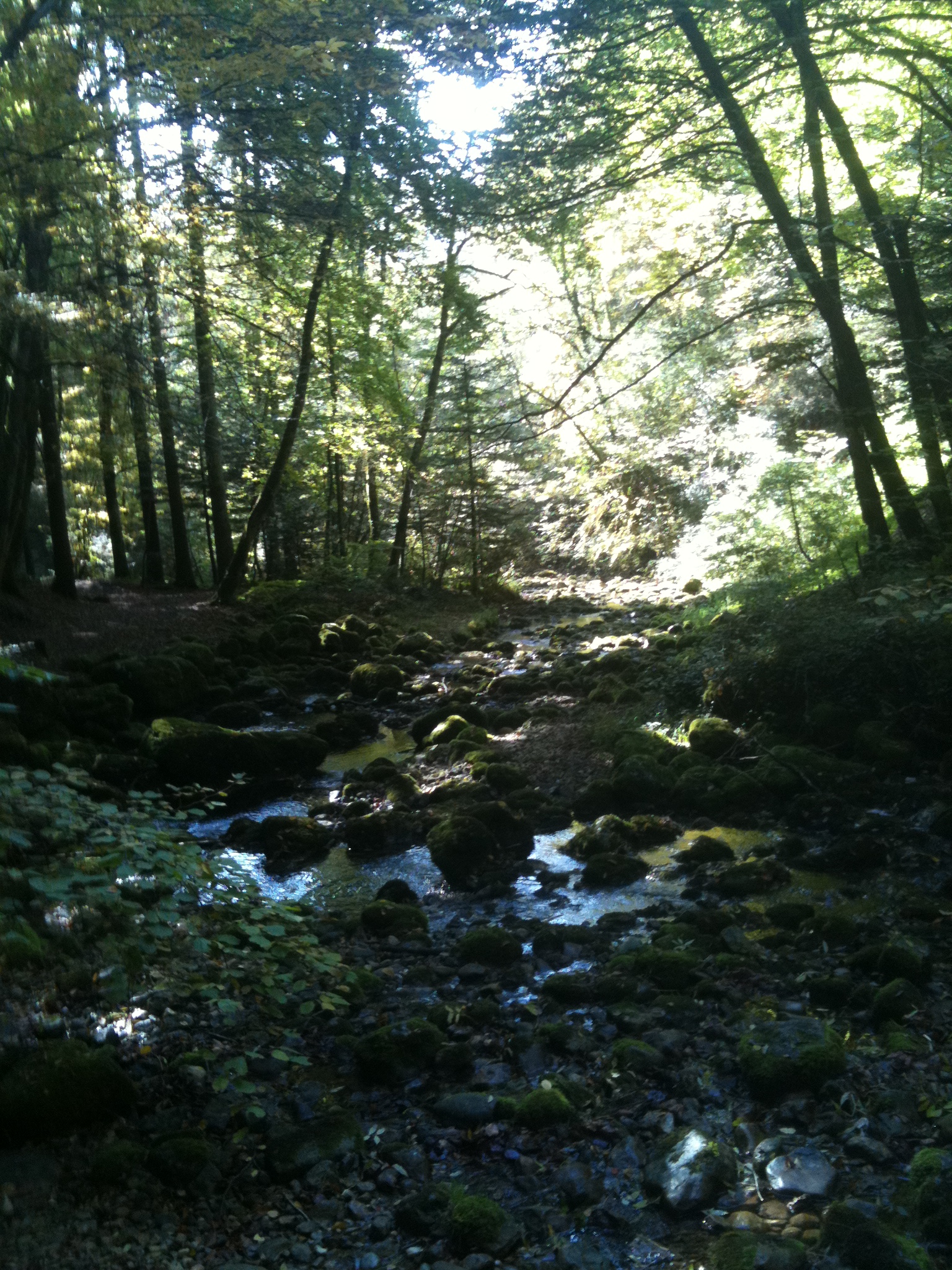
Afterwards I went for a walk in the beautiful woods near the source of the Allondon river. As I sat and listened to the sound of the water I was struck by how nature just does not worry about the meaning of life or the implications of its actions. It is not continually analyzing or counting. It is just faithful to its being. The river flows, the leaves fall, the seasons pass without the need to stand outside and observe their action. It is harder for us. Our minds are continually seeking active involvement with something. One instant, they run outward toward something, the next moment, they turn inward and away. Our practice is to try and develop stability and constancy in the mind, our capacity to simply be with life, and not always to think about it. As Pema Chodron reminds us, we cannot be in the present moment and run our storylines at the same time.

We tend to run our whole life trying to avoid all that hurts or displeases us, noticing the objects, people, or situations that we think will give us pain or pleasure, avoiding one and pursuing the other. Without exception, we all do this. We remain separate from our life, looking at it, analyzing it, judging it, seeking to answer the questions, ‘What am I going to get out of it? Is it going to give me pleasure or comfort or should I run away from it?” We do this from morning until night.

Charlotte Joko Beck

An inner voice

Anyone can revolt.

It is more difficult silently to obey our own inner promptings, and to spend our lives finding sincere and fitting means of expression for our temperament and gifts.

Georges Rouault  – with thanks to Julia for sending it to me.

Welcoming wolves to the table

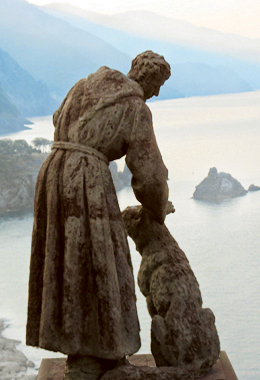
Today is the feastday of St Francis of Assisi (1182 – 1226), perhaps the most popular and likeable Christian saint. The example of his extraordinary heart reminds us of the joy that can be found in a life of meaning and service. Unlike some other saints he seems approachable. In his connection to nature he opens us out to all of creation. I am reminded of two stories from his life, both, not surprisingly, involving animals.

The first is the famous story about the wolf which was terrorizing the people of the town of Gubbio. It had killed several people, and they were now afraid to leave their homes. Francis heard about this and decided to go approach the wolf . When he came upon the wolf, it lunged at him, mouth open wide, about to bite. Francis simply, gently,  greeted the wolf as “Brother Wolf” and spoke to it, telling it not to harm him.  It stopped and lay down at his feet.  Francis and the wolf made a deal: the town would provide food for the wolf for the rest of its life, in exchange for the wolf’s ceasing to harm them. We are told the wolf  placed its right paw into Francis’ hand, and so the wolf lived in peace with the people of Gubbio for the rest of its life.

It is clear Francis was a peacemaker and reconciler – in this case helping the people in a society deal with what pushed them in fear to close their doors and withdraw. But I like to think of this story as a way that we can deal with our fears, the emotions that arise within us and scare us, like anger, jealousy and dislike of others. The stuff that relationships bring up in our lives.  Our normal first response is to be disturbed or frightened by these strong emotions and we move to push them away. However, in themselves,  these are not the problem, but it is our mind’s relationship to them that is. So what learn from Francis is to approach the things that frighten us – not to be afraid of the frightening wolves within us – but to begin by simply, gently looking at them directly. What would it be like to experiment with seeing them just as part of who we are at that moment and instead of pushing them away, to invite them to come close and to stay. As if they are part of the family – “brother wolf”, “brother anger” “brother fear” – and welcome them to the table? This is the practice: to first experience the anxiety you are going through – if it is not too overwhelming – as an embodied feeling, with no shoulds or shouldn’t about it. Our wounds – even the most frightening,  shameful, or self-inflicted ones – do not need to become a moment for showing ourselves further violence. They are, like all our practice, to be occasions of self-compassion and a letting go of judgment.

A second story tells us that Francis and Brother Leo were about to eat when he heard a nightingale singing. Francis seemed to have a special fondness for birds. So he suggested to Leo that they should also sing out their love along with the bird. Leo made the excuse that he was no singer, but Francis lifted up his voice and, line after line, sang a duet with the nightingale, until, late into the night, he tired and had to admit that the bird sang out his joy better than he could. I love the way that Francis opened his heart with all of creation and did not let the self- conscious, doubting “I am not a singer” story – which we all tell ourselves – get in the way. His heart naturally wanted to share and he did not let his fears get in the way.
In between

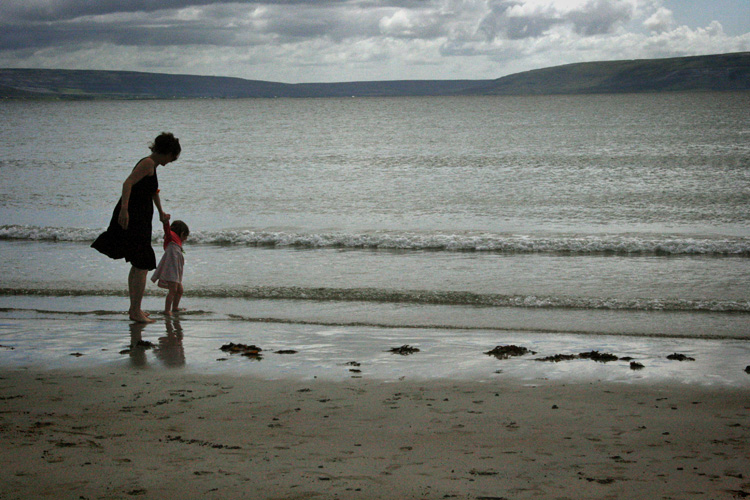
One practice which I find very useful in helping me stay mindful is to draw my attention to the importance of the times between times. Every day we have innumerable transition times, between the more formal or defined activities that take place. We can be tempted to see these moments as wasted, as having little value while we are anxious for the next thing to happen. For example, we can be waiting for a client who is late or for a meeting to start, waiting for someone to come back from the Post Office, waiting at the airport for a delayed flight or stuck at unexpected traffic works.

The suggestion  is to see these moments as invitations to stop and drop into ourselves before the next activity begins. In other words to create space between activities. The word I use to remind me to do this comes from the Christian monastic tradition, the word statio, meaning the practice of pausing between activities.

This latin word originally came from the Roman Army and meant a state of readiness or alertness.  The soldiers were fully aware because of possible danger. Therefore they stood  on watch, waiting. In the early Christian community, it became associated with a period of fasting in preparation for something important, the pause to prepare a space for what was to come. They compared their fasting to the guard duty of soldiers, seeing their actions as something to be approached with a similar seriousness and alertness of purpose.

Over the centuries this practicve evolved in the monastic communities to mean that we pause and remind ourselves beofre we start new activities. In other words, we create gaps between different activities or different parts of the day. Before we go into a meeting, or as we ring the elevator bell, we pause and form our intention to be aware. Or, for example, when we get home in the evening after work, we pause before entering our house or our apartment. We draw attention to the fact that we are chaging rhythms, from work to home, and we become conscious that we are about to come into contact with those whom we share this space. We wish to be fully present to them so we leave behind, as much as possible, the unfinished work of the workplace in order to be atttentive to them.

It is the time between times. It is a cure for the revolving door mentality that is common in a culture that runs on wheels.The practice of statio is meant to center us and make us conscious of what we’re about to do . . . Statio is the desire to do consciously
what I might otherwise do mechanically.  Statio is the virtue of presence.

We have learned well in our time to go through life nonstop. Now it is time to learn to collect ourselves from time to time so that God can touch us in the most hectic of moments. Statio is the monastic practice that sets out to get our attention before life goes by in one great blur …

Joan Chitchester, Wisdom distilled from the Daily

Sunday Quote: The little things matter

In the sweetness of friendship let there be laughter,

for in the dew of little things the heart finds its morning and is refreshed.

Kahlil Gibran