Light after darkness

dawn33

It was a nice bright morning here in Ireland and it is always heartening when we see the sun beginning to brighten the sky. So, here are another few words from Mary Oliver, on how darkness, in different senses, can give way to light, and how nature can soothe the spirit. Often at night the fixing side of our mind gets stuck in some problems or challenges we face and it can seem very dark. The light of morning or of nature can sometimes put things into perspective:

All night my heart makes its way
however it can over the rough ground
of uncertainties, but only until night
meets and then is overwhelmed by
morning, the light deepening, the
wind easing and just waiting, as I
too wait (and when have I ever been
disappointed?) for redbird to sing.

Mary Oliver, A Thousand Mornings

Which myth we live by

 File:Obilisk and gravestones of the Big Church in Templemore.JPG

It is clear that many things have changed in Ireland in the time I have been abroad, such as the confidence placed in institutional elements such as government, banking and most especially the church. However, we never really get rid of our guiding myths, just simply replace them with others – new populist ideologies, fads and obsessions with fashions and celebrity leaders – which play a similar role.

The crises of the world are not just “out there” in the geopolitical sphere but “in here” in the individual soul. The questions, explanations and great rhythms that once guided the soul by way of living myth are still within us, still guiding our lives. And we are obliged to render this process more conscious lest we live blindly, false to ourselves and false to nature. . . . we must more consciously create our own myth or be enslaved to the myth of another.

James Hollis, Tracking the gods

photo Templemore abbey, Laurel Lodged

A story about doing what is right

File:Black scorpion.jpg

Once, the sage Tulsidas saw a scorpion that was struggling to escape from a river.   The scorpion was about to drown, when Tulsidas reached over and saved it.   The scorpion immediately stung Tulsidas.   In shock, Tulsidas dropped the scorpion back into the waters, where it began struggling again to keep from drowning.   Tulsidas again reached over and picked up the scorpion to save it from drowning.   The scorpion stung Tulsidas once again.   This happened three more times, before Tulsidas was finally able to toss the scorpion to safety in the wooded land around the river.

A man who had been watching this whole incident walked over to Tulsidas, and asked him, “Are you crazy?”

Tulsidas replied, “It is the scorpion’s nature to sting, and it is my nature to be helpful to all beings.   If the scorpion keeps its nature even in the face of death, why should I give up my compassionate nature in the face of his sting?”

Photo: Per-Anders Olsson

The end of suffering

standing still

This is an interesting, important text, one of my absolute favourites, and merits some ongoing reflection. On first reading it seems strange – living in Ireland it is obvious we live on an earth, with plenty of water and wind! Obviously we come and go, either on holidays or as in relocating from country to country. It must mean something deeper about the causes of suffering.  There is a lot of evidence that people can benefit fairly immediately from some of the centering and calming practices that are found in meditation and mindfulness. They bring a certain release from the stresses and suffering of everyday life. However, texts like this suggest that real, lasting  and full liberation comes from coming to a felt knowledge of the dynamics beneath the human capacity for stress. It is somehow related to a stepping out of the continual movement of the mind towards or away from experiences –  what is referred to as the “shackles of constant becomings” – to a place that observes all comings and goings without judgment.

There is that sphere of being where there is no earth, no water, no fire, nor wind;

this sphere of being I call neither a coming nor a going nor a staying still,

neither a dying nor a reappearance; it has no basis, no evolution, and no support:

it is the end of suffering

The Buddha

Moving forward in spite of our fears

curragh

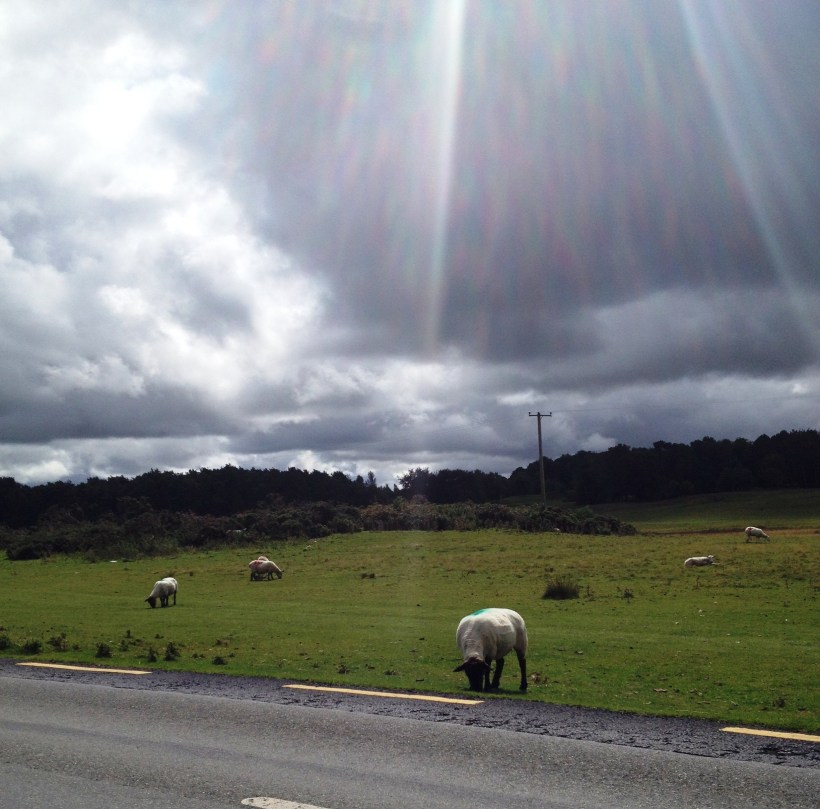
I drove back from some meetings yesterday across the Curragh, which is unique in Ireland as a flat open plain of land which has existed for thousands of years as uncultivated land, nowadays used for grazing.  It is without fences, so the sheep roam freely, and sit at the side of the road, or, as was the case yesterday, simply wander out in front of the car without any regard for safety or “rules”. It was interesting to see them behaving without fear because of their familiarity with traffic and because they have become used to the freedom of the area, having grown up in flocks where this “courage” was normal.  Most of our fearful behaviour is learnt, often due to frightening responses or lack of encouragement when we were young, or simply by being in proximity with people whose dominant narrative was fearful.  Knowing where they originate is less important than recognizing their presence in us as adults, where they frequently operate as thoughts, feelings and bodily sensations that we may not be aware of or simply think are inevitable.

We are more addicted to fear than to fearlessness. Notice how much of the day you hold tightly to your fears, especially the fear of the loss of control. All of our “what if” thinking falls into this category: “What if I don’t do it right?” “What if it’s painful?” “What if I look bad?“ These thoughts are based on wanting to control some imagined future more than on what’s happening now. It’s crucial to see and to label them with the question: “What is my most believed thought right now?”

After seeing the mental constructs, we just sit, experiencing what’s happening right now, aware of the intense physical sensations of anxiety — the tightness, the queasiness, the narrowing down. We might ask the practice question, “What is this moment?” What happens when we do this? Finding the answer is what practice is really about.

Again, the simplicity and clarity of practice amounts to this: first, we must see through the mental process, dropping the story line of “me.” What is the story line of “me”? It’s the addiction to comfort and thoughts, to our self-judgments and emotions, to our identities and our fears.

Ezra Bayda

The role of confusion

File:WinterFog.jpg

Dull and misty morning in Ireland today, obscuring the landscape and making things that were visible yesterday seem less clear.  A good metaphor for how our inner life can seem at times.

Confusion is seen as a mistake, even a madness.

In truth, our potential for psychological growth reveals itself in moments of disruption.

The gift of confusion must be honored to clear a space in your life for something new to claim you.

Jerry Ruhl, Director,  Jung Center, Houston

photo of fog in the Wicklow mountains by sarah777