Recommended Summer Reading 3

Jeffrey Brantley is the director of the Mindfulness-based Stress Reduction program at the Duke Center for Integrative Medicine. I find that he is one of the clearest and best writers about  mindfulness meditation practice, giving straightforward and unfussy instructions. His latest book, written in conjunction with Wendy Millstine, is a lovely small-sized work entitled, True Belonging: Mindful Practices to Help You Overcome Loneliness, Connect with Others, and Cultivate Happiness.

The book essentially looks at how mindfulness practice can help us nurture connections and relationships, thus reducing the sense of separateness and loneliness which is increasingly common in today’s world.  It is divided into four sections. The first section, called “Foundation” introduces mindfulness and leads in a core mindfulness of breath practice. The Next three sections are entitled “Connecting with yourself”, “Connecting with others” and Taking mindful and compassionate action in the world”, and consist of reflections followed by guided exercises to help the reader enter into the theme covered in each chapter.

There is a lot of lovely material contained in these short pages, which would reward any reader who takes each chapter and allows the insights and practices sink gently into the heart. For example, sections such as “The Gift of Forgiveness”. “Nourishing your hunger for Connection”  or “Dissolve the Boundary” introduces readers into reflections on what separates them from others or what historical baggage may be holding them back. The subsequent exercises then, in a simple, direct way, leads the reader into mediations focused on these areas.

This book, although it does have a section introducing mindfulness, is a perfect one for deepening meditation practice and allowing it soak into the deeper aspects of our being and our lives. Its format makes it seem like a guidebook and it seems to me to be something to be taken up at different times during the summer months. It touches into,  and potentially can heal, the disconnectedness arising from the mistaken beliefs we have built up about ourselves and others.

Our deep hope and intention in writing this book is that as you read the narratives here, and most importantly, you try and directly experience at least some of the practices, you will gain increased understanding, a deeper sense of connection and greater peace and happiness. And we hope and intend that you will be guided and inspired by that experience in some mysterious way so that, just possibly, our world and others in it may benefit more than ever by the beauty of your life (p. 13).

The changing textures of each moment

As we become aware of the textures of the moment, we’re rarely willing to experience them the way they are. We’re apt to see one aspect or another as a problem to be solved or an obstacle to be overcome. This is because we believe in our judgments and opinions about whatever is going on. For example, if we’re bored or sleepy during sitting,we usually judge it as a bad thing. If we feel agitated or upset, we think we have to calm down.. When we feel confused, we may long for clarity. But our practice is to simply remember that no matter what may be happening, it need not be seen as an obstacle or enemy, nor as something to fix or change or get rid of.  From a practice point of view, whatever it is, it’s our path.

Ezra Bayda, Being Zen

Making time for our better health 6: Not making excuses

When we get rushed, the mind will formulate all kinds of reasons why we cannot do the things which are good for us – take time out, meditate, exercise, visit friends. This is because it realizes we are under pressure, and mistakenly opts for two contrasting strategies to deal with this. Firstly, it convinces us that we need to conserve energy, that we do not have time to take things easy or socialize. Secondly, it focuses all its energy on the problem, normally by deciding that we should  think about it a lot. Both strategies will actually exacerbate the problem in the long run, but the mind prioritizes how we use our  time by being tricked by the very pressure it is trying to relieve.

Therefore until our practice becomes firmly established we have to remind ourselves to choose to meditate when we get stressed. This is why a fixed routine and a conscious intention are useful.  As one meditation teacher said, meditation actually begins the night before when we form the intention in our mind to set aside the time the next morning. A fixed time each day frees us from associating the practice with what sort of day yesterday was and what may  happen today, and allows us take a proactive stance towards our overall wellbeing in the face of constantly changing mind states. It help us embody the constancy we would like to feel in the face of our changing moods.

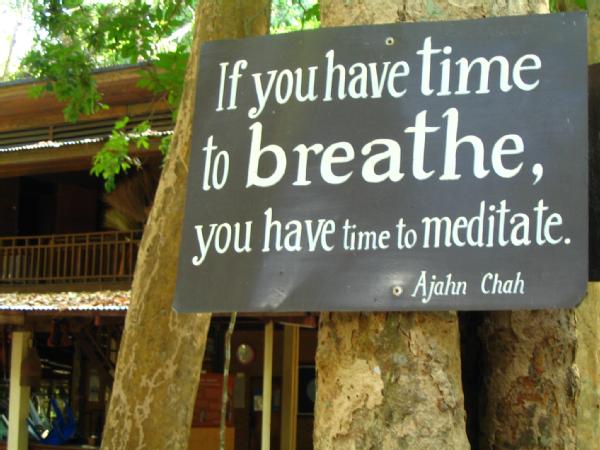
Simple daily practices : Use the breath


Breath is the bridge which connects life to consciousness,

which unites your body to your thoughts.

Thich Nhat Hahn

Recommended Summer Reading 2

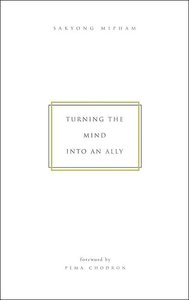
As well as books that apply mindfulness to problems or aspects of our life, it is good to strengthen our practice by reading books that focus on meditation in itself. Good ones are not easy to find, but this one – Turning the Mind into an Ally –  written by Sakyong Mipham Rinpoche in 2004 is one of the best that there is.  I have returned to it on numerous occasions over the years, because it is a serious, but accessible work that looks at meditation as an extended exercise  in mind training and gives the tools to do this.

The book “translates”  some traditional teachings from Tibetan Buddhism into a language that is easy to understand in the West. It gets across the heart of  that meditation practice without the cultural baggage which can be so off-putting in similar books. The author is fond of using imagery to convey his point, comparing the mind to a wild horse, which we have to get to know and tame:

The bewildered mind is like a wild horse. It runs away when we try to find it, shies when we try to approach it. If we find a way to ride it, it takes off with the bit in its teeth and finally throws us right into the mud. We think that the only way to steady it is to give it what it wants. We spend so much of our energy trying to satisfy and entertain this wild horse of a mind.

The author goes on to outline – in very clear language –  the basics of mindfulness and sitting meditation to tame this wild horse.  It is here that he is most successful, gently going through the steps from the first, when we place the mind on the breath:

Placing our mind on the breath is the first thing we do in meditation. In the moment of placing our mind, it’s like we’re mounting a horse: we put our foot in the stirrup and pull ourselves up to the saddle. It’s a matter of taking our seat properly. This moment of placement starts when we extract our mind from its engagement with events, problems, thoughts and emotions. We take that wild and busy mind and place it on the breath. Even though we’re placing our consciousness, which isn’t physical, placement feels very physical.  In order for placement to be successful, we have to formally acknowledge that we’re letting go of concepts, thoughts and emotions: “Now I’m placing my mind upon the breath.”

This is an excellent hands-on manual for those who wish to deepen their understanding and practice of meditation as a way of working with the mind.  It is an encouragement to practice and as such is a valuable addition to any library.

Why meditation may help with deep emotions

Research, mainly in the area of neuroscience,  is increasingly showing that meditation changes how the brain functions.  What I find interesting is how this harmonizes with the work of psychologists who look at the importance of early relationships or those who write about the unconscious. One of the most stimulating writers in this latter area is the modern psychoanalytical author, Christopher Bollas. Jon Kabat Zinn likes to say that meditation allows us to step out of “doing-mode” into “being-mode”. This strengthens our capacity to rest with experience rather than always conceptualizing it. As Ajahn Sumedho said in a recent  post, we simply recognize, without going into the need to analyse. Bollas’ quote here may suggest a link.  Maybe getting in touch with  silence may allow us reconnect with our earliest experiences which were processed without the use of language and thought. We may even say that sitting in silence and holding whatever arises may possibly, slowly,  heal these early experiences,  if they were somehow lacking.  His words also allow us see how our emotions contain a deep truth which may be outside of conscious thought, truths which may be “known” without being “thought”.

Some moments feel familiar, sacred, reverential, but are fundamentally outside cognitive experience. They are registered through an experience in being, rather than mind, because they express that part of us where the experience of rapport with the other was the essence of life before words existed….the aesthetic moment constitutes part of the unthought known. The aesthetic moment is an existential recollection of the time when communication took place primarily through this illusion of deep rapport of subject and object. Being with, as a form of dialogue, enabled the baby’s adequate processing of his existence prior to his ability to process it through thought. The mother’s idiom of care and the infant’s experience of this handling is one of the first if not the earliest human aesthetic. 

Christopher Bollas, The Shadow of the Object