Don’t believe everything you think!


You don’t have to believe your thoughts.We sometimes find ourselves in pretty dark corners, with lots of thoughts whirling around: sad thoughts, depressed thoughts.

We have a lot of sweeping to do everyday, not just house cleaning, but also have to pay attention to the mind and sweep these thoughts, seeing in them what they actually are: a simple and natural activity of the mind.

Taigu

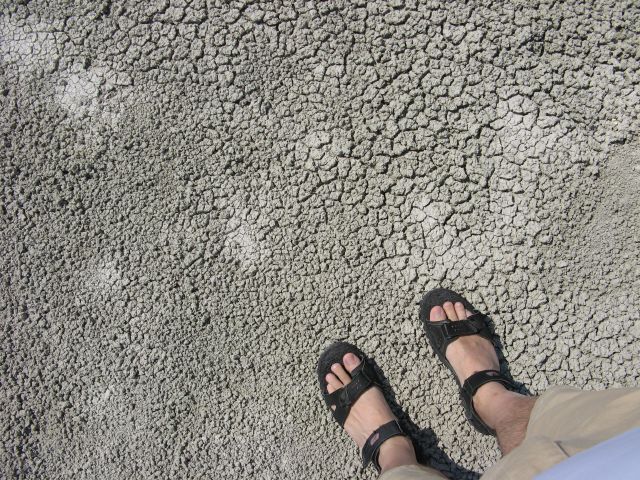
No ground beneath our feet

In Tibetan there is an interesting word:  ye tang che.  The ye part means “totally, completely,” and the rest of it means “exhausted.”  Altogether, ye tang che means totally tired out.   It describes an experience of complete hopelessness, of completely giving up hope.  This is an important point.  This is the beginning of the beginning.  Without giving up hope that there is somewhere better to be, that there is someone better to be,  we will never relax with where are or who we are.

To think that we can finally get it all together is unrealistic.  To seek for some lasting security is futile.  To undo our very ancient and very stuck habitual patterns of mind requires that we begin to turn around some of our most basic assumptions.  Believing in a solid, separate self, continuing to seek pleasure and avoid pain, thinking that someone “out there” is to blame for our pain : one has to get totally fed up with these ways of thinking.  One has to give up hope that this way of thinking will bring us satisfaction.  Suffering begins to dissolve when we can question the belief or the hope that there is anywhere to hide.

Hopelessness means that we no longer have the spirit for holding our trip together.  We may still want to hold our trip together.  We long to have some reliable, comfortable ground under our feet, but we’ve tried a thousand ways to hide and a thousand ways to tie up all the loose ends, and ground just keeps moving under us.  Trying to get lasting security teaches us a lot, because if we never try to do it, we never notice that it can’t be done.   At every turn we realize once again that it’s completely hopeless – we can’t get any ground under our feet.

Pema Chodron

There is a deep restlessness inside us….and it is ok

I have written before on how there is a fundamental restlessness at the heart of our being, or a fundamental loneliness, as some writers like to call it. Many are the strategies we use to get away from this, such as over-working,  continually running, throwing ourselves into relationships. staying constantly distracted.   And when those things are working for us, loneliness  does indeed seem absent. However, what we come to see over time is that is that this loneliness, or restlessness,  is something essential to human nature; we may succeed in covering it over for a while but it  can never actually go away.  As we can see in these two quotes from different sources, most wisdom traditions say the same thing: this feeling of restlessness, of having no real ground to stand on,  is part of being human, because there is nothing in existence that can completely fill the human heart. And at the end of the day this shows us the core of our practice, nothing other than learning to stay.

There is a deep hole in your being, like an abyss. You will never succeed in filling that hole, because your needs are inexhaustible. You have to work around it so that gradually the abyss closes.

Since the hole is so enormous and your anguish so deep, you will always be tempted to flee from it. There are two extremes to avoid: being completely absorbed in your pain and being distracted by so many things that you stay far away from the wound you want to heal.

Henri Nouwen

If we are willing to give up hope that insecurity and pain can be exterminated, then we can have  the courage to relax with the groundlessness of our situation.  This is the first step on the path.

Pema Chodron

What we do in meditation

Each separate being
in the universe
returns to (a) common source.


Returning to the source
is serenity.

Lao Tzu

Developing a more cheerful mind

Cheerfulness comes naturally with meditation. It is a quality of space created within the mind. When there’s space in the mind, the mind relaxes, and we feel a simple sense of delight. We experience the possibility of living a life in which we aren’t continuously bombarded by emotions, discursiveness and concepts about the nature of things. Lack of genuine cheerfulness is a result of claustrophobia in our mind and heart. There is simply too much going on; we feel overwhelmed and speedy. We were somehow under the impression that life was meant to be happy, and now we’re getting the short end of the stick. The harder we try to contort reality into our fantasy of happiness, the less happy we are, and the more chaotic our mind seems.

We can depend on random experiences to remind us of these truths, or we can go about it in a systematic way by engaging in a daily meditation practice. When we practice meditation, we are encouraging this natural state of cheerfulness. We don’t have to regard meditating as a somber activity; we can think of it as sitting there and being cheerful. We are using a technique to build clarity, strength and flexibility of mind. In training our mind in pliability and power, we’re learning to relax, to loosen up, so that we can change our attitude on a dime.

Sakyong Mipham Rinpoche

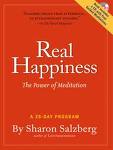
Book Review: Real Happiness

This is a really excellent book and highly recommended. Sharon Salzberg,  one of the leading Buddhist teachers in the United States and co-founder of the Insight Meditation Centre in Barre, Massachusetts, has written here one of the best introductions to meditation as well as an easy-to-grasp introduction to the whole science behind mediation and wellbeing.   Despite the fact that there are quite a few books out there on meditation, it is hard to find one that will help those starting off establish a practice in a way that is clear, well-written and experiential. Well, finally, here is such a book. It is written as a 28-Day Programme – or rather “experiment” –  for readers to try to see if they notice the beneficial effects in their lives. It includes a CD with guided meditations.

The book explains the science behind meditation and happiness, leads the reader through meditation practices for each day and then goes deeper into some of the assumptions which operate in our lives and which may get in the way of a full and compassionate life. We are led to bring these assumptions into awareness so as to loosen their grip on us:  Meditation teaches us to focus and to pay clear attention to our experiences and responses as they arise, and to observe them without judging them. That allows us to detect harmful habits of mind that were previously invisible to us. For example, we may sometimes base our actions on unexamined ideas (“I don’t deserve love, you just can’t reason with people, I’m not capable of dealing with tough situations”) that keep us stuck in unproductive patterns. Once we notice these reflexive responses and how they undermine our ability to pay attention to the present moment, then we can make better, more informed choices. And we can respond to others more compassionately and authentically, in a more creative way. (Page 10f)

This is why we practice meditation – so that we can treat ourselves more compassionately; improve our relationships with friends, family and community, live lives of greater connection and even in the face of challenges, stay in touch with what we really care about so that we can act in ways that are consistent with our values. One of the things I have always found so interesting about the meditation practice is that the arena can seem so small – just you in a room – but the life lessons, the realizations and understandings that arise  from it can be pretty big.