 In the different wisdom traditions we find attempts to reduce down to their simplest all of the instructions about living a full life: What is the essence of practice? What leads to true contentment? We can see that is this tale from the Jewish tradition, which resembles the simple direct presentation of wisdom found in the Christian Desert Fathers and in the Zen tradition. We are told that a man approached Rabbi Hillel and promised to convert to Judaism if the Rabbi managed to recite the whole of the Jewish teaching, while standing on one leg. Rabbi Hillel stood on one leg and said simply: That which is hateful to you, do not do that to your neighbour. That is the essence of the Law. Everything else is just a Commentary. Go and Study it.
Book Review: Beyond Happiness
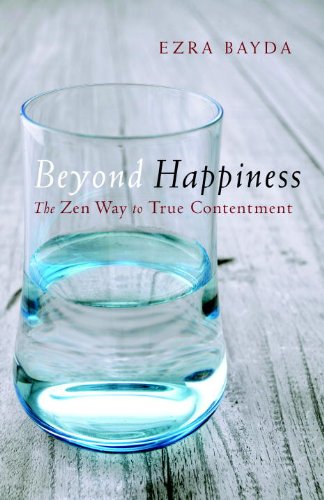 Will do some book reviews over the next few weeks. I always like Ezra Bayda’s writing, especially At Home in the Muddy Water. He is from the Zen tradition, having trained with Charlotte Joko Beck, at the Ordinary Mind Zen School. He is a student of meditation since 1970 and currently teaches at the Zen Center in San Diego. His latest book is entitled Beyond Happiness: The Zen Way to True Contentment. It was nominated as “one of the best books of the year” by the magazine Spirituality and Health.
This book bases itself on the most recent research on happiness, such as that found in The How of Happiness by Sonja Lyubomirsky, where we learn that external circumstances, such as our career, relationships and prosperity are not as important in our overall happiness as we may think. Rather, we are born with a certain predisposition to happiness and then can work on our happiness by the way we deal with our everyday circumstances. In other words, our “intentional activities”are largely responsible for how happy we are – mindful actions that we do every day to achieve a happier life. Eric Bayda develops this concept by asking three key questions: Am I truly happy right now? If not, what blocks it? And, can I surrender to what is? At the end of the day he comes up with two key ways that we can work at developing our sense of contentment and removing the things that block and poison our heart, namely, cultivating gratitude and actively forgiving.
This is a nice book in the current trend of applying Buddhist principles to the psychological areas of growth in our lives and practical ways of developing contentment.
Perhaps one of the commonest places we get stuck and consequently one of the places that most prevents happiness is holding onto resentments. If there is even one person we cannot forgive, it closes our hearts in bitterness and will prevent us from experiencing the equanimity of genuine happiness….It may be easy for us to be kind, and also forgiving, when life is going well. But it is only when life gets difficult that the depth of our spiritual practice is revealed. For our kindness to be real it cannot depend on how others treat us, or how we feel at any given moment.
Awakening Joy Course
 Awakening Joy is a hugely successful Course that has been developed by James Baraz, a meditation teacher with over 30 years experience and one of the founding teachers of Spirit Rock Meditation Center in Woodacre, California. The goal of the Course is to awaken joy through principles and practices that incline the mind toward well-being, happiness and contentment.
I am delighted to announce that James and his wife Jane are coming to Switzerland in August to run this Course as a 4-Day Workshop, from Thursday 4th to Sunday 7th. This is a great opportunity for us here to deepen our practice and grow in some of the areas we learned in the MBSR Programme or since we started meditation. This Course goes beyond Stress Reduction and looks at how we can actually increase contentment in our lives. As I have written elsewhere, the brain has evolved with a bias towards negativity, and consequently we have to work at developing the attitudes and skills that lead towards positivity, gratitude and joy. This Workshop teaches those skills in a very practical way, with structured exercises and periods of reflection. It will be held in the beautiful setting of the Kientalerhof Center in the Canton of Berne, allowing us to relax in the quiet countryside while deepening our understanding of what leads to happiness in our lives.
There are a limited number of places on the Course so early booking is advised. Full details as to how to reserve a place will be posted very shortly. For the moment, just mark the dates and check out more details about this exciting Course by clicking on the link at the side. If you have any questions just send a mail to awakeningjoy.info@gmail.com
Living a life fully
 I love the idea contained in these lines. Life is too precious and too short to waste it on regrets, or holding onto past hurts and misunderstandings. Today presents innumerable fresh moments to encounter people, occasions to reach out again, to let go of the past and to live with new eyes and love. What would it be like to live this day with as if it is our first, starting over with wonder, or, as many have to, as if it is our last, without regrets?
Walk around feeling like a leaf.
Know you could tumble any second.
Then decide what to do with your time.
Naomi Shhab Nye, The Art of Disappearing
Trusting in your own goodness
 We should find perfect existence through imperfect existence. Suzuki
Was out walking this afternoon in the lovely mild sunshine. Saw the beginnings of growth after this strange short winter, and a farmer working at ploughing her field. Got me reflecting on the conditions that are needed for us to feel safe and grow. There is no such thing as a typical winter; just the winter we have had. We cannot oblige the seasons to start and end exactly when we want. And as Winnicott said, when we were young, the conditions did not have to be perfect, just “good enough”. There just had to be enough security to allow us to be, before rushing us into doing. Parents just have to do their best and then the basic good conditions that allow love to grow take over. We just have to trust that this is the case.
If we do not trust, then we doubt our fundamental goodness and begin to push too hard or not do enough. The seeds may get laid down in infancy if a parent does not have an interior space or is confused in his or her signals. This can leave the young psyches having to do too much, too early, leading to us being “caught up in a false self and a compulsive cycle of “doing” to conceal the absence of “being”. In the adult ironically this lack of trust in being can manifest as the tendency to try to do more, to be perfect, to always give more. I see that I can get caught in this believed thought, seeking my security there. Then if something goes wrong I feel that is due to the fact that I did not do enough. A lot of energy goes into this self-judgment because it is dealing with material that is laid down very early in life.
The best way to work with this is to sit in silence, to nourish “fundamental trust”. There we return to just being and find contentment with that, no matter what the inner critical voice says. We do this in meditation. But we also have to do it in our relationships with others. One does not have to be perfect in relationships, no matter how others may expect us to be. There too, being is more important than doing : one just has to be present. We should not wait for the moment to be “perfect” to reach out and do something for others. This moment is good enough. What is needed is trust in the present moment, in reality, which becomes the most important “holding environment” for us. Trust means that we accept that things just happen in certain ways and are not due to personal failings on our side. And then we work with the moment as it is. It can be imperfect, but it is where we grow, even if we would prefer it to be otherwise.
In order to communicate very openly with the world, you need to develop fundamental trust. This kind of trust is not trusting“in”something, but simply trusting. It is very much like your breath. You do not consciously hold on to your breath, or trust in your breath, yet breathing is your very nature. In the same way, to be trusting is your very nature. To be trusting means you are fundamentally free from doubt about your goodness and about the goodness of others.
Dr. Jeremy Hayward
A rule of life
 Shall we make a new rule of life from tonight:
always try to be a little kinder than is necessary.
J.M. Barrie

