A short presentation by the always entertaining Robert Sapolsky, showing how prolonged exposure to the stress response causes more problems than stress itself:
Tag: Health
Book Review: Awakening Joy
 I should really have reviewed James Baraz’s book long before now, as I have had it in my possession for more than a year. However, with James coming to Switzerland in August to deliver, in a weekend Seminar, his hugely successful Course, now is as good a time as any. James has been teaching meditation since 1974 and is one of the founders of Spirit Rock Meditation Centre in California. The great strength of the book is that it is based on years of experience, especially in teaching the Awakening Joy Course. So it is filled with stories and testimonials, as well as practical strategies to help develop joy in our lives. James’ basic starting point is that joy is a choice that we make, and it can be developed. Each chapter introduces a different aspect of living a contented life, helping them become habits in our lives, such as developing a grateful heart or how to work when difficult emotions arise. It is one of those rare things: a book that is warm, practical and easy to use, while basing itself on up-to-date research on happiness.
Awakening Joy is not about fulfilling goals or changing particular circumstances. It’s about training the mind and the heart to live in a way that allows us to be truly happy with our life as it is right now. Not that we stop aspiring to change in positive ways, or that we remain in harmful situations, but we begin to find the joy inside us right where we are. As you work with the practices presented here, you will discover that happiness is not a place that you arrive at, but rather the result of training your mind to ride with ease and flexibility the roller coaster of life (page 7).
Mindfulness meditation changes the brain
 Participation in the 8 week MBSR programme affects the brain in areas which are responsible for memory, sense of self, empathy and stress, according to a new study due to be published next week in the Journal Psychiatry Research: Neuroimaging. The research was led by Sarah Lazar at the Massachusetts General Hospital and looked at MRI scans of participants before and after they took part in the MBSR Programme and compared them with a control group of non-meditators. They found, for example, that participant-reported reductions in stress were correlated with decreased density in the amygdala, which is known to play an important role in anxiety and stress. This change was not found in the control group, meaning that it was not just due to passage of time.
As Britta Hölzel, PhD, first author of the paper states: It is fascinating to see the brain’s plasticity and that, by practicing meditation, we can play an active role in changing the brain and can increase our well-being and quality of life. What is interesting about this study is that it shows how the reported effects of the MBSR Course are now beginning to be tracked in the underlying structures of the brain.
You can check out a report of the study here: http://www.sciencedaily.com/releases/2011/01/110121144007.htm
Work with your day as it is
 To practice we must see exactly where we are. Of course we can always imagine perfect conditions, how it should be ideally, how everyone else should behave. But it’s not our task to create an ideal. It’s our task to see how it is and to learn from the world as it is. For the awakening of the heart, conditions are always good enough.
Ajahn Sumedho
This week, reduce stress at work: 2: Starting and Ending
 Mindfulness practice encourages us to drop into our awareness of breathing and our inner world as a way of working with stress. However, keeping the sense of connectedness we feel in our formal practice is not always easy in the midst of a constantly changing everyday work life. So we need to build informal practices – little strategies – to help us strengthen our awareness skills. This post suggests some practices for the start and the end of the day – the transition moments which are really important in maintaining or restoring balance.
- Draw attention to the act of travelling to work – be it in a car or by public transport. Notice any tension while driving – such as shoulders tensed with hands wrapped on the steering wheel – and consciously work at releasing that tension. See if you can stay in the awareness of just travelling without already being in work mode before you even arrive there.
- When you arrive, take a moment to ground yourself before you enter the building. If parking the car, become aware of your walking across the car park. Slow down and notice any tendency to rush. Use the walk as a conscious reminder before the workday starts. Listen to the sounds as you walk, notice the air and look around you.
- At the end of the workday, consciously draw a line under the work you have done, making an intention to leave your work at work. Acknowledge quietly to yourself the end of the workday and be grateful for what you have accomplished. If possible, breathe mindfully for just one moment, letting go of the work.
- Again, notice any tendency to rush on your journey home. Try and mark a break with the tempo of the office by slowing down on the way to the car or transport. Make the journey itself as conscious as possible, restoring any balance lost during the stress of the day. When you come to a red light, use the moment to consciously become aware of your body, releasing any tension that has built up.
- When you get home it is good sometimes to draw attention to the transition from work space to home space, by changing clothes or having a shower. Formally acknowledge to yourself that you are now home. If you can, take five minutes to quieten down and drop into stillness.
This week, reduce stress at work: 1: Do Less
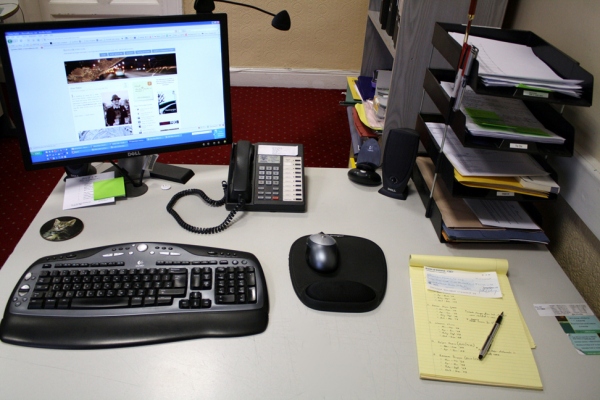 Three posts on how to shift your relationship with work, stay more mindful, and reduce stress. My father used to say that hard work never killed anyone, and he was right: some degree of being kept occupied by work is good for our creative energies. Furthermore, work allows us make a contribution to the world. However, modern work is frequently driven by non- stop deadlines and busyness. This can spread into our whole day by the fact that we are in constant connection through emails 24/7, notifying us of work to be done or forgotten. If we refuse to buy into this constant activity we are made to feel guilty or disloyal.
As Marc Lesser says: Our daily incessant busyness – too much to do and not enough time; the pressure to produce a to-do list and tick off items by each day’s end – seems to decide the direction and quality of our existence for us. But if we approach our days in a different way, we can consciously change this out-of-control pattern. It requires only the courage to do less.
He goes on to give three thoughts on how to begin doing less. They are our starting points for reflection on balance in work:
1. We do less by taking the time to rest mentally and physically in between or outside of our usual activities, perhaps instituting a regular practice of meditation, retreats, breaks, and reflection.
2. We do less by pausing in the midst of activities: mindfulness practice (such as coming in touch with our breath in between reading or sending emails) and walking meditation are two examples.
3. We do less by identifying and reducing unnecessary activities. In this case, “unnecessary” means those things that are not in alignment with what we want to accomplish.
Marc Lesser, Accomplishing More by Doing Less
 Mindfulbalance