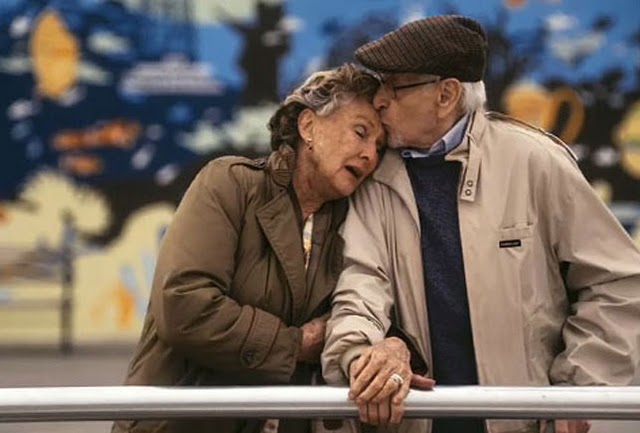
Facing ourselves in our relationships

Each day, as we grow older, we are challenged to live as the person we would like to be. This is not always easy when we are stressed or we are hurt or let down. And also we can, at times, choose selfishness rather than genuine care for others. And what I increasingly notice is how much of our behaviour has it roots in fear.

The places where these fears are most often activated is in relationships with others. Frequently we instinctively act in defensive ways to protect our hearts. Relationships have the capacity to trigger our deepest fears, which often reflect patterns established in our childhood. I notice this when a strong emotional reaction is triggered, and automatic,  deeply believed – often fearful – thoughts dominate, which are very easy to take as the truth. Normally my first move is to maximize distance in order to protect myself and act as if the other person is a threat to the security of my deepest self.  Relationships open our hearts and expose our needs. Sometimes we clearly feel that is not safe. And when that happens we all follow some strategy to escape feeling the fears that silently run our life.

However, the truth about relationships is that they reflect closely our relationship with ourselves and reveal a lot about the clarity or confusion in our inner life. In fact our relationships with others can never be better than the relationship we have with ourselves. We often project on to the other what is going on inside ourselves, often what we are unable to manage properly, and this is at the root of our fears, and the reason they are so strong. Thus we can blame the other for confusion which is actually inside ourselves.

I have noticed this often in myself recently. Therefore I am now trying, when strong fears are triggered, to turn towards them and let them in, looking on them as a ‘what’ instead of as ‘me’. Instead of running story lines of anger and blame, I try and just stay with the original feeling of hurt. Even if the fear triggered is strong, if I manage to do this soon afterwards, I notice the fear loses its power quickly and a more open response can emerge. The fear can thus becomes a teacher, hopefully leading to understanding rather than paralyzing.

Fear tells us to stop, to stay within the boundary of our protected cocoon-world. Yet when we feel fear, if we take even one small step toward it rather than yielding to our habitual pulling away, we move one step closer to the vast mind that lies beyond. When we feel fear instead of saying ‘I’m afraid,’ thus reinforcing our identification with our fear as who we are, we can simply say, ‘Fear is present.’  Thus fear’s power gradually dissipates, and we begin to free ourselves from it. When we simply experience fear just as it is — without our opinions, judgments, and reactions — fear is not nearly so frightening.

Ezra Bayda, Saying Yes to Life (Even the Hard Parts)

Celebrating life and birthdays

Celebrated a birthday today, and the passing of another year. When I lived in Rome I quickly lost any shyness around these occasions as they were considered moments of joy to be shared with all and an excuse for a cake and a celebration! So that is how I marked it, with gratitude for life and all the moments that it contains. And receiving messages and kindnesses from people, some of whom I was amazed even knew the day that it was,  also reminded me of the goodness of people and the joy there is in receiving.

I have learnt a lot this past year. In my work, and in my own life,  I have seen colleagues move far away,  I have been with people struggling with illness and death, walked with individuals as they tried to reconcile the demands of personal growth with their commitments and I have personally realized a lot about the nature of true friendship and support. At times, these experiences have made me really wonder whether there is any point in continuing to give, in remaining open; the temptation has been to shut down, to insulate the heart. I have asked whether it is worth the risk to continue to reach out to others. And yet, all these ups and downs have made me recognize more and more that life  is an extended practice of becoming the best I can be.  I see that it is a bit like meditation practice – I do not have to be perfect- all I have to do is just turn up. I just need to be there even if I think I do not have the right words and be close to what others and what life offers.

Even as an adult, with the years passing, I have had many moments when I felt lost. Life is such a long journey, and I have seen often this past year that we all have difficulty knowing who we really are or where we really need to go, or even where we come from. There is no GPS for this life,  no pre-determined  maps, no magical tarot cards which give us the final, clear answers to its mysteries.  We can only do our best. Sometimes, and for some people, that is not enough. But what we are working on is not perfection, but a slow and steady path which leads us to a greater acceptance of where our life is. It is about increasingly befriending who we are, moment by moment, year by year.

What does it take to use the life we already have in order to make us wiser rather than more stuck? What is the source of wisdom at a personal, individual level? The answer to these questions seems to have to do with bringing everything that we encounter to the path. Everything naturally had a ground, path, and fruition. This is like saying that everything has a beginning, middle, and end. But it is also said that the path itself is both the ground and the fruition. The path is the goal.

This path has one very distinct characteristic: it is not prefabricated. It doesn’t already exist. The path that we’re talking about is the moment-by-moment evolution of our experience, the moment-by-moment evolution of the world of phenomena, the moment-by-moment evolution of our thoughts and emotions. The path is uncharted. It comes into existence moment-by-moment and at the same time drops away behind us.

When we realize that the path is the goal, there’s a sense of workability. Everything that occurs in our confused mind we can regard as the path. Everything is workable.

Pema Chodron

Realities which make life beautiful

I was talking earlier today with someone about time spent I spent in the Ecumenical community in Taize in France many years ago, when the founder, Br. Roger,  was still alive. His extraordinary simplicity and humanity was very striking, managing to combine a deep inner life with an understanding of what makes for full human growth. He witnessed a time of hatred and war in his youth and went on to create a community that healed divisions. Many of his words, like these ones, reduce life down to its essence, away from the fears which make us lose faith in each other.

Are there realities which make life beautiful and of which it can be said that they bring a kind of fulfillment, an inner joy? Yes, there are. And one of these realities bears the name of trust. Do we realize that what is best in each of us is built up through a simple trusting? This is something even a child can do.

Br Roger.

How meditation leads to kindness

Think of Mindfulness as the habit of seeing things in an uncomplicated way. We generally don’t. Based on our individual histories, our memories, and our fears, we often make up our reality out of a projected worry and frighten or discourage ourselves. Mindfulness is seeing things as they actually are,  not as we imagine them to be.

Mindfulness practice… supports our ability to best serve. It keeps our motivation going. I say, “When we see, even in the simplest circumstances, how difficult it is to stay content, how easily irritated we become, how many worries we have, how hard it is to relax — we intuit that that must be true for other people as well. All other people. And we start to be kinder. We are kinder to ourselves and, ultimately, more forgiving of others. The world would get happier if everyone relaxed and forgave each other.” Usually people think about that a moment. Then they smile and say, “I think you’re right.”

Sylvia Boorstein

The essential rule for life and happiness

In the different wisdom traditions we find attempts to reduce down to their simplest all of the instructions about living a full life: What is the essence of practice? What leads to true contentment?  We can see that is this tale from the Jewish  tradition, which resembles the simple direct presentation of wisdom found in the Christian Desert Fathers and in the Zen tradition. We are told that a man approached Rabbi Hillel and promised to convert to Judaism if the Rabbi managed to recite the whole of the Jewish teaching, while standing on one leg. Rabbi Hillel stood on one leg and said simply: That which is hateful to you, do not do that to your neighbour. That is the essence of the Law. Everything else is just a Commentary. Go and Study it.

Living a life fully

I love the idea contained in these lines. Life is too precious and too short to waste it on regrets, or  holding onto past hurts and misunderstandings. Today presents innumerable fresh moments to encounter people, occasions to reach out again, to let go of the past and to live with new eyes and love. What would it be like to live this day with as if it is our first,  starting over with wonder, or, as many have to, as if it is our last, without regrets?

Walk around feeling like a leaf.

Know you could tumble any second.

Then decide what to do with your time.

Naomi Shhab Nye, The Art of Disappearing