The benefits of meditation for depression: now available on the NHS

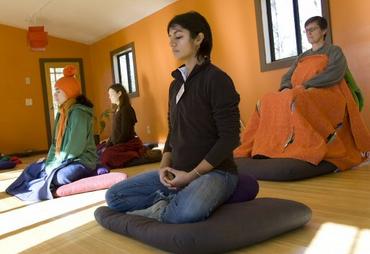
A report in the Sunday Observer newspaper bears witness to the ongoing research being done on the effectiveness of mindfulness meditation in cases of depression, leading to it being offered by the National Health Service (NHS)  in the U.K.  It refers to a new study published in the  December 2010 edition of the journal Archives of General Psychiatry which found that mindfulness meditation was as effective as the use of anti-depressants in remission from major depression. The study involved 84 persons in remission from a major depressive disorder and found that meditation offered protection against relapse or recurrence which was on a par with antidepressants.


The results of this and other studies has led the National Institute for Clinical Excellence to  recommend mindfulness meditation in cases of chronic depression. However, the article goes on to highlight one of the potential dangers coming from this increased popularity, namely, that people will see it as a quick fix. If not understood or practiced correctly there is a danger that people will think that “mindfulness” simply means being a bit more aware and that, with this understanding, it becomes diluted to mean almost anything in life. Suddenly having a nice meal, or seeing a beautiful sunset, becomes an act of mindfulness and the same results are expected from this broader understanding.

The article quotes Florian Ruths, who runs a mindfulness meditation programme at the Maudsley Hospital in south London, who reminds us that the benefits of meditation are best seen when practised properly in a clinical setting. He sees three main benefits in his work, namely, its focus on the present and not future worries, the passing nature of thoughts and the value of compassion towards ourselves.

How we speak to ourselves

I tell mindfulness practitioners to listen to the tone their inner voice uses to comment on their experience. I ask them to consider whether, if they had a friend who spoke that way, they would keep that friend.

The moment in which people discover they are not holding themselves in compassion, not speaking kindly, is often startling and always sad. That awareness is sometimes enough to cause the critic’s voice to soften, and the soother’s voice to be heard.

Sylvia Boorstein, I’m Not ok, you’re not ok  – and thats ok

What I learnt from last year: Give up this year

The main trend in the maturational process can be condensed into the different meanings of the word “integration” Winnicott

Wholeness is not achieved by cutting off a portion of one’s being, but by integration of the contraries. Jung

What am I looking for this year? One answer coming from modern society and from some  branches of psychology seems to indicate that I should continue to work on my self along a path toward greater development or some notion of perfection.

This drive toward change and perfection is everywhere today. Society suffers from a type of inner anorexia – continually,  unhappily,  looking at its shape in the mirror and seeing problems with it.  It is never where it wants to be.  Last evening, during a lovely celebration with friends, I listened as talk turned to the unrelenting pressure and push to reach deadlines at work. In my own work this last year I have seen the faces of people, drained, feeling cut off and empty, confused and alone  – sometimes even after they have met with the success that they have sought. I feel it myself in the unrelenting message of the media,  promoting,  as easily attainable,  a perfect body, the perfect job, the perfect friend,  perfect children, the perfect lover, a perfect life. On TV or in the cinema, I see people leading perfect lives every day, not having to struggle with the unattractive realities or ordinariness of everyday living as imperfect human beings, and I look at myself in the mirror and wonder as I see aspects of my life, “What is up with me….. I must be doing something wrong.”

Everyone has their own version of the  perfect image to which they cannot match up, linked to a fear of never being accepted. Often the striving for perfection is a defense against anxieties,  or against engagements with others that may disappoint us. For me,  it  is a struggle which drains and exhausts me, because it is linked to a self-image or concept of who I think I should be. I was well grounded in this fear and internalized,  while young,  that anything less than an ideal was not good enough. And over the years I have applied that mainly in my relationship with others. I have linked my feeling right about myself to the amount of giving I can do –  without asking for much in return   – while hoping that this will remove a sense of emptiness which I experience as residing in myself.  As time passes  I see that it is not so much that I have new experiences, but the same pattern,  over and over again. I run to take refuge in the  safe haven of my mind from the anxieties for perfection felt deep in the cells of the body. However, this just reinforces the dynamics that I mistakenly think it will overcome .

So this year, rather than demanding perfection of myself or of others, this year I intend to allow myself be the “relative failure” which Winnicott has said  is normal – human beings “fail and fail….in the course of ordinary care”. I do not have to be perfect in giving. I can see that we are never fully integrated,  and demanding continual improvement, despite what others may say, is wrong for us. Our path is towards wholeness rather than perfection, and wholeness includes being able to live with contrasts within ourselves, such as having needs while responding to others.  It also means that I can live with a fundamental emptiness without immediately thinking that it needs to be fixed. And this is the key insight of meditation practice: Opening a  non-judgmental holding space around our inner experience, without taking the feelings of imperfection personally. We need to rest with our experience of ourselves, without trying to feel more than we actually do. We can  live with the absence of perfection.

A map for the future year

Your soul knows the geography of your destiny. Your soul alone has the map of your future, therefore you can trust this indirect, oblique side of yourself.

If you do, it will take you where you need to go, but more important it will teach you a kindness of rhythm in your journey.

John O’Donohue, Anam Chara

The secret is in the seeing

Anyone who keeps the ability to see beauty

never grows old.

Frank Kafka

A New Year: Time moves on, or does it?

What, then, is time?  If no one ask of me, I know; if I wish to explain to him who asks, I know not. St Augustine

We cannot be separated from time…we ourselves are time.  Dozen

New Year’s Eve is one of the days when we can put ourselves under pressure by our understanding of time, which leads to judgmental thoughts.

Mindfulness practice emphasizes awareness of the present moment, without judgment, as being the only moment that we have to work with to produce happiness.  This is based on a frequent teaching in the Buddhist tradition, such as in The Sutra on Knowing the Better Way to Live Alone, where the Buddha advised his listeners not to dwell on the past and the future, but to live mindfully in the present. However, we can find a similar understanding in the Christian tradition from St Augustine, who argued that the past has no actual existence now,  and that the future has yet to come. We are subjectively alive and conscious only now, however much we like to run away from that.

A lot of stress this day comes from how we allow ourselves to see time as an external thing, which happens to us. Modern society likes to see time as something that has to be productive, provided we simply take better charge of it. Once we understand it this way we can easily fall into the fears associated with thoughts of it “being wasted”, “not being used well enough” or “going too fast”. These thoughts become judgmental on days like New Year’s Eve,  as we evaluate the past year and feel we have not used time well enough, or push ourselves with resolutions to “use” it better in the future. We even compare how we are using the minutes and hours just before midnight as some sort of measure as to how popular or successful we are.   This creates mental time zones in our head – a future imagining of something better and a current dissatisfaction with aspects of our life now – which serves to make us feel misplaced in the present. We mentally want to relocate into the future and this creates a tension which can be felt in our body and in our emotions.

However, time is not something that exists independent to us. We create time and the sense of its passing in our minds. Therefore, it is linked to our inner contentment and gratitude more than to any outside, objective standard. The future exists mainly in our thoughts,  and is largely a projection of the fears and desires which exist in us now. Seeing this, we realize that the only place we can work on our happiness is not tomorrow or next week, but now. Most of the talk about future resolutions are rooted in some understanding of effort and pushing,  which only ultimately increase the tension they are designed to relieve.

On a similar level,  the past can also cause us suffering today.  One of the main ways is by replaying the events of the past year and repeating stories to ourselves about them . We seem to hang onto painful events just as much as happy memories; indeed we get some of our present identity from them and are almost afrauid to let them go.  Thus we lose the present moment by letting memories or events of the past year impact on us, turning into a fear, which we mask as judgment or contempt, thus creating discontent, striving, and comparing.  The best way to ease this suffering is to develop a compassionate understanding of oneself and others, softening the heart rather than hardening it.

Mindfulness practice is slowly accepting ourselves, without judgment, in the present, as it actually is. Suffering comes from demanding more choices than what the present reality is actually offering. The present moment then becomes problematic for us and we deal with this by wishing or dreaming, pushing or blaming. Accepting the present moment means allowing whatever emotions that arise on this day to arise, without seeing them as pointing elsewhere, or implicating anyone. In that way this day is like any other day: we have the choice to work with our reality with compassion or with fear. With compassion the fear of the future or the blaming of the past can dissolve; we are left with the ongoing unfolding of life itself, not our thoughts about it.