On not running away in times of difficulty

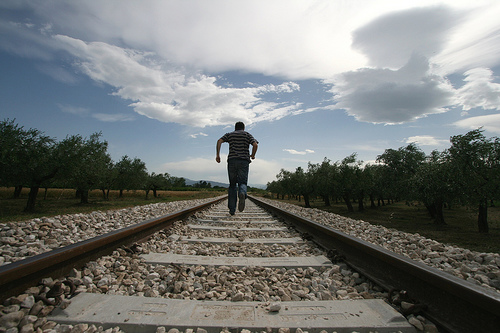
Building on yesterday’s post about staying with the fears and difficulties that are prompted by relationships and manifest themselves as emotions or feelings in the body. As I have said before, the essence of our practice is learning to stay, and in concrete terms this can mean simply staying with the feeling in the body. Running away – into distractions or compulsive activity, or in a more decisive way such as  starting a new relationship or initiating sudden changes of lifestyle – can take us away from the growth which a crisis often offers. Our sitting practice is the place where we work at learning how to do this. It is where we gradually strengthen our capacity  for faithfulness to our actual daily existence, no matter what arises.

The problem with running away when a relationship becomes difficult is that it’s also turning away from ourselves and our potential breakthroughs. Fleeing the raw, wounded places in ourselves because we don’t think we can handle them is a form of self-rejection and self-abandonment that turns our feeling body into an abandoned, haunted house. The more we flee our shadowy places, the more they fester in the dark, and the more haunted this house becomes. And the more haunted it becomes, the more it terrifies us….. Naturally we want to do everything we can to avoid this place, fix it, or neutralize it, so we’ll never have to experience such pain again……This is a vicious circle that keeps us cut off from and afraid of ourselves.

John Welwood, Intimate Relationship as a Spiritual Crucible.
A key way of working with fears: Stay with the emotion in the body

As the previous post noted, we try to bring awareness to the patterns which repeat in our lives. However, they can often have very deep roots in the emotional wounds which we carry with us from the past  of which we are unaware. This quote points to  a way of working with them as they actually manifest in the day-to-day of our experience. Most of our deep wounds are connected to relationships in the past and therefore we  can imagine a situation where a current relationship causes our anxiety and fears to rise.  These then give rise to a cascade of thoughts about ourselves or others, painting worse-case scenarios or stories about deficiencies in ourselves. What is the best way to work with this?  In this moment we do not know the roots in the past which the experience has touched into. However, we do have a very real feeling – of fear, or of  flight – in the body. So we stay with that. We acknowledge, if possible,   the story line that the mind is running, but leave it to one side. We try to stay with fear or anxiety as an embodied feeling and work with the energies associated with the feeling.  Stay with the emotion with kindness and non-judgment as much as you can as a feeling in the body, breathing into the feelings and widening the space around them. In this way we hold ourselves  and our fears in awareness and acceptance, just as a mother would hold a frightened child.

You may not yet be able to bring your unconscious mind activity into awareness as thoughts, but it will always be reflected in the body as an emotion, and of this you can become aware.

Eckhart Tolle

Why do we let things get so complicated?

I was looking at some old family photographs last week. These black-and-white images from when I was a child on holidays capture little moments, frozen for all time. In them I can see myself when I was  young and carefree, smiling easily, not observing myself, not wondering how I am doing. Looking at them I easily get back in touch with a time when love was given without  complications, a love that  was genuine and asked for little in return. Times were simple, and we were simple too. We embraced life – and each other – freely.

Life has changed everyone in this photograph, as it does all people. The naturalness of childhood, with its trust and more open spirit, makes way for  the passing of time, for  older, supposedly wiser years, for the onset of worries, and for a focus on ourselves and doubts about what once seemed so sure. We grow up, and as we do we become less open, more complicated. We begin to guard and armour the heart, hardening in our attitude towards others and toward life.  The sad thing is, we convince ourselves that this is right.

I am sure that everyone reading this has memories like the ones I have when I look at  a picture such as this. We all wonder where did all that optimism and openness go?  What happened to the love  that we gave to others over the years, that we invested with the best of our intentions? All those dreams, that looking forward to something  good, to something that would endure for ever, and would be there in good times and bad?

It seems to me that all of us are doing our best in a life story where we are never really sure of the conclusion.  A story where we try to live good lives, and be fair to others, and yet still learn that there is a lot of things that are outside our control and where we have to learn through pain and sorrow.  And in some cases, the simple openness does not work; we realize that we have to let go and trust in a process that we cannot understand.  Why do some things not work out, some good people get ill and die, friends move away and no longer stay in touch?  And yet, even if  we have been visited by sadness or have been hurt, we keep touching back into that young heart, which believes in the goodness of life and in the power of love and of friendship. We have to move on, holding on to our hopes despite the unresolved aspects of our life and our story. We are asked just  to try, and try again, and then again some more.  The greatest tragedy would be to let the experiences of life convince us that the optimism and smiles we had as children were completely misplaced.

Our sense of self and our early experiences

Our early experiences strongly shape our sense of self.  They become hard-wired into our unconscious system and then are triggered easily at important moments in adulthood. Because they are so deeply ingrained in our cells they can influence us when we are drawing conclusions about the kind of person we are. Frequently they are concerned with laying down a blueprint as to how reliable or safe the world is, and to what extent others can be trusted. This influences the broad autobiographical narrative which tends to be established by our late teens, colouring our expectations about life and about people. We are balancing our experiences of attachment or closeness with our experiences of unreliability and disappointment. Early disappointment affects our  ability to trust or feel safe, or to fully give  ourselves in adult relationships. Consequently we often approach a relationship in the hope that it will be the one which will finally heal these early disappointments –  hoping to rewrite the relational blueprint which caused us problems as a child – or behave in a way that our negative expectations will be confirmed.  Sometimes the repair happens, but often we are looking outside for something which needs inner work to be fully achieved.

We are wired for attachment
in a world of impermanence.

How we negotiate that tension
shapes who we become.

Robert Neimeyer, Ph.D.

Practice letting things go

It is over 20 years since I read this saying from Gurdjieff. It struck me then and still resonates now. We often pin our happiness onto what we have  – certain things, relationships, achievements, successes- and hold onto them for dear life. What this quotation reminds us is that happiness is rooted in a contented mind. It is often related to letting go, to holding things lightly, to being peaceful within ourselves  – with where we are and what we can do without. It is linked to knowing we are complete in ourselves, not holding on to some things and not needing to be  completed by others or by what we have.   

A man is satisfied not by the quantity of food, but by the absence of greed.

Facing ourselves in our relationships

Each day, as we grow older, we are challenged to live as the person we would like to be. This is not always easy when we are stressed or we are hurt or let down. And also we can, at times, choose selfishness rather than genuine care for others. And what I increasingly notice is how much of our behaviour has it roots in fear.

The places where these fears are most often activated is in relationships with others. Frequently we instinctively act in defensive ways to protect our hearts. Relationships have the capacity to trigger our deepest fears, which often reflect patterns established in our childhood. I notice this when a strong emotional reaction is triggered, and automatic,  deeply believed – often fearful – thoughts dominate, which are very easy to take as the truth. Normally my first move is to maximize distance in order to protect myself and act as if the other person is a threat to the security of my deepest self.  Relationships open our hearts and expose our needs. Sometimes we clearly feel that is not safe. And when that happens we all follow some strategy to escape feeling the fears that silently run our life.

However, the truth about relationships is that they reflect closely our relationship with ourselves and reveal a lot about the clarity or confusion in our inner life. In fact our relationships with others can never be better than the relationship we have with ourselves. We often project on to the other what is going on inside ourselves, often what we are unable to manage properly, and this is at the root of our fears, and the reason they are so strong. Thus we can blame the other for confusion which is actually inside ourselves.

I have noticed this often in myself recently. Therefore I am now trying, when strong fears are triggered, to turn towards them and let them in, looking on them as a ‘what’ instead of as ‘me’. Instead of running story lines of anger and blame, I try and just stay with the original feeling of hurt. Even if the fear triggered is strong, if I manage to do this soon afterwards, I notice the fear loses its power quickly and a more open response can emerge. The fear can thus becomes a teacher, hopefully leading to understanding rather than paralyzing.

Fear tells us to stop, to stay within the boundary of our protected cocoon-world. Yet when we feel fear, if we take even one small step toward it rather than yielding to our habitual pulling away, we move one step closer to the vast mind that lies beyond. When we feel fear instead of saying ‘I’m afraid,’ thus reinforcing our identification with our fear as who we are, we can simply say, ‘Fear is present.’  Thus fear’s power gradually dissipates, and we begin to free ourselves from it. When we simply experience fear just as it is — without our opinions, judgments, and reactions — fear is not nearly so frightening.

Ezra Bayda, Saying Yes to Life (Even the Hard Parts)