Mindful eating

People who eat mindfully are less likely to be overweight, according to a study led by researchers at Fred Hutchinson Cancer Research Center. The researchers found that people who ate mindfully – those were aware of why they ate and stopped eating when full – weighed less than those who ate mindlessly, who ate when not hungry or in response to anxiety or depression. The researchers also found a strong association between yoga practice and mindful eating but found no association between other types of physical activity, such as walking or running, and mindful eating.

“In our earlier study, we found that middle-age people who practice yoga gained less weight over a 10-year period than those who did not. This was independent of physical activity and dietary patterns. We hypothesized that mindfulness – a skill learned either directly or indirectly through yoga – could affect eating behavior” said Alan Kristal, associate head of the Cancer Prevention Program in the Public Health Sciences Division at the Hutchinson Center.

“Mindful eating is a skill that augments the usual approaches to weight loss, such as dieting, counting calories and limiting portion sizes. Thefindings fit with our hypothesis that yoga increases mindfulness in eating and leads to less weight gain over time, independent of the physical activity aspect of yoga practice
,” said Kristal.

Living fully

I have heard news of some deaths recently, one sudden, one after an illness, and also am aware of people who are facing challenging illnesses.

I remembered a story that Irish poet and priest John O’Donoghue told, with great warmth. He was sitting at the bedside of a dying man, offering his comfort and his presence. The man turned to him and said, with a great sense of calm, that he had no regrets, because he had taken a great big bite out of life.

It would be a significant thing if I could say that, not just about my life, but at the end of each day.

A Prayer in Irish for those who have gone before us, whose passing has made us sad:

Go maire na mairbh agus a mbriongloidi
I bhfoscadh chaoin dilis na Trinoide

[May the departed and their dreams ever dwell
In the kind and faithful shelter of the Trinity]

Falling

Sometimes we can only move forward if we let go of the past.

Learning to fly takes the courage to step out. Standing at the edge can seem frightening. We have to let ourselves fall into the unknown.

This requires faith. But the changing seasons tell us: things may seem frozen, nothing seems to grow, but new birth is taking place in the stillness of winter months.

Birds make great sky-circles
of their freedom.
How do they learn it?

They fall, and falling,
they’re given wings.

Rumi

Posted in Uncategorized

Starlings in Winter

Chunky and noisy,
but with stars in their black feathers,
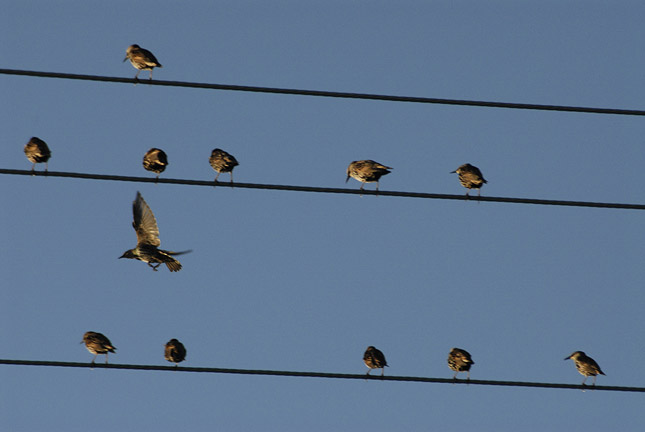
they spring from the telephone wire
and instantly

they are acrobats
in the freezing wind.
And now, in the theater of air,
they swing over buildings,

dipping and rising;
they float like one stippled star
that opens,
becomes for a moment fragmented,

then closes again;
and you watch
and you try
but you simply can’t imagine

how they do it
with no articulated instruction, no pause,
only the silent confirmation
that they are this notable thing,

this wheel of many parts, that can rise and spin
over and over again,
full of gorgeous life.

Ah, world, what lessons you prepare for us,
even in the leafless winter,
even in the ashy city.
I am thinking now
of grief, and of getting past it;

I feel my boots
trying to leave the ground,
I feel my heart
pumping hard. I want

to think again of dangerous and noble things.
I want to be light and frolicsome.
I want to be improbable beautiful and afraid of nothing,
as though I had wings.

Mary Oliver Owls and Other Fantasies: Poems and Essays

Posted in Uncategorized

Focusing

“Your brain will do what you ask of it” states David Rakel, Director of the University of Wisconsin Integrative Medicine Programme. Instead of multi-tasking, he suggests taking a few minutes every day to focus on one positive thought, like the word “happy”. Doing so, he explains, creates new neurological networks in your brain and helps you feel happy and compassionate more easily. On the contrary, focusing on angry thoughts can create networks that make you feel more negative about life, more often.

Saint Nicholas and the practice of generosity

Today is the feast of Saint Nicolas, which is at the origins of gift-giving to children around this period. In some countries these gifts are left in childrens’ shoes. The tradition is based on his generosity as Bishop of Myra, as he was accustomed to leaving gifts for the poor while they were asleep.

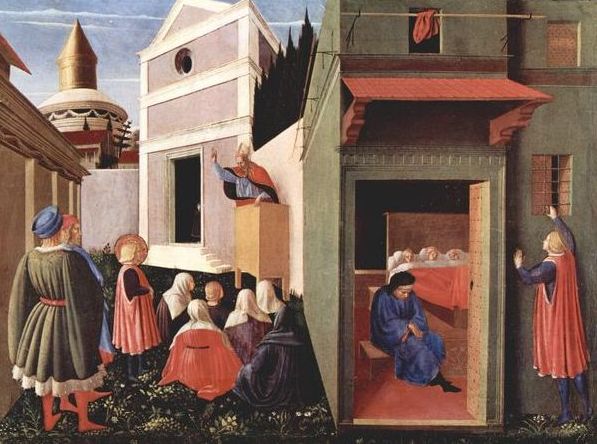
One story tells of a poor man with three daughters. In those times a woman’s father had to offer prospective husbands something of value, a dowry. The greater the dowry, the better was the chance that a young woman would find a good husband. Without a dowry, a woman was unlikely to marry and was in danger of poverty, prostitution or slavery. But this man was poor, and so his daughters, without dowries, were destined to be sold into slavery. Mysteriously, on three different occasions, a bag of gold appeared in their home – providing the necessary dowries. The bags of gold, tossed by the Bishop through an open window, – as seen in this exquisite painting by Fra Angelico – landed in stockings or shoes left before the fire to dry, while the girls slept unaware in bed.

There is so much in this tale, about generosity, or awareness of what we have been given, or the real meaning of this period, or about caring for those who are in difficulty at this time.

” In the African understanding of ubuntu, our generosity comes from realizing that we could not be alive, nor could we accomplish anything, without the support, love, and generosity of all the people who have helped us to become the people we are today. Certainly it is from experiencing this generosity of God and the generosity of those in our life that we learn gratitude and to be generous to others.”

Archbishop Desmond Tutu

“I think that generosity has many levels. We have to think generously, speak generously, and act generously. Thinking well of others and speaking well of others is the basis for generous giving. It means that we relate to others as part of our ‘gen’ or ‘kin’ and treat them as family. Generosity has to come from hearts that are fearless and free and are willing to share abundantly all that is given to us.”

Henri Nouwen