Earthquake

The destructive earthquake in Haiti seems to have affected over a third of the population there. It is a terrible tragedy to afflict one of the poorest nations on the planet. It reminds us how the inequality of the world leaves the poorest the most vulnerable. Injustice and suffering like this leads us to wonder why and makes us feel powerless. It also lets us see how trivial some of our day-to-day concerns are in comparison to the life and death struggles of some.

These extreme physical phenomenon also remind us how fragile our physical life is, and how we can never have a certainty of safety. Accidents and illness happen frequently. We can say “goodnight” at the end of a day and are not guaranteed to resume contact again. It reminds us every life is made up of a series of things arising and passing away – beginnings and endings – and that coming to a personal understanding of this is vital in the development of wisdom.

Our mindfulness practice helps. Mindfulness is about seeing things as they actually are not as we imagine them to be, and one of its key insights, which we learn the first time we sit down to meditate, is that things change. However, I do not find it easy to really accept this insight and the calm that it can bring. I prefer to hold onto things, especially those which present themselves as pleasant. Even in simple day-to-day circumstances it is difficult to stay content: I can get easily upset, worry and find it hard to relax. From my work with people I know that I am not alone in this. Each day presents new circumstances. I often have difficulty adjusting to them and can become demanding or be confused. Change can often mean that I do not feel safe, until meditation, time and support soothes the mind and the heart. I find that meditation helps me in facing the big and small changes that afflict my life and when the world’s suffering is brought close. Problems, in my life or in the world, are not necessarily solved but at least I feel more courageous in facing them.

Rain scatters plum petals
Weeping stains the earth
One can only take shelter
And wait for clearing

Tao Te Ching
More applications of Mindfulness


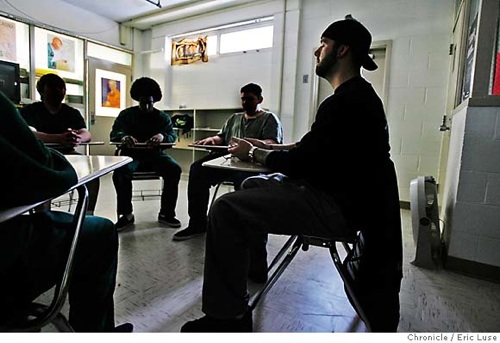
The Mind Body Awareness Project is another example of the way Mindfulness meditation is being adapted to work with different populations and in different settings. It was set up in the year 2000 to work with at-risk and incarcerated youth. It was founded in the belief that these young people have the potential to take control of their actions and fully transform their lives. It focuses on empowering them with the tools and competencies to overcome trauma, transform negative behaviors, and find real freedom from the inside. It was recently described as a “new national model for the rehabilitation of incarcerated youth”.

The slogan of the MBA Project “We are literally one breath away from making better decisions” is based on the key role that breath awareness has in Mindfulness meditation and emotional intelligence exercises. Their programme aims to help helping teenagers to develop empathy, gain impulse control, and equip them with the tools they need to live meaningful lives. It tries to response to common issues seen in disaffected teenagers today – lack of contentment, meaning and motivation – which can lead to destructive behaviours and a disinterested “whatever” attitude.

This ‘whatever’ attitude has another side. It is the statement ‘whatever’ that can express their ambivalence towards everything they don’t like. ‘Whatever’ is how today’s youth express their extreme apathy towards teachers (and other adults) that cannot relate to them, and classrooms and institution that do not engage their interests. Breaking through this ‘whatever’ is the educator’s biggest challenge.

Courage

When we practice meditation, we express confidence in the simple yet powerful gesture of opening to whatever arises during our meditation session. We may come to our meditation with the hope of reducing our stress or perfecting our technique or maybe even attaining enlightenment. But we very soon discover that the practice requires that we drop such ambition and sit still on the cushion, letting go of our internal dialogue, opening to our world — very simply, very directly.

When we examine this experience of opening, we find that we are expressing a part of ourselves that we may tend to overlook: we are expressing our ability to trust ourselves completely. In order to open — in meditation and in life in general — we must let go of our familiar thoughts and emotions, we must step out from behind the safe curtain of our inner rehearsals and onto the stage of reality, even if it’s for just a brief moment. When we open on the cushion, we renounce our attachment to our emotional security blanket, over and over again. We drop our pretense and our story lines and stand naked in the midst of uncertainty — the very essence of confidence itself.

Maybe we would like to protect ourselves, but instead we have the courage to let go, and such courage naturally blossoms into the confidence to be fully open.

Michael Carroll Bringing Spiritual Confidence to the Workplace

Footprints

Again Nature provides lessons for the Inner life. The snow which seemed so abundant just days ago begins to melt. Is is sad when we see something, which made the landscape so magical, changing.

To what can our life on earth be likened?
To a flock of geese,
alighting on the snow.
Sometimes leaving a trace of their passage.

Su Shi

Mindfulness in Schools

There is an article in today’s Times about the first school in England to teach mindfulness to pupils as a regular part of the curriculum. The Course has been designed in conjunction with Mark Williams, director of the Mindfulness Centre at Oxford, who collaborated with Jon Kabat Zinn on the book The Mindful way through Depression. The article summarizes the Course objectives as follows:

The course develops exercises to help to improve attention — rather than allowing the mind to be “hijacked” by emotional issues, regrets, worries about the past and future and other distractions. This can be done in a number of ways, such as by focusing on breathing, parts of the body or movement.

Mindfulness originated in Eastern meditation traditions such as Buddhism but is now an established secular discipline. A growing body of research supports wider use of the approach to address transient stress and deeper mental health problems, including recommendations from the National Institute for Health and Clinical Excellence that it be offered on the NHS to patients suffering from depression.

The article is interesting. It can be found here : http://www.timesonline.co.uk/tol/life_and_style/education/article6984113.ece

Stress and sleep

Stress is a leading factor in poor sleep, according to new research from Oklahoma State University. Their study, “Back Pain, Sleep Quality and Perceived Stress Following Introduction of New Bedding Systems,” published in the March 2009 Journal of Chiropractic Medicine, suggests that improved sleep quality not only reduces stress, but also helps us manage everyday stress. “When you’re stressed, and similarly when you are tired, every aspect of your waking life is affected, from work to personal relationships and even concentration,” says Better Sleep Council spokesperson Lissa Coffey. “Controlling stress and getting a good night’s rest start by evaluating your lifestyle and creating a healthy daily regimen that you can stick to”.