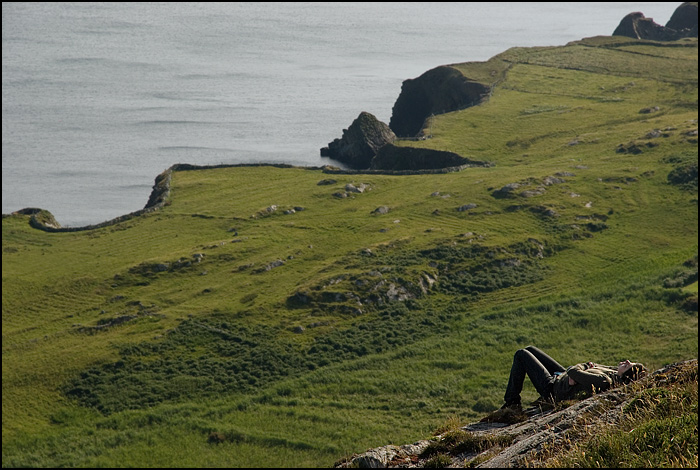
 To sit with a dog on a hillside on a glorious afternoon
is to be back in Eden,
where doing nothing was not boring – it was peace.
Milan Kundera
To sit with a dog on a hillside on a glorious afternoon
is to be back in Eden,
where doing nothing was not boring – it was peace.
Milan Kundera
 There is a twilight zone in our hearts that we ourselves cannot see. Even when we know quite a lot about ourselves – our gifts and weaknesses, our ambitions and aspirations, our motives and our drives – large parts of ourselves remain in the shadow of consciousness. This is a very good thing. We will always remain partially hidden to ourselves. Other people, especially those who love us, can often see our twilight zones better than we ourselves can. The way we are seen and understood by others is different from the way we see and understand ourselves. We will never fully know the significance of our presence in the lives of our friends. That’s a grace, a grace that calls us not only to humility, but to a deep trust in those who love us. It is the twilight zones of our hearts where true friendships are born.
Henri Nouwen
 One way of developing a more conscious approach to life is to create gaps during the day, short moments where we pause and pay more deliberate attention to what we are doing. This “informal mindulness” practice reduces the mind’s tendency to over-analyze and compliments the formal practice we do when we are in sitting meditation.
A number of acticvities can be chosen to practice with. It is best to choose a repetitive simple task which you perform on a regular basis. One possibilitiy is taking a shower. While having the shower practice bringing your full attention to the sensations of what you are doing – touch, taste, smell, sound, sight – and stay close to being fully present at that level.
So. for example, you can attend to the sound of the water, as it comes out from the shower, or the touch of it as it hits your body, the temperature of the water. You can be aware of the smell of the soap or shampoo, and the sight of the water drops on the walls or as it goes down the drain. You can focus on the steam rising. Finally, you can be as fully present as piossoible with the movement of the body and the arms.
As in formal practices, thoughts will arise. you simply touch them gently, without judging, and let them go, coming back to practice a greater awatreness of sensations, strengthening your capacity to distinguish between a sensation and a thought.
Peace is something that we can bring about if we can actually learn to wake up a bit more as individuals and a lot more as a species; if we can learn to be fully what we actually already are; to reside in the inherent potential of what is possible for us, being human.
Jon Kabat-Zinn
 I like to think of mindfulness simply as the art of conscious living.
In fact, the most important point is just to be yourself and not try to become anything that you are not already.
Jon Kabat Zinn
 I think Carl Rogers said it best. He said the great paradox was that it was not until I accepted myself just as I was that I was free to change. In other words – acceptance, pausing and being with our life just as it is, is the the precondition to all transformation. For us to be free, we need to stop believing the thoughts that something is wrong. We need to stop running away from the very vulnerability that needs a profound type of self-compassion. Whatever we cannot embrace with love or with acceptance imprisons us. It keeps us in the trance of a bad self. So the path of emotional healing is really the path of stopping the war, of pausing, of not believing the judgments, of not continuing to punish ourself. Instead of running away and trying to escape the rawness that is here, really meeting it with a deep, deep compassion.
Tara Brach, Meditations for Emotional Healing
 I find you Christians a very good people. When you see somebody in prison, you see Jesus. When you see somebody hungry, you give him food and see Jesus. When you see someone naked, you see Jesus. But what I don’t understand is why you don’t see Jesus in your own poverty.
Why is it that you see Him in the poor that are outside of you but you don’t in the poor one that is inside of you?
Carl Jung
The majority of men are subjective towards themselves and objective towards all others, terribly objective sometimes – but the real task is in fact to be objective towards oneself and subjective towards all others.
Soren Kierkegaard, Journal
 Mindfulbalance