Mindful eating and weight loss

A pilot study has looked at the effect of Mindful Eating on weight loss. The report of  the study was published in Complementary Therapies in Medicine in 2010  and involved ten people classified as “obese” (average age was 44) who followed a Mindful Eating program for six weeks, consisting of mindfulness meditation, group eating exercises, and group discussions.  Pairing daily meditation with eating was encouaged to enable people to identify and examine eating triggers, hunger and fullness  cues, the quality of craved foods, and emotions associated with eating. They were encouraged to engage in as much mindful eating as possible and to increase their physical activity by about 5 to 10% each week. The participants were assessed during the trial and again after three months for changes in eating behaviour, psychological functioning, and weight and inflammation markers.

It was found that all of the participants lost a significant amount of weight, almost nine pounds over 12 weeks, on average. A measure of inflammation in the body (C-reactive protein,), decreased significantly, as well. Measures of mindfulness—the ability to observe, be aware of, accept, and describe their eating patterns—saw moderate to large increases throughout the study and follow-up periods. The participants’ self control improved dramatically, and binge eating was significantly reduced. In addition, significant improvements were seen in depressive and physical symptoms (such as indigestion and headache), as well as negative affect (mood) and perceived stress. The cautious conclusions drawn by the researcher were that mindful eating programmes could result in significant changes in weight and eating behaviour.

In contrast to a focus on cutting calories, mindfulness helps people reduce weight and improve health by restoring the individual’s ability to detect and respond to natural cues,” stated Jeanne Dalen, lead author of the study who works at the Center for Family and Adolescent Research in Albuquerque, New Mexico.

Jeanne Dalen, Bruce W Smith, Brian M Shelley, Anita Lee Sloan, Lisa Leahigh, Debbie Begay, “Pilot study: Mindful Eating and Living : weight, eating behavior, and psychological outcomes associated with a mindfulness-based intervention for people with obesity”, Complementary Therapies In Medicine (2010), Volume: 18, Issue: 6.


Making time for our better health 2: Noticing internal busyness

[The Princeton] Study (see yesterday’s post) offers an important clue about internal busyness. It’s rooted in an attitude about time. When the pace of work is intensified, as it is in modern industrial and post industrial societies, time is seen as a finite, ever-dwindling commodity. Because time sees scarce, people try to squeeze the maximum amount of productivity out of every minute. They tend to spend less time on things like meditation, contemplation and singing – activities that can’t be made increase the “yield” on the time invested in them. Even we…who supposedly have our eyes on the inner depths of life, often find ourselves living by the basic capitalist assumption that what we do needs to yield a quantifiable result. How many of us got interested in meditation when we read about University of Wisconsin studies that  showed that people who meditate can increase activity in the “happiness” section of the brain?  This assumption – that if we are going to spend time on something, it needs to produce a measurable yield – is one root of internal busyness.

Sally Kemption, Busyness plan

Making time for our better health: Sorry, I’m too busy

I’m Late, I’m Late for a very important date,
No time to say hello, goodbye.
I’m late, I’m late, I’m late, and when I wave,
I lose the time I save.

White Rabbit, Alice in Wonderland

In a famous study, conducted in 1973  by J. M . Darley  and C. D. Batsonresearchers at Princeton University,  it was shown that our perception of busyness influences the way we  behave in certain situations.  It was conducted with theology students  who, after completing some initial questionnaires,  were told to go to another building on campus to give a speech. The irony in this study was that the speech was on the New Testament parable of the Good Samaritan, where the main character helps a person in distress whom he meets unexpectedly on the road. Some of the students were told that they were late for the speech; others were told that they had a few minutes to spare. On the way, they came across a man slumped in an alleyway who appeared to need help. Out of those students who were told they were late and thus felt that they were in a hurry,  10% stopped to help. Of the group who knew they had a few minutes to spare, 63% stopped.

The crucial variable in the study was not the values of the person or their basic kindness, it was whether or not they believed themselves to be in a hurry. When questioned afterwards, those who had failed to stop said they would have done so, if they had “had more time“. It seems that when we speed up and feel that we are in a hurry, we experience something similar to what Tolman called in 1948 the “narrowing of the cognitive map”. We miss details. We do not make the best or wisest choices. We are not present in the moment to notice what is really important.  Too much focus on the future – one of the driving features of today’s age – means that we ignore what is in front of us in the present. The words “Hurry, you’re late”  had the effect of turning someone who would normally notice,  into someone who was indifferent to suffering — of making someone, in that moment, into a different person.

Recommended Summer reading 1.

Summer often allows an opportunity for catching up on reading so I will give some suggestions for books in the next week or two.

Over the past few years we have seen mindfulness practice  being applied to specific areas where people  may have difficulties, such as anxiety or depression, or indeed when people struggle with issues such as shyness in public or procrastination.  It is nice to see that  we are also  beginning to find reflections on the even more fundamental issue of the sense of self, or our basic sense of unworthiness, themes which I have covered frequently in some of the posts in this blog.

One book which covers these themes, and which I can recommend wholeheartedly,  is entitled Living with your Heart Wide Open, written by two of the most experienced mindfulness teachers in the U.S.,  Steve Flowers and Bob Stahl. A nice title, but,  in fact,  the subtitle reveals more about the material covered,  in a very accessible fashion,  in the chapters: “How Mindfulness and Compassion can free you from unworthiness, inadequacy and shame“.

As this subtitle suggests,  the book is concerned with the basic underlying narrative tone which pervades our life, dealing with different aspects in each chapter and applying mindfulness exercises to the themes covered. In other words, it helps us become more aware of the manner in which we talk to ourselves. It looks at the origins of this self-talk in the way our life history has shaped us, but focuses mainly on how it hinders us in our daily lives and leads to ongoing suffering. Although many of the exercises in the book are familiar, using them in a systematic way linked to themes  means that this book  leads readers –  with great kindness –  to reflect on the ingrained thought patterns that keep them trapped in self-judgement,  or criticism,  to potential greater freedom:

This book offers a mindful path to breaking free from these habitual thought patterns. Through meditation and inquiry, you can discover where this negative self-talk came from and why you are so judgmental towards yourself. Addressing this lack of self-compassion is essential. In a sense our very existence is threatened by an endemic of self-loathing. War essentially begins inside the individual, stemming from a sense of alienation and separation from the interconnectedness of life. Making peace within is one of the noblest endeavors you can pursue – for yourself, for others and for the world (p.5).

One advantage of this book is that it presents recent psychological research on the Narrative Self, Attachment, Shame and Self-Esteem in a very straightforward manner, which will be of great benefit to readers coming to this material for the first time. It does not go into too much depth as it always keeps in mind that the purpose of the book is to help the reader in a practical manner in areas that are potentially life-changing.  I particularly liked chapter five which deals with Self-Compassion, the subject of a number of studies and books at the moment. The authors show how cultivating self-compassion is necessary in this modern age, with its excessive emphasis on continual self-improvement,  and then lead into two practices to allow the reader develop it better in their daily lives. These reflections and meditations are rich enough to keep returning to them again and again, allowing a gentle healing of some of the deeper parts of our psyche.

As you continue to practice self-compassion, you may notice more and more things about the self you’ve created with all of your old stories. Perhaps you tried to be especially good to counterbalance the problems in your family. Perhaps you learned to be generous of yourself as a way of earning the value you felt you lacked. Self-compassion lets you be with all the hurt, loneliness and fear that the narrative-based self has concealed. In the open heart of self-compassion, the wounded child within you will begin to heal (p. 105).

To sum up, a book that could be a very lovely companion on our journey this Summer and after, as we move towards greater acceptance of our our selves and our history, allowing us to see through our stories and live in the present more richly.

Not trying to get anywhere else

They harvested the field of barley beside our house yesterday. Planted last autumn,  it has grown strongly even in the present drought. Another cycle of planting, caring and harvesting completed, each in its own rhythm. The energy in the seed comes to fruition in its own time and cannot be rushed.

If you cultivate patience, you almost can’t help cultivating mindfulness, and your meditation practice will become richer and more mature. After all if you really aren’t trying to get anywhere else in this moment,  patience  takes care of itself. It is a remembering that things unfold in their own time. The seasons cannot be hurried. Spring comes, the grass grows by itself. Being in a hurry usually doesn’t help and it can create a great deal of suffering – sometimes in us, sometimes in those who have to be around us. Patience is an ever-present alternative to the mind’s endemic restlessness and impatience. Scratch the surface of impatience and you will find lying beneath it, subtly or not so subtly is anger. It’s the strong energy of not wanting things to be the way they are and blaming someone (often yourself)  or something for it.

Jon Kabat Zinn, Wherever you go, There you are

Patience and appreciation

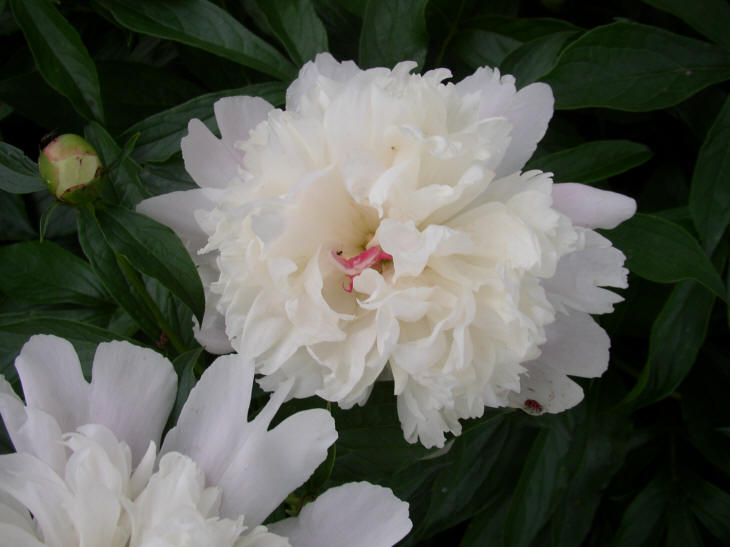
It does not astonish or make us angry that it takes a whole year to bring into the house three great white peonies and two pale blue iris.  It seems altogether right and appropriate that these glories are earned with long patience and faith. . . . and also that it is altogether right and appropriate that they cannot last. Yet in our human relations we are outraged when the supreme moments, the moments of flowering, must be waited for. . . . and then cannot last. We reach a summit, and then have to go down again.

May Sarton