Simply noticing the breath

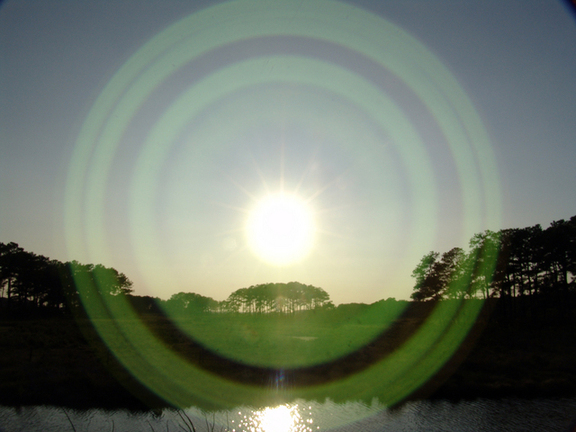
Meditation  is  simply a question of being. You just quietly  sit,  your body  still,  your speech silent, your mind at  ease,  and  allow thoughts to come and go, without letting them play havoc on  you. If you need something to do, then watch the breathing. This is  a  very  simple process. When you are breathing out, know  that  you are  breathing  out.  When  you breath  in,  know  that  you  are breathing  in, without supplying any kind of extra commentary  or internalized mental gossip, but just identifying with the breath.  There is no particular point on the  breath on which you need to focus, it is simply the  process of  breathing.  Twenty-five percent of your attention is  on  the breath and seventy-five percent is relaxed. Try to actually identify with the breathing, rather than just watching it.You sit quietly and let all thoughts and concepts dissolve. It is like when the clouds dissolve and the mist evaporates, to reveal the clear sky and the sun shining down. When everything dissolves like this, you begin to experience your true nature, to “live”.

Sogyal Rinpoche, Essential Advice on Meditation
Allowing space for the symbolic

The tendency to demand ever more signs to replace symbols..makes our lives more and more factual, intellectually strenuous, wedded to the march of mundane causes, and beset by disconcerting surprises…A life that does not incorporate some degree of ritual, of gesture and attitude, has no mental anchorage. It is prosaic to the point of total indifference, purely casual, devoid of that structure of intellect and feeling which we call “personality”

Susan Langer, Philosophy in a New Key

Different ways of getting to heaven


Sometimes ideas can give us insight. Some other times, it can be simple little encounters, when for a brief second, the mind is stilled and we see into the heart of things. Their newness, or their beauty, shock us briefly, giving us relief from the preoccupations in our mind, or the routine of daily activity,  and we are nourished within. We try to create some space for such moments today.

There is the heaven we enter
through institutional grace
and there are the yellow finches bathing and singing
in the lowly puddle.

Mary Oliver, Yellow

Sunday Quote: Already there

We have what we seek, it is there all the time,

and if we give it time,

it will make itself known to us.

Thomas Merton

Getting caught up in the content of our lives

For all of us, the experience of our entanglement differs from day-to-day. I know from personal experience how strong the habitual mind is. The discursive mind, the busy, worried, caught-up, spaced-out mind, is powerful. That’s all the more reason to do the most important thing — to realize what a strong opportunity every day is, and how easy it is to waste it. If you don’t allow your mind to open and to connect with where you are, with the immediacy of your experience, you could easily become completely submerged. You could be completely caught up and distracted by the details of your life, from the moment you get up in the morning until you fall asleep at night.

You get so caught up in the content of your life, the minutiae that make up a day, so self-absorbed in the big project you have to do, that the blessings, the magic, the stillness, and the vastness escape you. You never emerge from your cocoon, except for when there’s a noise that’s so loud you can’t help but notice it, or something shocks you, or captures your eye. Then for a moment you stick your head out and realize, Wow! Look at that sky! Look at that squirrel! Look at that person!

Pema Chodron.

The most profound teaching

What I encourage is a moving towards simplicity, rather than complexity. We’re already complicated personalities. Our cultural and social conditioning is usually very complicated. We’re educated and literate, which means that we know a lot and have much experience. This means that we are no longer simple. We’ve lost the simplicity we had as children and have become rather complicated characters. What is most simple is to wake up…it’s as simple as that. The most profound teaching is the  phrase “wake up”.  Hearing this, one then asks, “What am I supposed to do next?” We complicate it again because we’re not used to being really awake and fully present. We’re used to thinking about things and analyzing, trying to get something or get rid of something; achieving and attaining. In awakened awareness there is no grasping. It’s a simple, immanent act of being here, being patient. It takes trust, especially trust in yourself. 

Ajahn Sumedho, The Sound of Silence