Our roots are deep, despite the wind

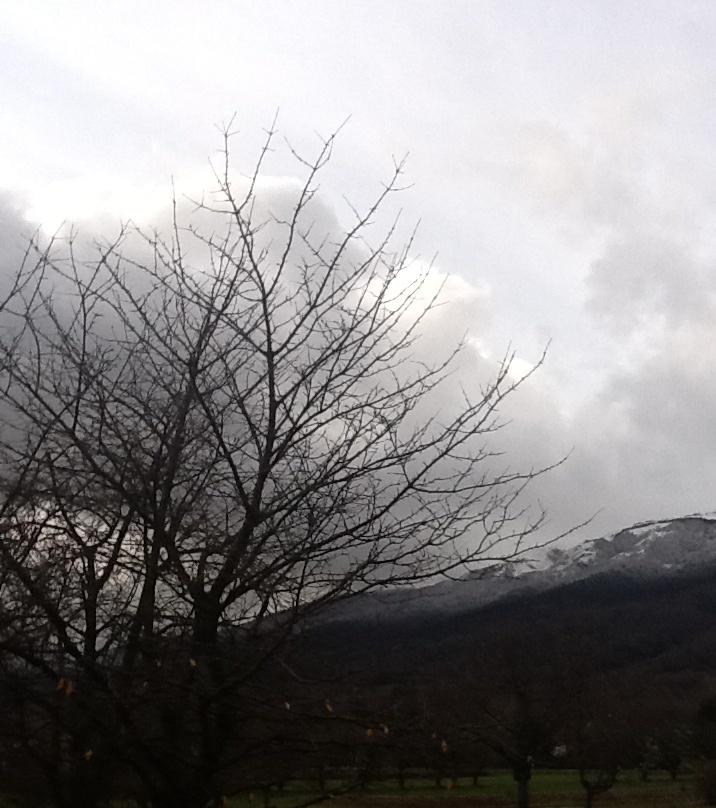
The strong winds on Sunday night blew the last leaves from the trees and they stand bare in the garden, clearly seen against the grey sky. Snow fell on the tops of the nearby Jura mountains. I was involved in a retreat over the weekend where we reflected on Kabir’s beautiful words “Throw away all thoughts of imaginary things and stand firm in that which you are“. However, as we all experience from time to time,  that firmness does not always seem so near, and we can be blown by winds of doubt and self-criticism. It feels cold and we think we are alone.  In moments like these we have to be patient. We cannot see the whole picture or understand why things are happening. When moments seem dark we can identify with what is going on in our emotions and get fixed there. We settle quickly into the negative feelings about ourself or our life,  turn in on ourselves and close down. However, the theme of the weekend,  and the weather outside,  remind us to keep our roots deep in the goodness underneath, and not in what passes through the mind.  We do not need to hold on to what is happening. Some kinds of unknowing are right. We trust even if we cannot see.  In waiting,  even in difficult moments,  what is coming to pass is gradually revealed.

I prefer winter …… when you feel the bone structure of the landscape  –  the loneliness of it, the dead feeling of winter.

Something waits beneath it, the whole story doesn’t show.

Andrew Wyatt,  American Painter

Working with hot and cold today

Winter has finally arrived here, with snow on the nearby mountains. So a little reflection on working with the things that we cannot change or with things that inconvenience us:

A disciple asked the Zen master Tung-shan: “When the heat of summer and the cold of winter arrive, how can we escape them?” Tung-shan answered, “Why don’t you go where there is no heat or cold?” “Where is this place,” asked the disciple, “where there is no heat or cold?” At this the master replied, “When it is hot, be completely hot; when it is cold, be completely cold.”

The disciple’s question had a symbolic meaning, and the answer was given on the same level. Heat and cold stand for circumstances that affect our daily existence but are out of our hands to regulate or rectify. Impersonal facts with far-reaching effects on us include: general economic conditions; situations of war, violence or peace; accidents; laws, policies and prejudices; possibilities and opportunities available in a particular community; mechanical and technological breakdowns  and so on.  The disciple wished to know how to escape such restraints. He wished to live in an ideal country where it is never too hot or too cold.

The Zen master’s reply was also symbolic. Instead of offering an escape route, he invited the disciple to plunge directly into the current situation and become completely hot in summer, completely cold in winter. According to an interpretation by Francis Dojun Cook, the Zen master was suggesting a radical affirmation of one’s very conditionedness in order to transcend it. By plunging directly into the current, one flows with it and on it. When resistance is futile, yielding to the flow of the current of events offers the promise of life. In order to understand the reply of Tung-shan, we have to realize that he was speaking of a change in attitude. Rather than attempting to change the facts of the situation, or escape them by flight, we may change our attitude, accept things as they are, and thereby move beyond them to a point where we find peace of mind. That point or region of peace is the country where “there is no heat or cold.” These conditions no longer exist as problems for us, although they continue to exist as facts. What has changed is our attitude toward them.

Charles Cummings, The Best Place to Live

A thank you to all who visit

A small milestone today, the blog received its 50,000 visit so far this year. I just use the moment to thank everyone who drops in or passes by regularly. Numbers do not really mean too much as I started writing as a small way of  supporting people who had finished the MBSR Course and begun to practice meditation and I would be pleased if the words were helpful to even just one person on his or her journey or at a difficult moment in their lives. But it allows me to take a moment to thank you in a direct way for the support of your visits. I am always amazed and encouraged to see where people visit from, as, for example, in the last 30 days there have been visitors from 115 different countries.   So, thanks to all of you for reading, for your ongoing support. I am also grateful to those of you who comment or click the “like” button beside posts, as this allows me to see where visits come from and sometimes to see some of the beautiful blogs which you yourselves are keeping.

Posted in Uncategorized

A winter grace

Authenticity is the expression of what is genuine and natural. It commands great respect because, unfortunately, it is so rare. The desire to be accepted, or to engage in competition and comparison, drives us to limit our behavior to what falls within narrowly prescribed, predictable norms. Ridding ourselves of old patterns and accessing the authentic self are entry ways to freedom and the domain of wisdom. In fact, as we discover how to befriend these processes, ageing and renewing our character can be what Carl Jung called, “A winter grace.” Jung believed that if we do not develop inner strength as we age, we will become defensive, dogmatic, depressed, resentful, and cynical. Our homeland of authenticity is within, and there we are sovereign. Until we rediscover this ancient truth in a way that is unique for each of us, we are condemned to wander, seeking solace in the outer world where it cannot be found.

Angeles Arrien, The Second Half of Life

Not following our patterns

We need the freedom that Mindfulness invites for us – the freedom that we do not have to follow the unconscious patterns of acute reactivity. We need to remember that it is possible to notice deeply what is happening, understand it with some wisdom, treat it with some of the compassion inherent in our humanity, and move into responses and actions that are of benefit – that is, to move toward that which lessens suffering and creates happiness, not just for us as individuals, but us as a collective world.

Our Mindfulness practice, whether it is on the cushion paying attention to the emotions and thoughts that weave between the breath and bodily sensations, or whether it is in the world paying attention to our actions and behaviors which emerge from our emotions and thoughts, is always a reminder that in order to change any unhealthy or harmful patterns –  in order to transform any suffering – we have to first become aware of the patterns themselves. We cannot change anything that we are not aware of.

Can I be mindful and loving of whatever arises.
If I can’t be loving in this moment, can I be kind.
If I can’t be kind, can I be non-judgmental.
If I can’t be non-judgmental, can I not cause harm.
And if I cannot not cause harm, can I cause the least amount of harm possible?

Larry Yang, Now More Than Ever We Need Mindfulness, Huffington Post

Thoughts as arising and passing away

All conditions are impermanent. By the word “condition”, we mean a formation of the mind, such as a thought or opinion. Men and women are conditions. Similarly, Jews and Gentiles, Buddhists and Christians, Asians and Europeans, Africans, the working class, the middle class, the upper class-all these are only formations that go through the mind. They aren’t absolutes. They are merely conventions that are useful for communication. We must use these conventions, but we must also realize that they are only conventions – not absolutes. In this way, our minds are no longer fixed in our views or opinions. Views and opinions are seen simply as conditions that arise and cease in the mind, because that’s what they really are. All conditions are impermanent; they arise and cease.

Ajahn Sumedho, The Mind and the Way