Where is the point of life to be found?

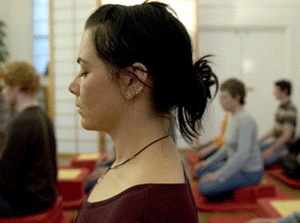
We could say that meditation doesn’t have a reason or doesn’t have a purpose. In this respect it’s unlike almost all other things we do except perhaps making music and dancing. When we make music we don’t do it in order to reach a certain point, such as the end of the composition. If that were the purpose of music then obviously the fastest players would be the best. Also, when we are dancing we are not aiming to arrive at a particular place on the floor as in a journey. When we dance, the journey itself is the point, as when we play music the playing itself is the point. And exactly the same thing is true in meditation. Meditation is the discovery that the point of life is always arrived at in the immediate moment.

Alan Watts

The Beauty in the cracks

The world breaks everyone, and afterward many are strong at the broken places. Hemingway

Most of us are trying to live an authentic life. Deep down, we want to take off our game face and be real and imperfect. There is a line from Leonard Cohen’s song “Anthem” that serves as a reminder to me when I get into that place where I’m trying to control everything and make it perfect. The line is, “There is a crack in everything. That’s how the light gets in.” So many of us run around spackling all of the cracks, trying to make everything look just right. This line helps me remember the beauty of the cracks (and the messy house and the imperfect manuscript…). It reminds me that our imperfections are not inadequacies; they are reminders that we’re all in this together. Imperfectly, but together.

Brene Brown, The Gifts of Imperfection

How to meditate: very simple instructions

When a thought arises that’s strong enough to take your attention away from the breath, simply note it as not breath. Whether it’s the most beautiful thought in the world or the most terrible, one you would never disclose to another soul, in this meditation, it’s simply not breath. You don’t have to judge yourself. You don’t have to get lost in making up a story about what triggered the thought or its possible consequences. All you have to do is recognize that it is not a thought. Some of your thoughts may be tender and caring, some may be boring and banal; all that matters is that they are not the breath. See them, recognize them, very gently let them go, and bring your attention back to the feeling of the breath.

Sharon Salzberg, Real Happiness: The Power of Meditation

The hidden work that is essential for growth

The ladder whose ascent implies spiritual progress has a long pedigree.  Hebrews, Greeks and Christians all gave special value to the heights, and Western morality tends to put all better things up high and worse things down low. By the last century growth became inexorably caught in this ascensionist fantasy. Darwin’s thesis The Descent of Man became, in our minds, the ascent of man. Each immigrant moved upward in social class as buildings moved upwards with their elevators to more expensive levels. By now the upward idea of growth has become a biographical cliché. To be an adult is to be a grown-up. Yet this is merely one way of speaking of maturity, and an heroic one at that. For even tomato plants and the  tallest trees send down roots as they rise toward the light. Yet the metaphors for our lives see mainly the upward part of the organic motion.

James Hillman, The Soul’s Code

Mindfulness in the news: BBC looks at brain scans and meditation

Following on from yesterday, here is a link to the next part of the BBC report which contains some material on brain scans, brain activity and meditation. One of the most exciting recent discoveries in the field of neuroscience is that the brain is quite plastic all through life, and that we can change its activity patterns depending on what we do. So if we practice calmness, the brain changes in response to that, in the same way as it responds to the occasions when we “practice” worrying or being anxious.

http://www.bbc.co.uk/news/health-16406814

Befriending the wandering mind

From a different tradition than yesterday – this time from a former Catholic monk and friend of Thomas Merton –   similar instructions on how to work with thoughts in meditation. He recommends a patient, gentle attitude towards ourselves, or toward the inevitable swings in thoughts and moods which we experience, not over-identifying with that which arises and passes away. This gentle, non-judgmental, befriending is the key to ongoing practice.

As we patiently learn to listen to the thoughts that arise, endure,  and pass away within us, we come to a deep experiential knowing of ourselves as we really are. We learn to befriend our own wandering mind, neither abandoning it through daydreaming or sleepiness nor invading it with more thoughts about the thoughts that are already there.  By quietly persevering in sustained nonthinking meditative awareness, we come to a new groundedness within ourselves. The meditative mind that neither thinks,  nor is reducible to any thought. grows stronger, calmer and more stable. In time we learn to listen with God’s ears to our wandering mind while at the same time passing beyond all that our wandering mind can comprehend