All the time in the world

Wherever we are, from one day to the next, the Earth is moving at the same speed. Yet in the modern world, we’ve convinced ourselves that the world is moving faster, and that speed is the way to make our life work. Under the pressure of schedules and commitments, we think we can accomplish more if we speed through our day. Speed gives life a frantic quality. It is an anxious state of mind that keeps us from settling into whatever we are doing. There is always something more important than what we’re doing now. We’re double-parked outside a store, trying to find what we need, while talking to our mother on the cell-phone. Rather than accomplishing our activity well, we are nullifying it, because we aren’t really there for it.  Speed comes from being overly ambitious. We aren’t content with our own mind, so we become aggressive in how we conduct our life. In an effort to match a concept of what success might be, we fill our calendars and spend the whole day holding on to our “to do” list. We chase after appointments, phone calls and meetings with jealousy, competition, fixation and irritation — whatever it takes to get us where we think we need to go. When life still won’t match our concept, we get mad — mad that others are late, or mad that we are early.

The practice of meditation offers us the opportunity to slow down for a short time every day. This is how we can begin to step out of the cycle of speed. In sitting still and focusing our mind, we are declaring daily that this human life is precious. Taking time to appreciate it comes from our own determination and wisdom. Through this discipline, we simplify our life. We regain the space to appreciate it, having lost nothing but speediness. We learn how to float aloft, carried by the winds, appreciating what we see in every direction. We learn to relax.

Sakyong Mipham Rinpoche, Slow Down, You Move Too Fast
Seeing things from a different perspective today

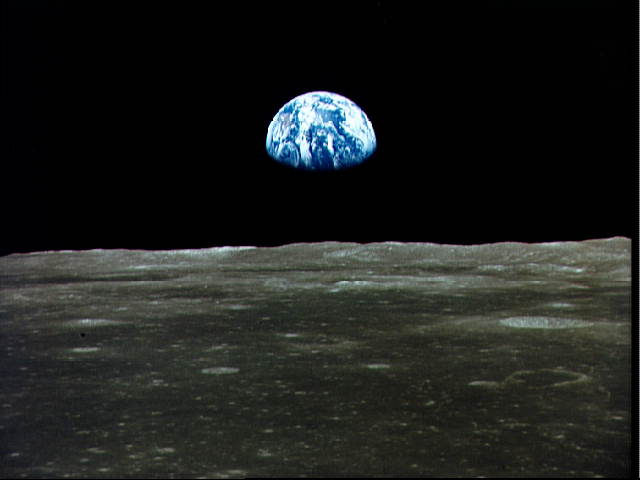
My favorite picture is earthrise as seen from the moon. It’s perfect. A great blue and green ball floating in vast black space, hanging right there in its orbit. From that vantage point,  the scene on earth is awesome. creatures being born, other ones dying; plants blooming on one side, plants withering on the other; snow snowing, winds blowing, volcanoes erupting, earthquakes shivering, people talking, music playing. From the moonview, its incredible cosmic drama. From our usual view, inside the drama, looking up at the moon, it’s a different story. It changes from the drama to my drama and gets to be a problem. If you’re far enough away, it’s not your story – its one of the six and a half billion stories.

Sylvia Boorstein: It’s Easier than you Think

Combining effort and allowing

The combination of stillness and movement is a spiritually effective style for how we live our lives. We refuse to be caught up in activity but are committed to frequent pausing, taking time to let things unfold. [This] combination of opposites characterizes us when we find psychological health and enter the spiritual realm, the twin goals of our evolution towards wholeness. We combine our psychological work, which takes effort, with our spiritual work, which takes allowing. The ego-Higher Self axis that happens in such individuation is visible in the combination of action and acceptance. A statue is motionless, but movement bursts forth, not only in the how the sculptor’s imagination brings it to life, but in the mysterious sense of motion he has achieved. This may be what he poet Rilke meant by “outer standstill and inner movement”

David Richo, Being True to Life

Empty branches

To have loved is everything,
I loved, once, a hummingbird who came every afternoon– the freedom-loving male–

who flew by himself to sample the sweets of the garden, to sit on a high, leafless branch with his red throat gleaming.

And then, he came no more.
And I’m still waiting for him, ten years later,

to come back, and he will, or he will not.
There is a certain commitment that each of us is given,
that has to do with another world,

if there is one.
I remember you, hummingbird.
I think of you every day even as I am still here,
soaked in color, waiting year after honey-rich year.

Mary Oliver, An Empty Branch in the Orchard

Sunday Quote: Noticing


Beauty and grace are performed whether or not we will or sense them.

The least we can do is try to be there

Annie Diliard

Not always struggling with our sadness

As I have written before, modern society is not very comfortable with any nuances in happiness.  It invariably prefers to portray people’s lives as always happy and show that successful people have gotten it all together. There is  no real place for  a narrative that contains moments of struggle or periods when less obvious forms of growth are nurtured. This can mean that we fall in to the trap of interpreting all sadness or mundane moments as an indication that we are doing something wrong, or that our life is on the wrong track. Frequently we fail to see that a lot of the models presented to us are not valid representations of our lives. And many images we see can easily turn into thoughts of an idealized future where we will be happier, thinner, more popular, and these thoughts may undermine the place we are actually called to be. This can be especially present in the weeks after Christmas and New Year,  moments that some people find tough and when the media is full of  strategies, advice and initiatives to improve our life and achieve greater success. A different strategy is cultivated in mindfulness practice, based on staying close to where we actually are, acknowledging that a sense of groundlessness or loneliness is normal in humans,  and that part of practice is learning to sit with this.

If we are feeling unhappy, what is called for is a willingness to simply be with that unhappiness. If we’re not careful, we say something’s wrong, though it doesn’t really help to say that. We say it either inwardly or outwardly. This projecting of blame is a consequence of having made an inner mistake of misperceiving our unhappiness, sadness or suffering as being something wrong. We don’t receive it just as it is. We don’t acknowledge it and feel it, allowing it to happen; we don’t have the ‘knowingness’ to see it as activity taking place in awareness.  Because we don’t have that perspective, we struggle to do something about our suffering, to deal with it in some way. To say that something has gone wrong and that it’s somebody’s fault is a heedless way of dealing with our unpleasant experiences. The habit of consistently doing this is a symptom of what I call the compulsive judging mind.

Ajahn Munindo