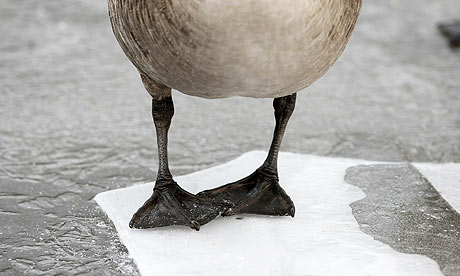
To what can our life on earth be likened?
To a flock of geese,
alighting on the snow.
Sometimes leaving a trace of their passage.
Su Shi (1037 – 1101), Remembrance
To what can our life on earth be likened?
To a flock of geese,
alighting on the snow.
Sometimes leaving a trace of their passage.
Su Shi (1037 – 1101), Remembrance
 Good practice is about fear. Fear takes the form of constantly thinking, speculating, analyzing, fantasizing. With all that activity we create a cloud cover to keep ourselves safe in make-believe practice. True practice is not safe; it’s anything but safe. But we don’t like that, so we obsess with our feverish efforts to achieve our version of the personal dream. Such obsessive practice is itself just another cloud between ourselves and reality. The only thing that matters is seeing with an impersonal searchlight: seeing things as they are. When the personal barrier drops away, why do we have to call it anything? We just live our lives. And when we die, we just die. No problem anywhere.
Charlotte Joko Beck, Everyday Zen
 The deep cold continues, and hardens the snow which fell in the past few days. I am reminded of this Mahamudra text:
When a wintry wind strikes and stirs up water,
Though soft, it takes the form of stone.
When concepts attempt to disturb mind’s nature,
Appearances become very dense and solid.
In our practice we notice whatever passes through the mind-body in the form of thoughts or emotions. When under pressure we can sometimes turn them into a very solid reality, allowing them define us at that moment, as somehow a bad or defective person. However, no matter how solid they seem, practice helps us to hold them fluid, seeing them just as energies in the mind,which can be worked with when we hold them in awareness.
 Most of the time we go through the day, through our activities, our work, our relationships, our conversations, and very rarely do we ground ourselves in an awareness of our bodies. We are lost in our thoughts, our feelings, our emotions, our stories, our plans. A very simple guide or check on this state of being lost is to pay attention to those times when you feel like you are rushing. Rushing does not have to do with speed. You can rush moving slowly, and you can rush moving quickly.
We are rushing when we feel as if we are toppling forward. Our minds run ahead of ourselves; they are out there where we want to get to, instead of being settled back in our bodies. The feeling of rushing is good feedback. Whenever we are not present, right then, in that situation, we should stop and take a few deep breaths. Settle into the body again. Feel yourself sitting. Feel the step of a walk. Be in your body.
Joseph Goldstein, Transforming the Mind, Healing the World
 Two writers, from different traditions, speaking of our most important journey – coming to terms with the basic restlessness and unease at the core of our being – and being able to rest there.
To live an inner life we must first find the courage to enter into the desert of our loneliness and to change it by gentle and persistent efforts into a garden of solitude. The movement from loneliness to solitude, however, is the beginning of any spiritual life because it is the movement from the restless senses to the restful spirit, from the outward-reaching cravings to the inward-reaching search, from the fearful clinging to fearless play.
Henri Nouwen, Reaching out
As I look out of my eyes at the world, I see that a lot of us are just running around in circles pretending that there’s ground where there actually isn’t any ground. And that somehow, if we could learn to not be afraid of groundlessness, not be afraid of insecurity and uncertainty, it would be calling on an inner strength that would allow us to be open and free and loving and compassionate in any situation. But as long as we keep trying to scramble to get ground under our feet and avoid this uneasy feeling of groundlessness and insecurity and uncertainty and ambiguity and paradox, any of that, then the wars will continue. It’s like the matrix of creative potential. The matrix of the spiritual life. It’s like if we could rest there, which I suppose would be the description of enlightenment or the mystic, you know. Rest in that place, and is completely happy. That’s why, you know, they always say, with someone who’s very, very awake… the walls could start crumbling in and they wouldn’t like freak out or something. Because they’re kind of ready for anything to happen.
Pema Chodron, Interview with Bill Moyers, Faith and Reason, 2006.

There is a difference between watching the mind and controlling the mind. Watching the mind with a gentle, open attitude allows the mind to settle down and come to rest. Trying to control the mind, or trying to control the way one’s spiritual practice will unfold, just stirs up more agitation and suffering.
Bhante Henepola Gunaratana, Eight Mindful Steps to Happiness
 Mindfulbalance