A simple way to find balance each day

DSC_0464

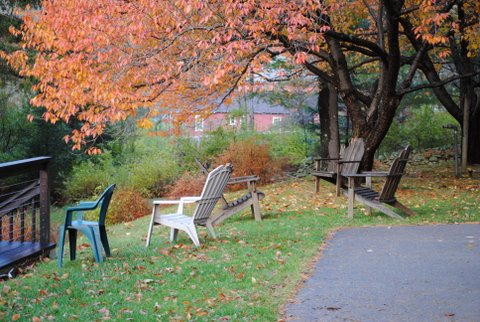
A change in the weather in Ireland this morning –  gone noticeably cooler – but it still remains bright and clear. A perfect  day for a Autumnal walk, to appreciate the changing colours.  Tuning into the change in nature’s rhythms is good for our internal sense of balance, as we see that things arise and pass away, and that life cannot be composed only of periods of growth and achievement. However, walking has significant physical health benefits also, as studies show that being out in natural light increases serotonin levels in the brain, as even on a cloudy day the light outside is normally greater than what can be achieved indoors. Thus,  a break away from the desk or the computer helps us to let go of some of the stresses that each day brings and see things in perspective:

When despair for the world grows in me
and I wake in the night at the least sound
in fear of what my life and my children’s lives may be,
I go and lie down where the wood drake
rests in his beauty on the water, and the great heron feeds.
I come into the peace of wild things 
who do not tax their lives with forethought
of grief. I come into the presence of still water.
And I feel above me the day-blind stars
waiting with their light. For a time
I rest in the grace of the world, and am free.

Wendell Berry, The Peace of Wild Things

Mistaking our thoughts for our self

keyboard-typing-internet-computer

“This is boring” or “This is not working”, or “I can’t do this”. These are judgments.

Actually they are just thoughts.

It is important to recognize them as judgmental thinking and remind yourself that our practice involves suspending judgment and just watching whatever comes up, without pursuing them or acting in any way

Jon Kabat Zinn

Making meditation hard

ChangeWhen one composes one’s mind and looks inwards, there is a sense of coming to one point. If we are not caught in the thinking process, we can be aware of the here and now, the body, the breath, mental states, moods; we can allow everything to be what it is. The attitude of many people in meditation is that there is always a need to change something. There might be an attempt to attain a particular state or some kind of blissful experience they have had before, or even if they haven’t had anything like that, they might hope that if they continue to practise, they will. When we practise meditation with this idea of getting something, then even the idea of practice, even the word ‘meditation’, can bring up this conditioned reaction of: ‘There’s something I’ve got to do. If I’m in a bad mood I should get rid of that mood. I’ve got to concentrate my mind.’ If the mind’s scattered and we’re all over the place, ‘I should make it one-pointed; I’ve got to concentrate.’ And so we make meditation into hard work and there is a great deal of failure in it because we’re trying to control everything through these ideas

Ajahn Sumedho, Developing an Attitude toward Meditation

Become what you are

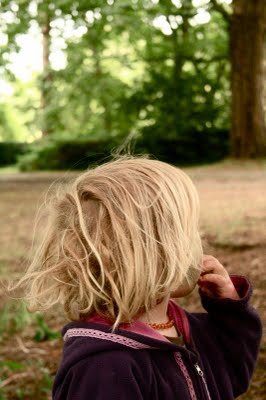
child head

Each of us has a place in this world. Taking that place, I have come to feel, is our real job as human beings. We are not generic people, we are individuals, and when we appreciate that fact completely and allow ourselves to embrace it and grow into it fully, we see that taking our unique place in this world is the one thing that gives us a sense of ultimate fulfillment. Bantu tribesmen, it is said, sneak into the rooms of their children as they sleep and whisper in their ears, “Become what you are.”

To take our place is to mature, to grow into what we are. Mostly we take maturity for granted, as if it were something that comes quite naturally and completely as our bodies grow and our minds and hearts fill up with life experience. In fact, however, few of us are truly mature individuals; few of us really occupy our places. We are merely living out a dream of maturity, a set of received notions and images that passes for adulthood. What does it really mean to grow up? How do we do the work that will nurture a truly mature heart from which can flow healing words and deeds? Each of our lives depends on our undertaking the exploration that these questions urge us toward. And the mystery is that the whole world depends on each of us to take this human journey.

Norman Fischer, Taking our Places

Posted in Uncategorized

When we live fully

heathers

You should train yourself thus:

In the seen, there is only the seen,
in the heard, there is only the heard,
in the sensed, there is only the sensed,
in the cognized, there is only the cognized.
Thus you should see that
indeed there is no thing here;

…as you see that there is no thing there,
you will see that
you are therefore located neither in the world of this,
nor in the world of that,
nor in any place betwixt the two.
This alone is the end of suffering.

The Buddha, The Udana, 1.10

Always wanting more

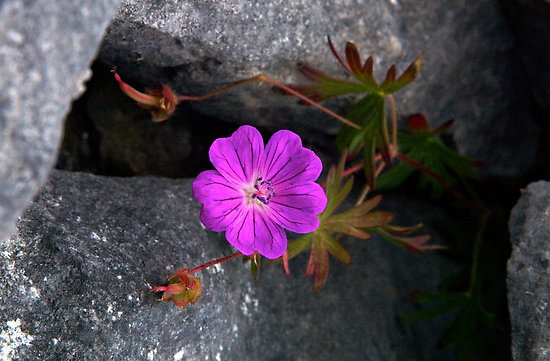
flower in rocks

I do not talk of the beginning or the end. 

There was never any more inception than there is now, 
Nor any more youth or age than there is now, 
And will never be any more perfection than there is now, 
Nor any more heaven or hell than there is now. 

Urge and urge and urge, 
Always the procreant urge of the world.

Walt Whitman, Song of Myself