Clear, open space

File:Prairie Homestead.jpg

We might think of the mind as being like clear, open space. All kinds of things arise there, but the space is not affected….In meditation  and in our lives, it is not so important what particular experience arises. What’s important is how we relate to it. By learning to relate well with whatever arises, we open to the full range of human experience, to what the Taoists call “the ten thousand joys and the ten thousand sorrows”.

Joseph Goldstein, A Heart Full of Peace

photo chitrapa

Speeding up or slowing down

File:Busy.jpg

What I’ve noticed is that there are two main ways that fear of uncertainty affects us, at least initially. One is that we speed up and the other is that we get very lazy. As I’ve talked with people many of them share their experiences of how a basic level of nervousness causes them to speed about even in their own homes, bouncing from room to room and task to task and never quite finishing anything. People talk about going back and forth between one thing and another, emailing and calling people on the phone. …Lazy is the other way to go. It is the opposite of speed, and yet these two seeming opposites  are both about the same thing: avoiding being present with our fear of uncertainty. You procrastinate. You feel unworthy. Laziness has a frozen quality. You spend hour after hour on the computer, not as a form of speediness, but just distracting yourself, trying not to feel what’s underneath what you’re feeling, trying to avoid touching the uncertainty and uneasiness.

Pema Chodron

photo trishna datta

Life is like this

closed33
Life is like this. You can’t say it’s a banquet all the time.  Breath going in… I wouldn’t describe that as a banquet, or that the sound of silence is life at its best, where it’s just one laugh after another.  It’s just like this. Most of our experience is neither one extreme  nor another; it’s like this…[yet]..there  are ways of  noticing that even within what can be physically unpleasant –   like cold, dampness and things like this – that we find unpleasant as sensory experiences, that the real suffering  is the aversion: “I don’t like this. I don’t want life to be like this. I want to be where there are blue skies and sunshine all the time.”… When you’re seeking happiness and trying to get away from pain and misery, then you’re caught in always trying to get something or hold on to happiness. That leads to an extreme again — wanting, always grasping after the ideal of some refined conscious experience.
Ajahn Sumedho, Intuitive Awareness

Controlling the weather

bird flying33

I have had some visitors staying these past days. The weather so far  this year has been very unusual for this area, with clouds and rain dominating in the last few week. This certainly can make touring a little more difficult, but no matter what the weather, once we fix on one desired result, inevitably the alternative seems a disappointment. A useful practice for the larger things in life. When we notice little habits like this we can let go and save ourselves stressing over things we cannot control.

I once led a retreat during a monsoon-like rainstorm: For a few days I wanted to apologize to everyone for the weather until a …voice of deeper wisdom arose “Weather is weather. This is what happens”. We’ve all had weather moments – times when we’ve felt responsible for everyone’s good or well-being. It’s our job, we think, to fix the temperature and humidity, or the people around us (if only we could get our partner to quit smoking, consult a map, stick to a diet). We even think we’re capable of totally controlling our own emotions – “I shouldn’t feel envious, or resentful or spiteful! That’s awful! I’m going to stop”. You might as well say “I’m never going to catch a cold again!”

Though we can affect our physical and emotional experiences, we can’t ultimately determine them; we can’t decree what emotions will arise in us. But we can learn in meditation to change our responses to them. That way we are spared a trip down a path of suffering we’ve traveled many times before. Recognizing what we can’t control (the feelings that arise within us; other people; the weather) helps us to have healthier boundaries at work and at home – no more trying to reform everyone all the time.

Sharon Salzberg, Real Happiness

Noticing ordinary perfection

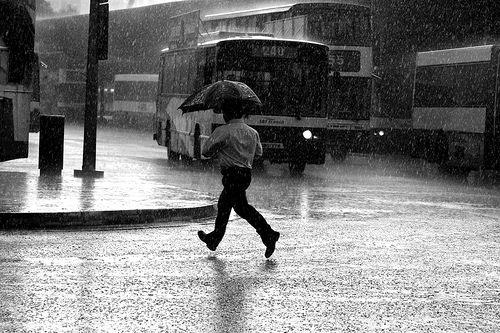
rain unbrella

To overcome perfectionism, you’d have to learn to accept reality for what it is at any given moment. I can imagine the objections: ” What? Accept the reality as it is? You must be kidding me!” Not at all. There are two reasons to accept reality as it is. First, there is no other reality at any given point in time than the one that there is. We can think of things being different from how they are at this period in time, but this hypothetically better, ideal reality exists only in our minds. In reality, there is just reality. So what is there to accept but this? The second reason for accepting the present reality as it is? It’s already perfect.

Pavel Somov, Present Perfect

Without effort

01 AA Blue 002 359

With no mind, flowers lure the butterfly;
With no mind, the butterfly visits the blossoms.
Yet when flowers bloom, the butterfly comes;
When the butterfly comes, the flowers bloom.

Taigu Ryokan, Japaneses Zen Poet, 1758 – 1831