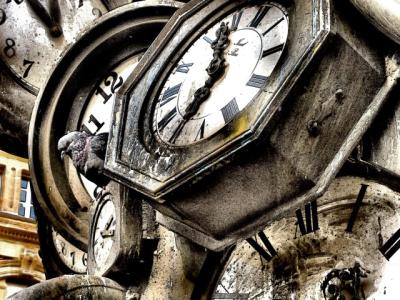
The opposite of time

Pigeon clocks

All is always now,” says T. S. Eliot. This statement implies a profound insight: Not only is the now not in time; time is in the now. When the future comes, it will be now, and any past event becomes now as we remember it. There is only one now. It cannot be multiplied; it simply is. The now is the opposite of time. In fact, this is Augustine’s definition: “Eternity is the now that does not pass away.” A happiness anchored in the now is eternal. This precisely is the happiness our heart desires — eternal, and unassailable, because it is beyond the reach of “time the destroyer”

David Steindl-Rast, A Basic Human Approach to Happiness

Being present

File:Ecola State Park Haystack Rock.JPG

To listen is to lean in softly
With a willingness to be changed
By what we hear


Mark Nepo

photo brmuchin at en.wikipedia

A self compassion practice

File:穏やかな眼差し Gentle Eyes (8360606632).jpg

We often find it easier to change and fix ourselves than to just accept ourselves, and as Pema Chodron once said, this can sometimes mask a subtle form of aggression towards ourselves. Frequently,  we expect some kinds of perfection in everything we undertake, so this variation on loving-kindness practice – suggested by Dr. Willoughby Britton – might be helpful. She recommends choosing one of the phrases and repeating them during the day, or when we are sitting in meditation:

I allow myself to be imperfect

I allow myself to make mistakes

I allow myself to be a learner in life

I forgive myself

May I be free

photo yuya sekiguchi

A paradox

File:Sit 08860.jpg

Just sitting means just that. That ‘just’ endlessly goes against the grain of our need to fix, transform, and improve ourselves. The paradox of our practice is that the most effective way of transformation is to leave ourselves alone. The more we let everything be just what it is, the more we relax into an open, attentive awareness of one moment after another.

Barry Magid, Leave yourself alone

photo nevit dilmen

Part of life

Working with unpredictability

Trauma is not just the result of major disasters. It does not happen to only some people. An undercurrent of trauma runs through ordinary life, shot through as it is with the poignancy of impermanence. I like to say that if we are not suffering from post-traumatic stress disorder, we are suffering from pre-traumatic stress disorder. There is no way to be alive without being conscious of the potential for disaster. One way or another, death (and its cousins: old age, illness, accidents, separation and loss) hangs over all of us. Nobody is immune. Our world is unstable and unpredictable, and operates, to a great degree and despite incredible scientific advancement, outside our ability to control it.

Mark Epstein, The Trauma of Being Alive, New York Times, August 2013

Control

Image taken from rawforbeauty.com