Our limited words

File:Winter rose.jpg

 All of the wisdom traditions speak of the limitations of the interpretations or labels which we use to guide us through the day, or even through life. We form judgements about events and get strongly attached to those views, when we actually have no way of really knowing how things will turn out in the long run. Oftentimes, all we succeed in doing is raising our own anxiety. What we seek is that in each moment we have a direct experience of our life. The deepest realities about life, love and beauty cannot be put into words. 

The true seeing is when there is no seeing

Heze Shenshsui, Chinese Zen monk, 684 – 758

The disciples were absorbed in a discussion of Lao Tzu’s words ” Those who know do not say. Those who say do not know” When the Master entered they asked him what the words meant. The Master answered “Which of you knows the fragrance of a rose”.  All of them knew.  

Then he said “Put it into words” All of them were silent.

Anthony de Mello, One Minute Wisdom

photo mike plante

When things fall apart

pine-cone

Today is the Feast of St Martin, traditionally one of the big feasts which defined how we should work with time and the pace of our lives. It marked the start of winter and signalled a change of tempo. From tomorrow, a forty  day period of  preparation for Christmas began, a time which recommended that we should slow down, simplify our activity, reflect and see what really endures. 

Perhaps this is fitting at the end of a tumultuous and frenetic week, which caused a lot of uncertainty in many people, and made us all examine our values,  and the different solutions to being human which are being offered. We need to see what will withstand the passing of time, the passing of empires and changing human paradigms.  It reminded us to connect with a deeper wisdom in order to learn how to deal with the frequently moving and disappointing nature of life: 

Whether we’re conscious of it or not, the ground is always shifting. Nothing lasts, including us. … It’s not impermanence per se that is the cause of our suffering. Rather, it’s our resistance to the fundamental uncertainty of our situation. Our discomfort arises from all of our effort to put ground under our feet, to realize our dream of constant okayness.

Pema Chodron, The Fundamental Ambiguity of Being Human

Trusting our inner sense

EnsoDownload

The center that I cannot find
is known to my unconscious mind.

W.H. Auden

Brightness

dark-river

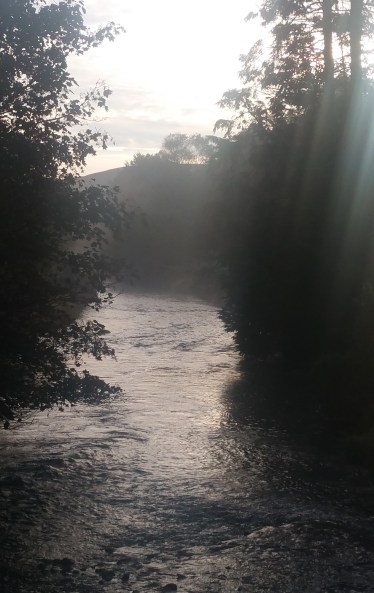
The only true antidote to always wanting more, as this 8th Century  reminds us, is to be aware of, and rooted in,  our inherent completeness, an awareness which will contradict the arising feeling of never being satisfied.

There is a solitary brightness without fixed shape or form.
It knows how to listen to the teachings,
it knows how to understand the teachings,
it knows how to teach.
That solitary brightness is you.

Linji Yìxuán, Chinese Zen Buddhist monk, died 866

Learning to let go, as life passes

What I mean to say is that you hear the Bat Kol (The Divine Voice). You hear this other deep reality singing to you all the time, and much of the time you can’t decipher it. Even when I was healthy, I was sensitive to the process. At this stage of the game, I hear it saying, ‘Leonard, just get on with the things you have to do.’ It’s very compassionate at this stage. More than at any time of my life, I no longer have that voice that says, ‘You’re fucking up.’ That’s a tremendous blessing, really.

Leonard Cohen’s wisdom as he gets older and is more aware of his mortality

photo taken from leonardcohen.com

Always wanting more

fallen-apples

More on the basic feeling of lack, which if we do not attend to it, makes us feel as if life is not offering us enough, or that we are not making enough of it:

The Dalai Lama, when asked what surprised him most about humanity, answered,

‘Man. Because he sacrifices his health in order to make money. Then he sacrifices money to recuperate his health. And then he is so anxious about the future that he does not enjoy the present; the result being that he does not live in the the present or the future; he lives as if he is never going to die, and then dies having never really lived’.