Bare Attention

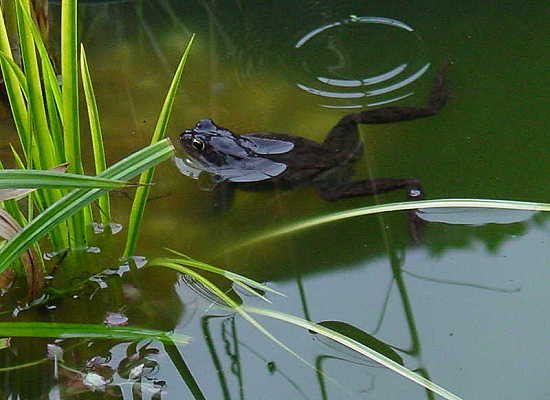
The Old Pond. A Frog jumps in. Plop. Matsuo Bash0, 1644 – 1694

How do we tame our minds? How do we train ourselves to stay open to our experience from moment to moment? The answer lies in the mind state called  “bare attention”. “Bare” means simple, direct, without trappings of judgment or interpretation. “Attention” means mindfulness, awareness; not forgetting to be present. A famous Zen haiku reads: “The old Pond. A Frog jumps in. Plop”

This is a wonderful description of bare attention. The old pond is not necessarily beautiful or covered with lily pods or green or blue. The poet, Basho, goes directly to the essence of his experience: the pond, frog, plop. We can say that in meditation we are developing “plop mind”. We are stripping away everything that is extraneous to our immediate experience and simply being present with what is happening. This is bare attention: direct, essential, noninterfering.

Joseph Goldstein, Bare Attention
Remember, when stressed today…

 
Sometimes the most important thing
in a whole day
is the rest we take between two deep breaths.
 
Etty Hillesum
 

Creating ourselves by our choices

Michelangelo stated that his sculptures were already present in the stone and all he had to do was carve away everything else. Our understanding of identity is often similar: Beneath the many layers of shoulds and shouldn’ts that cover us, there lies a constant single true self that is just waiting to be discovered. We think of the process as a personal excavation. We dig deep, getting under the surface, throwing away the extraneous, to reveal our everlasting self. And the tool by which we unearth this piece de resistance is none other than choice. Your choices of which clothes to wear or which soda to drink, where you live, which school to attend or what to study, and of course your profession all say something about you, and its your job to make sure that they are an accurate reflection of who you are.

Shena Iyengar, The Art of Choosing

We are responsible for our reactions

When your mind doesn’t stir inside, the world doesn’t arise outside.  Bodhidharma

Pain does not necessarily lead to suffering, though the two are often linked as though they were one: pain-and-suffering. If we learn to distinguish the two, a different possibility opens up, a possibility that is as liberating as it is challenging. This possibility is the freedom of becoming responsible for our mind states, no matter what the situation.  “Responsible for our mind states” – what does this mean?  It means that no one else is responsible for your thoughts and stories, for your reactions to painful stimuli. Pain may come your way, but you do not have to add to this pain the suffering of thoughts and stories about why it happened and what should or should not be happening.

Gordon Peerman, Blessed Relief: What Christians can learn from Buddhists about Suffering

The mind and direct experience

The challenge is to let go of our ideas about life, in order to more fully live. Our stories and mental images can often create a frame which dictates how we relate to each moment, or create expectations which we then use to judge how we are doing, causing frustration and self-doubt. The direct experience of each moment leads us into unfamiliar but rich territory. We practice letting go of our ideas and making room for what is here in this moment, a space to listen outside the confines of our fears and internal scripts.

We tell ourselves stories in order to live. We look for the sermon in the suicide, for the social or moral lesson in the murder of five. We interpret what we see, select the most workable of possible choices. We live entirely by the imposition of a narrative line upon disparate images, by the ideas by which we have learned to freeze the shifting phantasmagoria which is our actual experience.

Joan Didion, The White Album

Create life a day at a time.

The present moment is all we have, and it becomes the doorway to true calm, your healing refuge. The only place you can love, or heal or awaken is here and now, the eternal present. Create life a day at a time. You cannot know the future. But you can plant beautiful seeds here and now and learn to tend them with the love, courage and survival instinct that is inborn in you. Somerset Maugham once said “There are three rules for writing the novel. Unfortunately, no one knows what they are”. He wrote marvellous novels, the only way we can, a page at a time.

Jack Kornfield, A Lamp in the Darkness