Procedures, memories, patterns

We all have well-established habits of thought, emotion, reaction and judgement, and without the keen awareness of practice, we’re just acting out these patterns.

When they arise, we’re not aware they’ve arisen.
We get lost in them, identify with them, act on them  —  so much of our life is just acting out patterns.

Joseph Goldstein

As I was washing my hands the other evening  before the meal I turned on the tap marked “C” and started to wash.  After a moment something registered, and I thought “this water is cold, it should be getting warm by now”. And then I realized that “C” in an anglophone country like Ireland refers to “cold” whereas “C” in a francophone bathroom would indicate hot water. I noticed that my behaviour had been automatic, done without conscious awareness,  based on procedural,  formed,  memories. I had turned the “C” tap without thinking and gradually my brain caught up with the fact that this was not France and that the patterned behaviour would not get the desired result.

Frequently we operate on procedural memories or knowledge. This is fine for something like driving, which is fairly automatic regardless of whether one is driving on the right or the left. However, doing things in an automatic way can mean that we fit things into familiar boxes, or do not see things as new but presume that they will be the same as before. We do not give the moment a chance to reveal any new riches, because we have it figured out even before it happens. We can reduce others and,  even more frequently,  ourselves,  to limited pre-defined expectations and not believe in any possibility for change.
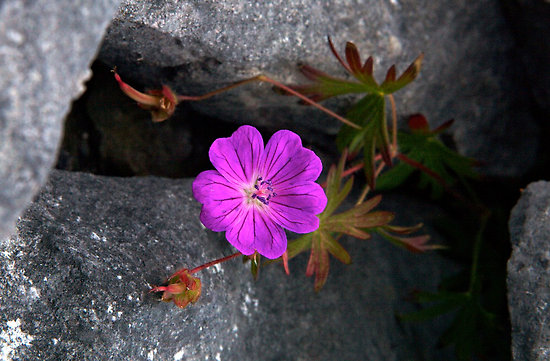
How we grow

flower in rocks

The promise of being broken

and the possibility of being opened

are written into the contract of human life.

Elizabeth Lesser, Broken Open

Seconds at a time

05-29 BEE POLLEN web A

Most of life only lasts a moment. Then our life becomes a memory, a dream. We are only alive a millisecond at a time. This moment! Or as one teacher put it, holding his thumb and forefinger about a quarter-inch apart, “All of life is only just this much –just a moment in time.” When we open to this very instant in which awareness produces consciousness, we are fully alive. Completely present. Big-minded. To the degree we are present for “just this much”,  this living moment, we are alive.

Stephen and Ondrea Levine, Embracing the Beloved

The strength from within

Each person must learn to relate to external people and situations. But it is equally important, and even more urgent, that he learn to relate to his own self. Until he learns to confront the motives, desires and unlived possibilities of his own secret heart, he can never be complete within or genuinely fulfilled. That power within, which constantly urges us to experience our unlived possibilities and values, is the most awesome force in human life. For ultimate meaning must be found within: A man must relate to the outer world from the strength of inner wholeness, not search outside for a meaning that he finds, at last, only in the solitary pathways of his own soul.

Robert Johnson, We: Understanding the Psychology of Romantic Love

Sunday Quote: Round and round

File:Unisphere-cc.jpg

The secret of the world is this:

the world is entirely circular and you will go round and round endlessly, never finding what you want,

unless you have found what you really want inside you. 

Jeanette Winterson

photo uri baruchin

….And keeping our faces toward change

imageLife is either a daring adventure, or nothing.

To keep our faces toward change and behave like free spirits in the presence of fate is strength undefeatable.

Helen Keller

In a general sense we seem to prefer things to remain the same and dislike too much uncertainty (except  maybe when the normal dull Irish Summer has been replaced by warm sunny days).  Change unsettles and can prompt an almost instant movement towards turning away or tightening up.  So it is a challenge to “keep our faces towards change” –  as Helen Keller says-  by going against our instinct for once and staying with something that our fears tell us to avoid.  When we consistently buy into our fears and strengthen fearful  thoughts, we can forget some of the larger truths of life, or  lose sight of our essential confidence and strength. An avoidance mentality leads us to expect trouble and weakens our ability to live with how the present moment is unfolding.

One of the fundamental truths of existence is that life changes, and changes in ways that we cannot expect. So developing this capacity to turn towards change is a necessary skill for working with life. It is probably best to practice it in smaller matters, so that it is somewhat developed when the bigger changes happen. So it is good to sometimes look at some small things we avoid and see what we can learn from them. We could practice with something like some paperwork we have been putting off, a contact we have been delaying, or staying in the presence of  someone who disturbs us instead of running away.  In this way we can be curious about  what happens when we  move towards something rather than moving away.

photo of dawn at Dunmore East Co. Waterford, Ireland