Not identifying with where we are today

We try to maintain a relaxed observing,  and not identify with our thoughts. The heart of mindfulness practice:

To think ‘I am screwed up’, is a value judgement, isn’t it? ‘Screwed up’ makes the ‘I am’. It is identifying with a certain kind of condition, a feeling about oneself personally. If we leave off the ‘screwed up’ bit, we get more to the reality of the moment ― ‘Right now I am . . .’ and there is this sense of being here and now. This is a recognition of conscious experience as an entity. There is an entity but it is not personal any more; it is not ‘I am Ajahn Sumedho’ or ‘I am’ anything at all; it is just this sense of ‘I am’, of presence. Being a conscious entity is ― ‘like this’. Reflect on that and sustain it for a while, that sense of ‘I am’, without adding any personal conditions to it.

In this sense of ‘I am’, the body is ‘like this’. There is consciousness, there is the breath (one can be aware of just the breathing of the body, in-breathing and out-breathing.), there is the ‘sound of silence’, the background. And in this intuitive moment, one observes without adding any kind of personal quality.

Ajahn Sumedho, Try to have a Permanent Emotion.

From the heart

Many native cultures believe that the heart is the bridge between Father Sky and Mother Earth. For these traditions, the ‘four-chambered heart,’ the source for sustaining emotional and spiritual health, is described as being full, open, clear, and strong. These traditions feel that it is important to check the condition of the four-chambered heart daily, asking: ‘Am I full-hearted, open-hearted, clear-hearted, and strong-hearted?’

Angeles Arrien 1940 – 2014, Cultural anthropologist.

Sunday Quote: Allow


Allow your life to unfold naturally.

Just as you breathe in and breathe out, there is a time for being ahead and a time for being behind; a time for being in motion and a time for being at rest; a time for being vigorous and a time for being exhausted; a time for being safe and a time for being in danger.

Lao Tzu

Each ending is a beginning

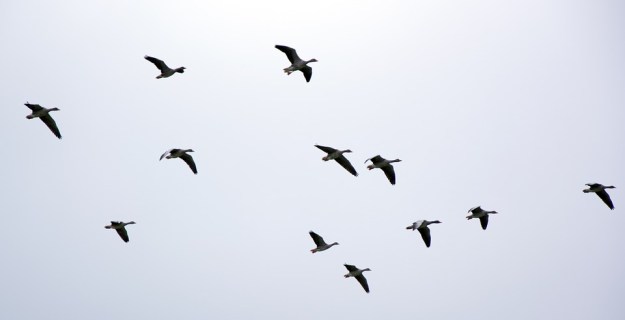
The black birds feeding in the garden yesterday morning stood out clear against the snow, and they brought to mind this poem.

The snow went on to melt quickly. More lessons from life’s weathers. Transition and change are inevitable parts of the human experience. This time of year, as the days shorten, and the themes of Advent remind us that we are always between here and there, we work at re-imagining and making space, at being at ease in a moment that is always both  an ending and a beginning.

Above the mountains
the geese turn into
the light again

Painting their
black silhouettes
on an open sky.

Sometimes everything
has to be
inscribed across
the heavens

so you can find
the one line
already written
inside you.

Sometimes it takes
a great sky
to find that

first, bright
and indescribable
wedge of freedom
in your own heart.

Sometimes with
the bones of the black
sticks left when the fire
has gone out

someone has written
something new
in the ashes of your life.

You are not leaving.
Even as the light fades quickly now,
you are arriving.

David Whyte, The Journey

Walk in trust


A blanket of light snow this morning.

Life is movement, and continually changing in ways which we cannot anticipate:

Your soul alone has the map of your future, 

therefore you can trust this indirect, oblique side of yourself.

If you do, it will take you where you need to go,

but more important it will teach you a kindness of rhythm in your journey.

John O Donohue, Anam Chara

Life’s weather

Another storm passing over parts of Ireland today: high winds, then cold and snow. A good metaphor for our life.  Sometimes  we are subject to cold winds from an unexpected direction:

Being tossed and turned by circumstances is part of life’s weather. You may trip on obstacles, hurting someone you love. You may find yourself alone, without the person with whom you thought you’d spend the rest of your life. 

How do we meet these challenges?

For me, I try to remember, when breaking, that every crack is an opening. No matter how harsh the experience, something is always opened within us; and what is opened is always more important than what breaks us. We might experience cruelty or unfairness or indifference or the brutality of chance — all of which are difficult and life-changing. And while cruelty and injustice are never excusable and need to be rectified, we must not get stuck in our list of legitimate grievances, or we will never be able to enter the depth that becomes available for being open. 

It’s hard to keep this deeper understanding of life in view when in pain, when in fear, when confused and worried. But this is the nature of being broken. “To be broken is no reason to see all things as broken.” This notion has been a profound teacher for me in meeting difficulty. Though it’s understandable to be consumed with what we’re going through, it’s essential to remember that all of life is not where we are. In fact, this is when we need the aliveness and vitality of everything that is not us. When closed, we need to open. When fearful, we need to trust again. When feeling lost, we need to remember that we are in the stream of life, which is never lost.

Mark Nepo, What to Do When You’re Broken