Everyday life is muddy

The essence of the practice life involves cultivating awareness. This process has two basic aspects. The first is clarifying the mental process. The second is experiencing — entering into awareness of the physical reality of the present moment. When we’re standing in the muddy water of everyday life, practice is often not simple and clear. But part of our challenge is to bring a certain precision and impeccability to our efforts. That’s why it’s important to keep returning to these two basic aspects of practice: first, seeing through the mental process, with all its noise; and second, entering the non-conceptual silence of reality as-it-is. As practitioners we learn to honestly and relentlessly observe the mental or conceptual process — thoughts, emotional reactions, strategies and fears — and then bring ourselves back again and again to the physical reality of the present moment.

Ezra Bayda, How to Live a Genuine Life  
Where the tension in our lives comes from

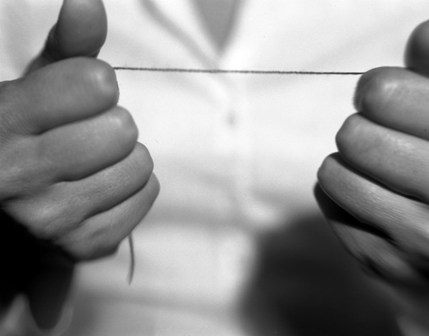
The moment we stray from where we are, we create a tension between two places – where we are and where we are thinking of being. It is this tension that blocks us from the sensation of being fully alive, because being split in our attention prevents us from being authentic – even though managing many tasks at once (being skilful in splitting our attention)  is considered intelligent.

For most of us, straying from where we are and coming back is a never-ending task, very much like blinking and breathing. When we incorporate the fullness of attention into our daily lives, we seldom notice it. But if we should interrupt our flow of being, we will stumble just as surely as if we were to stop seeing or breathing. That we stray from the moment is not surprising. The more crucial thing is that we return. 

Mark Nepo, The Book Of Awakening

Welcoming whatever is present today with kindness

Mindfulness is an act of hospitality. A way of learning to treat ourselves with kindness and care that slowly begins to percolate into the deepest recesses of our being while gradually offering us the possibility of relating to others in the same manner. Working with whatever is present is enough. There is no need to condemn ourselves for not feeling loving or kind. Rather, the process asks us to entertain the possibility of offering hospitality to ourselves no matter what we are thinking or feeling.

[Today] try taking some time to explore the possibility of sitting with yourself as if you were your own best friend. Dwelling in the awareness of the breath, allowing thoughts and feelings to come and go, experiment with the possibility of embracing yourself as you would embrace another person who is dear to you and needs to be held. If you like try silently repeating a phrase on your own behalf. You might offer yourself one or more of the following: “May I be safe”. “May I be free from suffering”. “May I be peaceful”.

Saki Santorelli, Letting Ourselves Heal

Staying within the moment

A key skill for sustaining mindfulness in daily life is being able to distinguish between our experience and our interpretation of our experience. Experience is simply whatever is happening in the moment — a sound, a taste, a body sensation, an emotion, an interaction, etc. Interpretation is the mind’s reaction to our experience. One way to understand this difference is that when we are directly experiencing a moment of life, we are “within” it; when we are interpreting it, we are “outside” it. 

Once you begin to recognize that interpretation is only your view of an experience, it becomes possible for you to begin to release your compulsion to interpret every moment. Ideally, your goal is to create a new habit or “default setting” for responding mindfully rather than reacting unskillfully to all types of experiences….You can begin to break your habit of automatically interpreting every experience by practicing being mindful of your experience within the experience. So when an unpleasant moment arises, be interested in the direct experience of what happens. You might say to yourself,  “I’m just going to be interested in this,” and then watch what happens. Just be in the moment and let the experience form.

Philipp Moffitt, Maintaining Mindfulness in Daily Life

Taking charge of how we experience life

I have written before about Jill Bolte Taylor who suffered a severe hemorrhage in the left hemisphere of her brain in 1996. After this stroke  she could not walk, talk, read, write, or recall any of her life. It took  her eight years  to completely recover all of her functions and thinking ability, and in that time she observed closely the action and functioning of her brain. She noticed that it was possible to choose whether to hook into a feeling as it arises in the brain and prolong its presence in my body, or just let it quickly flow right through.  As a result she now encourages people to practice this brain development and to “Step to the Right” of  their – often judgmental –   left hemisphere brain chatter in order to live a more balanced life. This can be done by setting aside time for meditation, yoga or other activities. In this way we can take control over a lot of what passes through the mind and not over-identify with it.

As my left brain became stronger, it seemed natural for me to want to “blame” other people or external events for my feelings or circumstances. But realistically, I knew that no one had the power to make me feel anything, except for me and my brain. Nothing external to me had the power to take away my peace of heart and mind. That was completely up to me. I may not be in total control of what happens to my life, but I certainly am in charge of how I choose to perceive my experience.

Jill Bolte Taylor, My Stroke of Insight

Learning from the moment

Another post by Pema Chodron on the basic practice in mindful living – staying with what is right in front of us or happening inside right now.

All religions point to the fact that being fully present is the only state in which you can wake up — not by somehow leaving.

So you have to find your own simple, grounded language to say that to yourself, and that’s a beautiful way to express it: What is this moment, this situation, or this person trying to teach me? Another one that I love is “This is a unique moment. Maybe I’m not so glad about it because it’s painful, but I don’t want to waste it, because it’s never going to happen again this way. So let’s taste it, smell it, experience it”.

Pema Chodron