Keeping our life whole

Anything you do to escape the fundamental duality of ego consciousness just kicks more energy into it. Your only choice is to stop. That unsplit, unifying place is found at the fulcrum. This is the holy place, the whole place. The demand for human consciousness to have the “right” thing –  at the exclusion of something else –  just sets the wheel in motion again. There is a kind of consciousness that assists slowing down. If you can honestly assess what is true in your life, looking at it with objectivity and intelligence, this is getting closer.

Practically speaking, if we would spend as much time being alert and aware as we do worrying, we would be out of any mess fairly soon. When you stop fighting your situation, you just have the situation but no longer the struggle to cope with. Generally one can endure that. This is to cease wounding yourself on the jailhouse bars of reality —  to stop complaining about what is.

Robert Johnson

A pilgrimage to our own life

Since everything is sacred, staying close to what is sacred is a matter of presence and attention more than travel to some secret place. In essence, staying close is a pilgrimage to the heart of where we are. Since it is we who lose our directness of living, our task is often to restore that freshness of being alive….How do we stray on and off the path of what matters? How do we befriend the life of obstacles? How do we find a home between suffering and loving the world? How do help each other respond to the invitation to grow?

Mark Nepo

Sunday Quote: When we do not appreciate what we have


You cannot avoid paradise.

You can only avoid seeing it.

Charlotte Joko Beck

Not a way to escape from ourselves

When we come into therapy, instead of pursuing some ideal, we may be trying to escape some part of ourselves. Our anger. Our depression. Our sexuality. Then we think that therapy may be some kind fo mental surgery, cutting out all those disagreeable aspects of the mind and leaving behind only what is calm or compassionate. But neither therapy or… [meditation] practice works that way. The mind cannot escape itself – that would be like riding a donkey fleeing a donkey.

The only way out of that struggle is to leave our mind alone,   to fully accept the mind that we have, anger, delusions, and all. And when we no longer judge ourselves or try to emotionally neuter ourselves, the internal tensions and conflicts gradually begin to quiet down. We might say that this is the most basic psychological insight: I can’t escape myself, so I must come to terms with the mind that I have. I call this a “psychological” insight,  because the basic task of all …practice is re-owning the split-off and denied or dissociated aspects of the mind

Barry Magid, Ending the Pursuit of happiness

When stressed, shift attention

On the same theme as recent posts,  but applying it as a practical way of dealing with the stresses and crises that arise during our working day. This is an easy-to-apply way of breaking the cycle of stress reactivity – divert your attention to your physical environment, like the touch of your hands on the keyboard, your breathing, or your feet in contact with the floor. See if you can create a small break from the spinning of the mind by tuning into the sensations of the body.

To gain composure at stressful moments, we can apply the mindfulness effort of letting go – abruptly shifting our attention from our thoughts to the immediacy of our physical environment. By suddenly being mindful in this way, we discover a stillness, an emotional space of “not knowing” , like opening a door to an unknown room or leaping from a diving board. When we are mindful in the immediate moment, the chaotic flood of emotions no longer vies for our attention like a crowd of loud, unruly voices. Instead they focus and settle into a physical feeling, unclear and murky, but no less powerful – a tickle in the stomach, a vague softness around the heart, or an openenss in the throat.

Michael Carroll, At Times of Risk and Stress, Cultivate Stillness

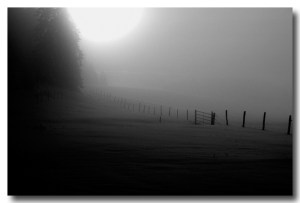
Grey days

The past few days have dawned quite grey, and this has hardly lifted at all during the course of the day.   Like all other types of weather this can be a useful metaphor for the mind. We frequently fall into the trap of thinking that we see things directly and clearly, when rather it is truer to say that we see them through the filters of our  mental and emotional conditioning. For example, we often expand a lot of energy worrying about future events, many of which never came to pass in the manner imagined. It is as Mark Twain said, “I am an old man and have known a great many troubles, but most of them never happened”. However this  does not prevent us from believing that we see the clearly what is going to happen, when in actual fact we am looking through the fog of our own interests and fears. This means a lot of our energy goes into not what is actually happening in that moment, but into the anticipations of what may happen in the future.

One of the reasons for meditation is the cultivation of clear seeing. We practice meditation to strengthen our ability to  pay attention to this moment instead of getting lost in the fog that we’re usually in. It is one way of trying to see the world clearly, and not getting stuck in the wanderings of our minds, no matter what is the changing “weather” of our moods or experiences. To do this we try to sit under all kinds of circumstances, whether we are well or sick, whether we’re in a good mood or down, whether we feel our meditation is going well or is completely falling apart. In this way we develop a consistency.  and see that meditation is rather about staying with ourselves, in this moment, no mater what that is like.  Clear seeing starts with becoming aware of some of the habitual patterns in our thinking, our defense mechanisms, and the ways we rehearse life, rather than live it directly

“This is an essential discovery: our experience of life and the world is strongly flavoured by our own internal cycles of mental weather – sunny, foggy, rainy, sunny, misty, cloudy – and around and around we go: jealous, proud, anxious, craving, excited, deflated. When we look closely we see that we have deeply ingrained habits of distracting ourselves from the present.”

Gaylon Ferguson Natural Wakefulness