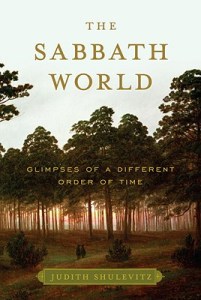
 A book that is not directly about Meditation or Mindfulness, but which does impact upon stress reduction, The Sabbath World: Glimpses of A Different Order of Time, is a beautiful work which discusses our use of time by reflecting on the millenia-old practice of the Sabbath rest. The author, Julie Shulevitz, a successful journalist at the New York Times, found herself increasingly uneasy with the speeded-up and frantic pace of modern life. She decided to return to look at the meaning and value of the practice which had been honoured in her Jewish childhood – and which she rebelled against – the setting aside of a special time which was the Sabbath, and see if it made any sense in this modern age:
Americans, once the most Sabbatharian people on earth, are now the most ambivalent on the subject. On the one hand we miss the Sabbath. When we pine for escape from the rat race; when we check into spas, yoga centers, encounter weekends, spiritual retreats; when we fret about the disappearance of a more old-fashioned time, with its former, generally agreed-upon rhythms of labor and repose; when we deplore the increase in time devoted to consumerism; when we complain about the commercialization of leisure, which turns fun into work, and requires military-scale budgeting and logistics and interactions with service personnel – whenever we worry about these things we are remembering the Sabbath, its power to protect us from the clamor of our own desires.
The book that unfolds from this starting point is partly a personal memoir, partly a reflection on the role of the spiritual in life, part history and cultural analysis, and is written in a lovely, engaging prose. I picked it up two weeks ago and read it easily over a few days as it deals with its big topic – and the philosophical and life reflections prompted by it – quite lightly, without being superficial. Although it takes as its starting point a religious practice, it is really a long reflection on the anthropological roots beneath all religious acts, the need for balance and the difficulty we have today in finding it. What makes it appealing is that one can sense the author’s desire to find what is meant by home and meaningful ritual, and her search for the inner space to find rest in them. Her reflections can help us all consider the need to set aside some silence to reflect upon why we work in the first place and to see the wonder and depth in life:
So why remember the Sabbath? Because the Sabbath comes to us out of the past – out of the bodies of our mothers and fathers, out of the churches on our streets, out of our own dreams – to train us to pay attention to it. And why do we need to be trained? Consider the mystery surrounding God’s first Sabbath. Why did God stop anyway? In the eighteenth century, Rabbi Elijah of Vilna…ventured this explanation: God stopped to show us that what we are creating becomes meaningful only once we stop creating and start remembering why it was worth creating in the first place.
 The decisive question for man is: Is he related to something infinite or not? That is the telling question of his life. Only if we know that the thing which truly matters is the infinite can we avoid fixing our interests upon futilities, and upon all kinds of goals which are not of real importance. Thus we demand that the world grant us recognition for qualities which we regard as personal possessions: our talent or our beauty. The more a man lays stress on false possessions, and the less sensitivity he has for what is essential, the less satisfying is his life. He feels limited because he has limited aims, and the result is envy and jealousy. If we understand and feel that here in this life we already have a link with the infinite, desires and attitudes change.



 Mindfulbalance