
Stillness

No snowflake falls in the wrong place.
Zen Saying

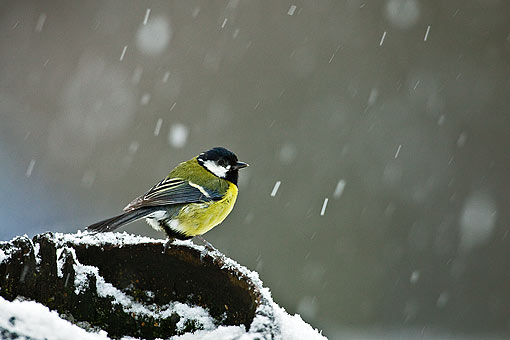
All things happen for a reason. Everything can be our teacher. Snow falls quietly. It covers all in a blanket of stillness. We look out the window at the falling snow. At times like this it is easy to be at one with exactly what is happening here and now – simply being with the snow falling, simply being with what is in our lives.

Setting out

The soul is dyed the colour of its thoughts.
Think only on those things that are in line with your principles and can bear the light of day.

The content of your character is your choice.

Day by day, what you do is who you become.
Your integrity is your destiny –
it is the light that guides your way.

Heraclitus (c.540 – c.475 BC)

Transitions

One metaphor used for our lives is that of a journey. Sometimes we can get insights when we travel, on a plane, in a car or simply walking. A journey can help us understand the changes we are experiencing in our life. It can have three parts: a beginning, an ending, and a neutral zone. It can be seen as a rite of passage, a movement from one period to another in our lives.

Often we think of change as setting out, a new beginning, but to do so jumps over the other two necessary and important components. Often setting out starts easily, or is prompted by new encounters or a change in circumstances. However, it is strangely in in the neutral zone that we can go through feelings such as loss, doubt, anxiety and confusion that we are most vulnerable, and yet unexpectedly most open to creative growth. We need to trust the process of the journey, to believe that it will lead to a new place. Not always the destination we imagined at the start. However, the only way to learn about life is to explore.

We shall not cease from exploration
And the end of all our exploring
Will be to arrive where we started
And know the place for the first time.

T.S. Eliot, Little Gidding

Melting our difficulties

It has begun to get quite cold here and a lot of snow is forecast for the weekend. The barrel used to gather rainwater in the garden has a solid layer of ice on top. It reminded me of this passage, about how we can feel when problems and accompanying difficult emotions turn our warm heart – or our courage – into a solid frozen mass within us.

Our habits and patterns can feel just as frozen as ice. But when spring comes, the ice melts. The quality of water has never really disappeared, even in the deepest depths of winter. It just changed form. The ice melts, and the essential fluid, living quality of water is there. Our essential good heart and open mind is like that. It is here even if we’re experiencing it as so solid we could land an airplane on it.

When I’m emotionally in midwinter and nothing I do seems to melt my frozen heart and mind, it helps me to remember that no matter how hard the ice, the water hasn’t really gone anywhere. It’s always right here.

So I work on melting that hardness by generating more warmth, more open heart. A good way for any of us to do this is to think of a person toward whom we feel appreciation or love or gratitude. In other words, we connect with the warmth that we already have. If we can’t think of a person, we can think of a pet, or even a plant. Sometimes we have to search a bit. But as Trungpa Rinpoche used to say, “Everybody loves something. Even if it’s just tortillas.” The point is to touch in to the good heart that we already have and nurture it.

Pema Chodron, Shambala Sun, 1998

Disappointment

Sometimes things really don’t work out as well as you think. It’s true, no? You can buy the latest must-have gadget, find it marvellous for a few days and then it breaks, leaving you with a sour taste in your mouth.

Life can be even worse. You work hard on your career, or on a relationship or in changes to your lifestyle, but still you are not as happy as you assumed you would be “if only” this or that happened. Or someone who you thought you could be safe with can let you down. Our family stories can be complicated and painful. Or we may have a setback or rejection, and feel our hopes and dreams dashed. We can come to understand that something we always thought possible is never going to happen: a change in some behaviours, making peace with a difficult part of our history, realizing all the dreams and potentialities that we think we have.

One first step toward dealing with disappointment is to understand the forces that drive disappointment in our own view and in that of the culture around us. One is the deep seated belief that life can be free from disappointments and suffering. This is ingrained in today’s society which needs us to think we deserve all the toys, thrills, and pleasures we can get, and that our fulfillment is linked to that. However, the teachings that are the basis for mindfulness tell another message, namely that life is challenging, even unsatisfactory, for everyone. Our physical bodies, our health, our plans, our relationships, all the elements in our story are fragile and subject ot change. This is a basic reality. The cause of our disappoinment, our suffering, is not the change in itself, but the mind’s struggle in reaction to the change. Mindfulness proposes one way of dealing with suffering – training a non-struggling, peaceful mind.

A second step is to work directly with the sense of disappointment as it arises. We firstly stop being surprised when our internal life is not as smooth as we would like it to be, and simply try some practices gently and kindly. One practice is to say to ourselves, “I feel disappointed. I have made a desire such and such expectation so solid that I have let myself be identified with it. That is now causing me to suffer.” Once we recognize this, we have a moment to choose between two possibilities – whether we want to go back to our story and wander around in it, and feed it more, or whether we can rest in the felt sense of disappointment and simply acknowledge it for what it truly is.

If we do the first we often notice that the disappointment can trigger our core beliefs, such as, “I am not good enough”, “They always leave”, “I’ll never be happy”. If we choose the second way it can help us gently break through the defensiveness and armour by looking at the distress directly. Maybe seeing that it is not as solid as we first thought. Although difficult, we try to begin by saying “I am disappointed. What does it feel like at this moment? Where is it in my body?” Thus, instead of maybe contracting into our disappointment, we allow some space for a broader picture to be seen.

From a worm’s cocoon, silk.
Be patient if you can,
and from sour grapes will come something sweet.

Rumi
Illness


These days there is a lot in the news about illness and pandemics. Closer to home, I have been aware of persons who are ill, recovering from operations or close to death.

The news of an illness can surface anxieties, including how we are supposed to respond. These can also touch into an unconscious, deeper anxiety about “ceasing to be,”. Like all emotions, that anxiety can actually be useful and instructive. One of the principles of Mindfulness practice is that negative emotion—when we turn toward it rather than run away from it— is itself the path.

We try and work with noticing the initial apparent unpleasantness of negative emotions. This initial feeling tone is somewhat illusory. The actual “taste” of anxiety is in the just a sensation, like the sourness of a lemon; our initial response tells us that it is bad, but actually it’s just what it is. Like a lemon, anxiety has its uses. These strong emotional states can often be our best teachers.

Mindfulness of illness can teach us so much at a deeper, fundamental level. When illness affects us directly it makes us slow down, and be more attentive to the ongoing wonders that we take for granted. We can see the individual moment of our lives through the perspective of new priorities. We can also be challenged in the way we feel the need to be in control of our lives, to constantly hold ourselves up. Illness helps us see that much of life is out of our hands. Ill people need to let themselves be held by others – by the medical staff, by their families, by the support of friends. At times we too need to receive and learn how to be vulnerable. We learn that not all of life can be measured in achievements and outcomes, but often just waiting in silence can be the best work we can do.

“A waiting person is a patient person. The word “patience” means the willingness to stay where we are and life the situation out to the full in the belief that something hidden there will manifest itself to us. Impatient people are always expecting the real thing to happen somewhere else and therefore want to go elsewhere. The moment is empty. But patient people dare to stay where they are. Patient living means to live actively in the present and wait there”.

Henri Nouwen, A Spirituality of Waiting