…but rather, looking inside

One of Tony De Mello’s stories, with a similar theme – We often think that what we want is outside us. Rather, the real work we need to do is within:

One day God got tired of being pestered by people asking for this and for that, so God calls a meeting of the most trusted angels and asks for suggestions as to where one can hide from pestering people. One angel advises God to hide on the highest peak of the highest mountain because no one will search there. Another angel says, “No, hide in the depth of the deepest ocean in the world and no one will search for you there.” Finally, God turns to the most trusted angel and asks: “Where do you suggest I should hide?” And the angel responds: “Hide in the human heart! No one will search for you there.”

Combining effort and allowing

The combination of stillness and movement is a spiritually effective style for how we live our lives. We refuse to be caught up in activity but are committed to frequent pausing, taking time to let things unfold. [This] combination of opposites characterizes us when we find psychological health and enter the spiritual realm, the twin goals of our evolution towards wholeness. We combine our psychological work, which takes effort, with our spiritual work, which takes allowing. The ego-Higher Self axis that happens in such individuation is visible in the combination of action and acceptance. A statue is motionless, but movement bursts forth, not only in the how the sculptor’s imagination brings it to life, but in the mysterious sense of motion he has achieved. This may be what he poet Rilke meant by “outer standstill and inner movement”

David Richo, Being True to Life

The hidden work that is essential for growth

The ladder whose ascent implies spiritual progress has a long pedigree.  Hebrews, Greeks and Christians all gave special value to the heights, and Western morality tends to put all better things up high and worse things down low. By the last century growth became inexorably caught in this ascensionist fantasy. Darwin’s thesis The Descent of Man became, in our minds, the ascent of man. Each immigrant moved upward in social class as buildings moved upwards with their elevators to more expensive levels. By now the upward idea of growth has become a biographical cliché. To be an adult is to be a grown-up. Yet this is merely one way of speaking of maturity, and an heroic one at that. For even tomato plants and the  tallest trees send down roots as they rise toward the light. Yet the metaphors for our lives see mainly the upward part of the organic motion.

James Hillman, The Soul’s Code

Replacing our myths

Society today prides itself at times at having thrown out some of the outdated myths that guided our forefathers and grandparents. We have progressed and base ourselves on more rational forces now. However, we are always guided by some myths, whether we are aware of it or not. We simply replace one philosophy by another, and worship in a different type of temple.

The collective fantasies of the modern world are that the old myths can be revived by acts of will, or that by acts of will new myths will be generated. While we have suffered the loss of the old, tribal myths, by and large,  we cannot generate new ones – though for sure many have tried. We transfer the need for the experience of the transcendent onto persons, objects, and causes and wonder why they disappoint.

Another way of putting this is that when the gods are not experienced inwardly, they will be projected outwardly. The energy we project onto the things of our world – objects, causes, ideologies, relationships – possess a kind of autonomy, for they momentarily carry spirituality for us. As Jung warns “Our consciousness only imagines that it has lost the gods; in reality they are still there and it only needs general conditions to bring them back in full force”.  Whenever the level of personal attention is lowered…the tendency of the ego to project what is not addressed in the inner life increases its fascination with the outer.

James Hollis, Finding Meaning in the Second Half of Life

Genuine happiness comes from gently working with the mind

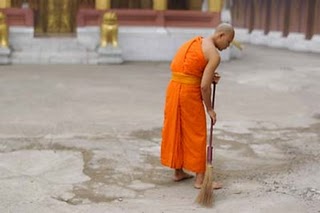
If we could put as much effort into cleaning up our minds as we do sweeping our houses, washing our clothes and doing the dishes, we would likely be at ease. But when we talk about cleaning like this, people don’t know what we are getting at…I’ve come to think it’s because people don’t seek their own dwelling place. We scrub and sweep elsewhere. We don’t make our minds clean, so there is always confusion. We are always looking outside.

…These days there is only force and hurry. Mangoes are never sweet now. They are forced. Before they are ripe they picked and artificially ripened. This is done because people want to get them in a hurry. So when you eat them you find they are sour. To get something good, you have to allow it be sour first, according to its own natural way. But we pick them early and then complain that they are sour. For the most part things are imitations. We grasp the things that are false and uncertain as real…If the mind does not see and realize, there is no path to clarity. 

Ajahn Chah, Being Dharma

Where meaning is found


The holiest of all holidays are those

Kept by ourselves in silence and apart;

The secret anniversaries of the heart

When the full river of feeling overflows

Longfellow, Holidays