Happiness is already here…..

An interesting quote. Sometimes we look in all kinds of places for our happiness – a new relationship, a better car, a holiday, other people, a more prestigious job. However most research and practice shows that very little of happiness is due to changes in external circumstances, or getting the world to be as we think it should be. These things change all the time,  and even when we think we have gotten the mix right, and feel we are in control,  it is often a short-lived illusion. Rather, happiness  is a skill,  or a group of skills, that we can cultivate, based on a source of natural goodness already within us, with which we approach both good and bad in life as they arise and pass away before us. Looking for happiness creates a duality which is not always helpful. Always focusing outside of ourselves means that we do not often realize what we already have, and fail to live in this moment, as we work to change ourselves and our circumstances to “improve” them and ourselves.

I wish to draw attention to the following problem:

the idea of happiness presupposes that at present we are unhappy.

Kosho Uchiyama Roshi
A mistaken view of happiness

Genuine happiness does not come from accumulating pleasant feelings.

Joseph Goldstein

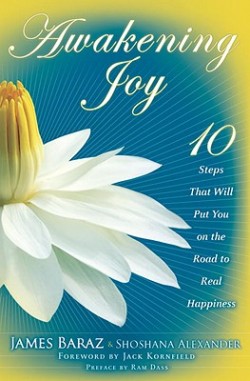
Book Review: Awakening Joy

I should really have reviewed James Baraz’s book long before now, as I have had it in my possession for more than a year. However, with James coming to Switzerland in August to deliver, in a weekend Seminar,  his hugely successful Course, now is as good a time as any. James has been teaching meditation since 1974 and is one of the founders of Spirit Rock Meditation Centre in California. The great strength of the book is that it is based on years of  experience, especially in teaching the Awakening Joy Course. So it is filled with stories and testimonials,  as well as practical strategies to help develop joy in our lives. James’ basic starting point is that joy is a choice that we make, and it can be developed. Each chapter introduces a different aspect of living a contented life, helping them become habits in our lives, such as developing a grateful heart or how to work when difficult emotions arise. It is one of those rare things: a book that is warm, practical and easy to use, while basing itself on up-to-date research on happiness.

Awakening Joy is not about fulfilling goals or changing particular circumstances. It’s about training the mind and the heart to live in a way that allows us to be truly happy with our life as it is right now. Not that we stop aspiring to change in positive ways, or that we remain in harmful situations, but we begin to find the joy inside us right where we are. As you work with the practices presented here, you will discover that happiness is not a place that you arrive at, but rather the result of training your mind to ride with ease and flexibility the roller coaster of life (page 7).

When you don’t have the answers

Some thoughts prompted somewhat by celebrating a birthday, the passing of time, and another poem by Mary Oliver.  A lot of the time I do not have answers to the questions that arise in me or to why things have happened. But increasingly, as the poet describes, I do not dwell too long on them as they have a capacity to stir up discontent. I prefer now not to try to put names or words on my journey, but to keep my heart moving towards an interior openness, or, in the image the poem uses,  to walk in an unnamed broad field. To let in space and the vastness of the world. All I can do is open up; what happens afterwards is not within my control. I will just try to welcome it. Life is an adventure, that continually surprises. Its joy and freshness lie there.

How did it come to be
that I am no longer young
and the world that keeps time

in its own way has just been born?
I don’t have the answers
and anyway I have become suspicious

of such questions,
and as for hope, that tender advisement,
even that

I’m going to leave behind.
I’m just going to put on
my jacket, my boots,
I’m just going to go out

to sleep all this night
in some unnamed, flowered corner
of the pasture.

Looking in the wrong place for happiness

There are many wrong tracks in society, but they are all basically the same: They all take us outside of ourselves to satisfy our inner needs.  Whether they take us toward material goods or towards social relationships and emotional codependence, they all ignore the mind’s own potential to provide us with happiness and peace

Dzigar Kongtrul, It’s Up to You

How meditation leads to kindness

Think of Mindfulness as the habit of seeing things in an uncomplicated way. We generally don’t. Based on our individual histories, our memories, and our fears, we often make up our reality out of a projected worry and frighten or discourage ourselves. Mindfulness is seeing things as they actually are,  not as we imagine them to be.

Mindfulness practice… supports our ability to best serve. It keeps our motivation going. I say, “When we see, even in the simplest circumstances, how difficult it is to stay content, how easily irritated we become, how many worries we have, how hard it is to relax — we intuit that that must be true for other people as well. All other people. And we start to be kinder. We are kinder to ourselves and, ultimately, more forgiving of others. The world would get happier if everyone relaxed and forgave each other.” Usually people think about that a moment. Then they smile and say, “I think you’re right.”

Sylvia Boorstein