Being simple

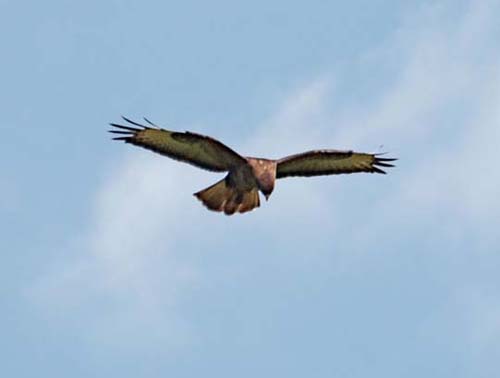
I was driving home from lecturing today and saw a hawk,   still in the sky, hovering over the field, its eyes fixed on prey somewhere far below. I do not know why but this sight always makes me catch my breath; I always feel that I am before  a thing of beauty.  And it brought home to me again how animals simply are true to their nature, and follow their essence, without worrying too much about the meaning of it. They are, in some ways, “simple”  – in the sense that the medieval writers used to talk about God –  in the unity of their being and their actions. They are not divided within.

We, on the other hand, are frequently only too aware  of the divisions within ourselves ,  of  ongoing tensions, of a separation from our deepest self.  We may spend our lives seeking a greater unity and a simple,  undivided self, but on a day-to-day level are most conscious of how much we observe ourselves  from outside.  We are rarely just one., with ourselves or with our experiences.  As I listened to the class today sharing their stories, I realized yet again how difficult it is to achieve the wholeness and simplicity we desire. Everyone forms ways of behaving  – or defenses  – as they are growing up, to cope with the  demands and dangers of experiences that threatened them emotionally – caused maybe  by  parents’ imperfections or ways that they felt left down. And thus some arrive in adulthood with structures which allow them keep going in safety, but which at the same time can keep them severely limited in their fears and lack of ability to trust. Or others arrive with huge conditions placed on their worth – tied to others’ approval or to the necessity to  strive, to achieve success or push themselves in work. They look outside themselves for the solutions to the emotional templates formed within when young.

We find it so hard to simply be ourselves, to believe that this is enough, that it is a safe place to be.  We look to always add something to ourselves, or to this moment,  to feel secure. And yet, looking at the hawk today,  in its stillness, what strikes me most is the absence of something, maybe the absence of striving, the resting in just what  it is –  the ability to just be still  and secure with that.  We too need to relax into our own being, to let go of the patterns we have built up to protect ourselves, to trust that who we are, deep down, is enough.

We all have well-established habits of thought, emotion, reaction and judgement, and without the keen awareness of practice, we’re just acting out these patterns. When they arise, we’re not aware they’ve arisen. We get lost in them, identify with them, act on them — so much of our life is just acting out patterns.

Joseph Goldstein
Who are you comparing yourself to this day?

A samurai, a very proud warrior, came to see a Zen Master one day. The samurai was very famous, but looking at the beauty of the Master and the grace of the moment, he suddenly felt inferior.

He said to the Master, “Why am I feeling inferior? Just a moment ago everything was okay. As I entered your court suddenly I felt inferior. I have never felt like that before. I have faced death many times, and I have never felt any fear — why am I now feeling frightened?”

The Master said, “Come outside.”

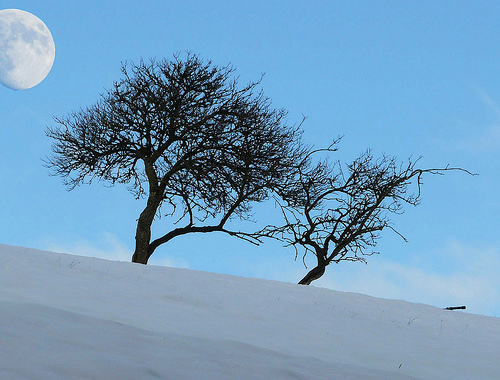
It was a full moon night, the moon was just rising on the horizon. And he said, “Look at these trees. This tree is high in the sky and this small one beside it. They both have existed beside my window for years, and there has never been any problem. The smaller tree has never said to the big tree, ‘Why do I feel inferior before you?’ This tree is small, and that tree is big — why have I never heard a whisper of it?”

The samurai said, “Because they can’t compare.”

The Master replied, “Then you need not ask me. You know the answer.”

Zen Parable

The power of the past and the future

If my happiness at this moment consists largely in reviewing happy memories and expectations, I am but dimly aware of this present. I shall still be dimly aware of the present when the good things that I have been expecting come to pass. For I shall have formed a habit of looking behind and ahead, making it difficult for me to attend to the here and now. If, then , my awareness of the past and future makes me less aware of the present, I must begin to wonder whether I am actually living in the real world.

Alan Watts

Early Spring morning walk

Walking the lanes near my house early this morning, with the spring chorus of the birds. At times one is just struck by the beauty and freshness of nature.  Practice is easy then. Nothing needs to be added to this moment or to this step. We need not worry about getting anywhere, or measuring up or competing the journey. Just this step, and this moment, that bird singing, those three ducks flying overhead.

What activity is most important in your life?  To pass an exam, get a car or a house, or get a promotion in your career?  There are so many people who have passed exams, who have bought cars and houses, who have gotten promotions, but still find themselves without peace of mind, without joy, and without happiness.  The most important thing in life is to find this treasure…  In order to have peace and joy, you must succeed in having peace within each of your steps.  Your steps are the most important thing.  They decide everything.

But often in our daily life, our steps are burdened with anxieties and fears.  Life itself seems to be a continuous chain of insecure feelings, and so our steps lose their natural easiness.  Our earth is truly beautiful.  There is so much graceful, natural scenery along paths and roads around the earth!   They are all available to us, yet we cannot enjoy them because our hearts are not trouble-free, and our steps are not at ease.

Thich Nhat Hahn

What arises, ceases.

The past is a memory… Remembering is a condition that arises and ceases. It has no core or substance. When you explore memories,  you stop believing in them so strongly, and you no longer live in their world, assuming all kinds of things from just remembering.  “Panna”  in this sense is being aware of the way it is, rather than holding views, opinions and emotional reactions to memories. Or applying this to people : Where is that person right now? They are just a memory that arises. In the reality of this moment, what we remember of them is a condition of the mind that arises and ceases in the present. This way of reflecting helps us break down the illusion that people are permanently what we think.

Ajahn Sumedho

Where suffering begins


The origin of suffering – the idea that we need to have something, become something  or get rid of something – has the power to get any of us heated up.

It is the mind’s relationship to the senses that is the problem


Ajahn Sucitto, Turning the Wheel of Truth