Good days and bad days

Níl aon suáilce gan a duáilce féin.  Irish Proverb

(lit. There is no virtue that does not have its own vice = There are no unmixed blessings in life)

Acceptance of life’s up and down’s may be a wiser way to start the New Year  and may  reflect the wisdom worked out over the centuries in some of the religious and wisdom traditions.  However, it does not mean that it is easy to do. The fact that we are continually surprised and upset by changes in our life is testimony to the resilience of our belief in – and wish for – something unchanging and permanent. We want things to last, to stay as they are, as indeed sometimes they should. Therefore, every time we have an experience that brings us face to face with the reality of impermanence, such as when someone moves away, a friendship ends or we lose something we care about, we suffer, sometimes deeply. It  is a reminder that it is in the nature of the human heart to form attachments, and of the flip side of being fully involved in life. However, when we come to really understand that things are not guaranteed to remain the same, or that people are not always consistent , it frees us from always reading what happened as a story about us. It also saves us from defaulting to the usual pattern of interpretation that we use, such as that we are to blame or that we did not try hard enough.

It would seem that some awareness of the impossibility of holding onto things exactly as we would like to has been around since time began.  Different cultures have tried to understand it in different ways. We can see this in the Irish proverb quoted at the start of the post. The Ancient Greeks tried to understand it by blaming the gods. As we can see in this extract from the Iliad, they believed that humans received either a mixture of up’s and down’s, good and evil, or received suffering, but never received pure good times that lasted forever: On the floor of Jove’s palace there stand two urns, the one filled with evil gifts, and the other with good ones.  He for whom Jove the lord of thunder mixes the gifts he sends, will meet now with good and now with evil fortune; but he to whom Jove sends none but evil gifts will be pointed at by the finger of scorn, the hand of famine will pursue him to the ends of the world, and he will go up and down the face of the earth, respected neither by gods nor men.
Preparing for a new year

As yesterday’s post said, people begin to look forward to the new year as an opportunity to start again. This is natural, but frequently does not lead to any real change, unless we understand the patterns within our own heart. Any lasting growth comes from  an understanding of our heart, with all its needs and hopes, its vulnerabilities and wisdom.  This means that we can drop all pretense and the need to blame others for what is lacking in our lives.  In many cases the desire for change around this time is based on comparing our lives with others and feeling we are lacking.  Instead of looking outward, we turn within and gently look forward – not based on fear of where we are now or criticism of this past year – but rather accepting who we are and opening to the new opportunities which will unfold.

Your vision will become clear only when you look into your heart.

Who looks outside, dreams. Who looks inside, awakens.

C.G. Jung

Throwing plates out the window

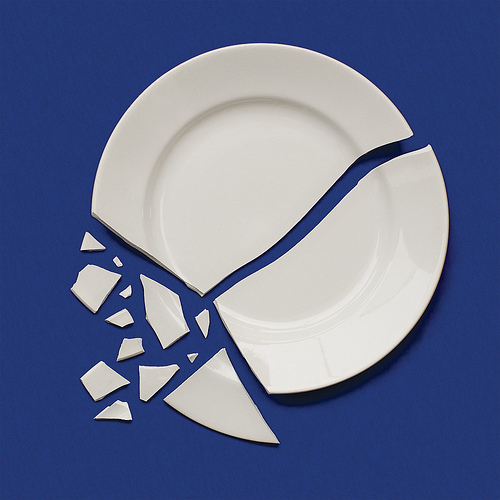
When I lived in Rome, New Year’s Eve was a noisy affair, with fireworks in most households and the old custom of throwing plates out of windows. This practice, more honoured nowadays in the South of Italy, was meant to get rid of all of the negative events and influences of the old year, so you could start the new one with renewed strength and enthusiasm. It maybe corresponds to a human need around this time of year, as we can see something similar in the Times Square Good Riddance Day which was held yesterday. People were invited to bring their worst memory from 2010, write it down and shred it, getting rid of it once and for all.

We probably all have some things from this past year that we are glad to get rid of. I know I have. It can be useful to consciously let go of those things and move on.  It may mean that you have to say yes to things that did not go as you wanted but cannot now change. This  does not mean that you are suddenly happy or at peace about everything, or have come to understand the meaning of any of it. You do not need to know all the answers.  It just means that at some stage you have decided to move on and find a new outlook on life, trying to integrate the losses and everything you can learn from them. You may have to live with some sadness, while trying to live without regret. You accept it and give yourself permission to move on.

The slight problem with the way that the Times Square event was named is that it plays into our need to blame others or justify ourselves when things do not work out. One way of dealing with  experiences we do not fully understand is to protect ourselves and ensure that we minimize hurt by needing to feel that we are in the right. Thus we may turn all our upset into anger towards the other and ensure that we “win”.  We blame them for the decision and freeze them into that moment.  However, what we need to realize is that we all get lost from time to time. Maybe we learn more about ourselves that way. The famous physicist Hermann von Helmholtz compared growing in knowledge to climbing a mountain. You do not proceed in a direct line up the mountain. You go round, crossways, zigzag, retrace steps, and on and on in this fashion until you arrive at the peak. From there you can see all the way down as if in a straight line.  But it was not that way coming up. Growth is that twisting path, those zigzags where we learn, the stumbling, the turning back. We are moving onwards, even when we feel we are not. Now that we have arrived at a point in the journey we may need to look at some of those twists and turns  where we got lost and simply let them go. There are more mountains to climb.

Fog and living moment to moment

Dark and foggy. The mountains hidden. All we can be sure of is this moment. We do not really know what the future holds. We construct the future not by dreaming how we would like it to be,  but by living the reality of what is in our life at this moment.

The future is completely open,

and we are writing it moment to moment.

Pema Chodron

Looking forward

One’s life shrinks or expands according to one’s courage

Anaïs Nin

Natural cycles

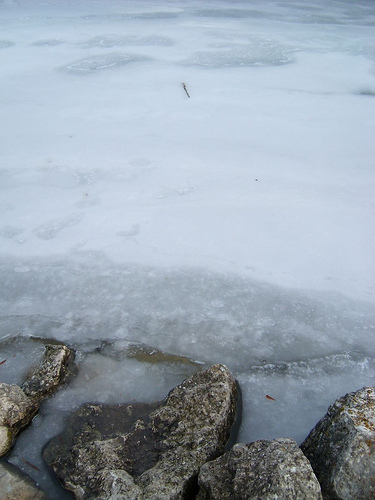
Went walking early yesterday alongside the lake in Divonne. It was completely frozen,  a barren landscape.  The bare trees were stripped down to their essentials, the ground hard. The ducks and swans were walking on the surface of the lake, white in the cold morning air. One wonders what they eat, if they will survive this cold, if the natural cycles are too hard for them. For us too, there are natural cycles, natural learning. Sometimes it may feel like a struggle to just survive. At other times it seems that we are in different phases of growth, such as when we arrive at the end of a year.  One thing we do at this time is look back and see what will grow into next year and what to let go of.

Every year
everything I have ever learned

in my lifetime
leads back to this: the fires
and the black river of loss
whose other side

is salvation, whose meaning
none of us will ever know.

To live in this world

you must be able
to do three things
to love what is mortal;
to hold it

against your bones knowing
your own life depends on it;
and, when the time comes to let it go,
to let it go

Mary Oliver