Qualities for a full life

File:Glasblaeser.jpg

Rumi’s advice for us if we want to fully take part in the dance this year. Courage to make the first step will always be a good idea….

There’s courage involved if you want

to become truth.  There is a broken-

open place in a lover.  Where are

those qualities of bravery and sharp

compassion in this group?  What’s the

use of old and frozen thought?  I want

a howling hurt.  This is not a treasury

where gold is stored; this is for copper.

We alchemists look for talent that

can heat up and change.  Lukewarm

won’t do. Halfhearted holding back,

well-enough getting by?  Not here.

Rumi

Sunday and New Year Quote: Just Dance

File:U.S. Navy Cryptologic Technician Technical 3rd Class Emily Garcia-Delgado dances with a child at the Thanh Tam Special School while members of the U.S. 7th Fleet Band ensemble Orient Express perform in Da Nang 110717-N-XR557-090.jpg

Every child has known God

Not the God of Names

Not the God of Don’ts

Not the God who never does anything weird

But the God who only knows four words

And keeps repeating them, saying

“Come Dance with Me”

Come Dance.

Hafiz

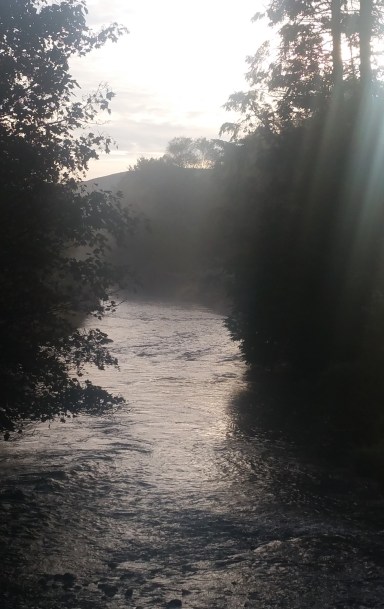
Not rushing to fix ambiguities

dark-river

The period between Christmas and New Year has a distinct tone and  a change of rhythm. There is an intensity about the Christmas period which can stir us up; to add to this we will soon be bombarded by the messages of New Year resolutions and dramatically  fixing our lives. So one or two posts about how to deal with this time, when the temptation is often to make abrupt changes in the face of the different parts of our lives.

There is a certain type of uncertainty which is just part of being human, and which we cannot control, such as that which comes from illness. This fundamental ambiguity – the unsatisfactory nature of life and of circumstances  – is always there in the background. It can be accentuated at periods like Christmas, and we intensify our efforts to get solid ground. So the dilemma is how to live wholeheartedly as adults in the realization that some elements will always be displeasing and we are never fully going to get it all together. How can we hold different parts together  – “manage the grey” – when we prefer things to be simply black or white: 

Most of us are uncomfortable when things are undefined, when things are not clearly to or for, up or down, left or right, or right or wrong. But the deeper truths always take time to reach us, and it is our job to enter a practice of waiting openly – which involves enduring the tensions of not-knowing. The truths that matter require us not to form opinions or beliefs hastily. On the contrary, we are asked to allow time to surround us with the Wholeness of life, to take the time required for the paradox of truth to show itself. It seems that the practice of not-knowing begins with a trust in the unnameable space that holds us, in the mysterious atmosphere in which we all live. That seems to be the true space of listening and learning, where our brief experiences of life in its totality, whether harsh or calm, will not fit into our tidy little maps of perception.

Mark Nepo

Choosing light …and life

File:Chinese floating lotus lanterns.jpg

Today is the Winter Solstice, the shortest day of the year in the Northern Hemisphere, when the sun delivers the fewest hours of sunlight. I have posted on it in different ways over the years, sometimes encouraging the balance of light and dark in our lives, but today I will do as the ancient Celts did, and remind myself of the victory of  light and life, not letting darkness have the last word:

There are moments that cry out to be fulfilled.
Like, telling someone you love them.
Or giving your money away, all of it.

Your heart is beating, isn’t it?
You’re not in chains, are you?

There is nothing more pathetic than caution
when headlong might save a life,
even, possibly, your own.

Mary Oliver, Moments

photo mike

On being amazing and perfect

tree

When entering a supermarket store on Saturday I was greeted with a banner telling me that shopping there would make this Christmas “the most perfect ever”.  This desire for perfect conditions  is necessary when we are young, in order to allow the development of a stable self. As the English psychoanalyst Winnicott said,  “the mind has a root in the need of the individual, at the core of the self, for a perfect environment”. However, as the child grows,  its capacity to live with a less than perfect environment develops and the mother just has to be “good enough” in an ongoing committed relationship rather than being perfect in every instance. And it is the same for us as adults.

Our lives are always a work in progress, with moments  of failing followed by repairing, integration mixed with disintegration.  Despite what we sometimes think and express from time to time,  we don’t really need perfection. We push ourselves hard enough due to that false belief. That things go wrong – despite our best efforts – is just part of the human condition. What we really want is to be seen as we are – not completely sorted out –  and for that to be good enough. 

It’s odd in a way, this business of Perfect Christmasses. The story of the first Christmas is the story of a series of completely unplanned, messy events – a surprise pregnancy, an unexpected journey that’s got to be made, a complete muddle over the hotel accommodation when you get there… Not exactly a perfect holiday.

But it tells us something really vital. We try to plan all this stuff and stay in charge, and too often (especially with advertisers singing in our ears the whole time) we think that unless we can cook the perfect dinner, organise the perfect Christmas, we somehow don’t really count or we can’t hold our heads up. But in the complete mess of the first Christmas, God says, ‘Don’t worry – I’m not going to wait until you’ve got everything sorted out perfectly before I get involved with you. I’m already there for you in the middle of it all, and if you just let yourself lean on me a bit instead of trying to make yourself and everything around you perfect by your own efforts, everyone will feel a little more of my love flowing’.

Archbishop of Canterbury, Pause for Thought, BBC Radio 2.

A way of holding

File:Noah's hand.jpg

More on butterflies and lightness in dealing with the daily events, or more precisely, the thoughts they give rise to :

For years and years I struggled
just to love my life. And then
the butterfly
rose, weightless, in the wind.
“don’t love your life
too much,” it said,
and vanished into the world.

Mary Oliver, One or Two Things

photo andre engels