New to Mindfulness Practice 6: Notice the breath

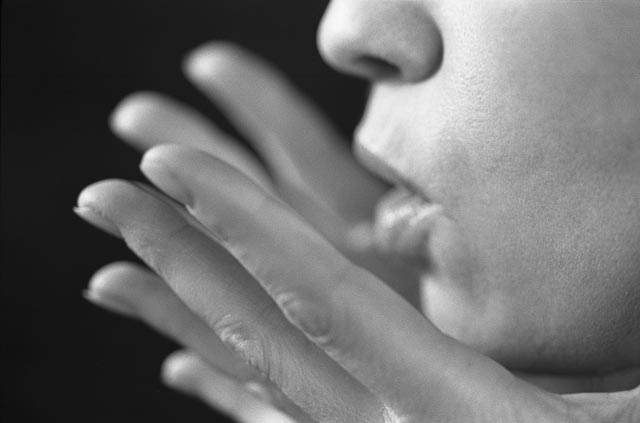
As you start the practice, you have a sense of your body and a sense of where you are, and then you begin to notice the breathing. The whole feeling of the breath is very important. The breath should not be forced, obviously; you are breathing naturally. The breath is going in and out, in and out. With each breath you become relaxed.

Sakyong Mipham Rinpoche

New to Mindfulness Practice 3: Patient learning….

[Learning to meditate…..] is like a child who is learning to write. At first she doesn’t write nicely – big, long loops and squiggles – she writes like a child. After a while the writing improves through practice. Practicing meditation is like this. At first you are awkward… sometimes calm, sometimes not, you don’t really know what’s what. Some people get discouraged. Don’t slacken off! You must persevere with the practice. Live with effort, just like the child: as she gets older she writes better and better. From writing badly she grows to write beautifully, all because of the practice from childhood.

Ajahn Chah

Stopping for breath

The difficulty most of us face is that we’re afraid of our humanity. We don’t know how to give our humanity space. We don’t know how to give it love. We don’t know how to offer our appreciation. We seize upon whenever difficult  emotions or painful thoughts arise – in large part because we have been taught from a very early age that life is a serious business. We’re taught that we have to accomplish so many things and excel at so many things because we have to compete for a limited amount of resources. We develop such high expectations for ourselves and others, and we develop high expectations of life. Such a competitive, goal-orientated approach to life makes us very speedy inside. We become so tight physically, mentally  and emotionally as we rush through each day, each moment, that many of us forget – often quite literally – to breathe.

Tsoknyi Rinpoche, Upgrading our Practice

Starting over and over again

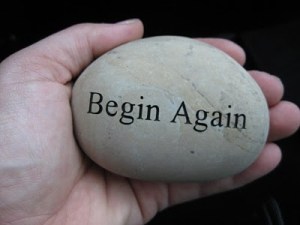
As I said in this morning’s post, mindfulness practice renews itself every day, as we start over again and again, returning to the present moment which is always different, always new. This is because life is continually changing, and what we are presented with today is not the same as yesterday, no matter what our thoughts tell us. So the underlying attitude is key: a gentle, non-judging, attitude towards ourselves and our efforts.

I first heard the phrase “just start over”  some 20 years ago from the meditation teacher Sharon Salzburg….who told us about her own struggle with learning to meditate – how she would become lost, distracted, and discouraged and would constantly second-guess herself and her teachers. Gradually she learned to pay no attention to the mental and emotional chatter and to just start over by meditating on her breath as she had been instructed. “Just start over” became her mantra, which she now teaches to her students.

Each time Salzburg repeated this phrase, I was deeply inspired. I realized that she was pointing to a radical attitudinal shift in which you cease to be reactive when you are knocked off your intended path. Instead, when you discover that you have lost your focus, you just begin again without getting caught up in emotional stories about why you can’t achieve your aim or judgments about how unworthy you are or why the change you seek is impossible.

As you know if you’ve ever tried to meditate, the mind is constantly being pulled away from its object of concentration by bodily sensations and mental activity, causing you to lose awareness of the present moment. In this same way, when strong feelings arise during your daily life, you get swept up in the story they create. You lose the awareness that enables you respond skillfully to events and that gives you peace of mind in the face of difficulty….. You have the mistaken notion that you must know why you have a problem and must get rid of it before you can act in a more self-empowering manner. Starting-over practice takes a different approach. It switches your focus away from dwelling on those characteristics that limit you and redirects it toward recognizing your strengths from which you can realize your potential…. In so doing, you free yourself from your judging mind that thinks it can control results and creates the grandiose expectation that you can do more than you can do in the present moment. You become a more effective person by simply learning to use your time and energy to do what you can do right now.

Phillip Moffitt, Starting Over

The eye of the storm

One reason why people  meditate is to remain calm and focused in the face of the storms and pressures which face they encounter each day.  Here Ajahn Sumedho breaks down how to do that, in practical terms.  The simple ability to be aware – which we all have –  is the key.  Awareness is the calm place from which we can observe and notice those things that  change – moods, good and bad, thoughts, positive and negative – without trying to hold on to them, or becoming identified with them. This is how we can remain at the eye of the storm and not get blown by the winds. We are aware of what we are feeling emotionally, but do not get caught up in it by analyzing it, judging it, or becoming it.

The stillpoint, the centredness, that’s awareness. When I cannot notice it and go out into the turning world, I become a person and get caught in my habits, my loves and hates, my likes and dislikes.  But if I am centered at this point, it’s like the island you cannot go beyond, or the stillpoint of the turning world, the eye of the storm. And then the world revolves around it. The mood you are in is not the stillness. The mood comes and goes. It changes, revolves; it’s happy, sad, elated, depressed, inspired, bored, loving, hateful, and on and on like this….It’s so easy to say “I’m in a bad mood” or “I’m in a good mood” Our langauge is like that, so we become the mood – “I feel happy today, everything’s fine” or “Today is one of my bad days”. That’s why I encourage this investigation of thought, so that you are not creating yourself, endlessly reinforcing the sense of self through your proliferating thoughts.

Ajahn Sumedho, The Sound of Silence

Elephants and fleas

Sometimes when our thoughts are like little fleas that jump off our noses, we just see the little flickers of thought, like ripples, which might have a very liberating quality. For the first time you might feel ” My goodness! There’s so much space, and it’s always been here.”   Another time it might feel like that elephant is sitting on you. It’s important to realize that meditation doesn’t prefer the flea to the elephant, or vice versa. It is simply a process of seeing what is, noticing that, accepting that, and then going on with life, which, in terms of the technique, is coming back to the simplicity of nowness, the simplicity of the out-breath. Whether you are completely caught up in discursive thought for the entire sitting period, or whether you feel that enormous sense of space, you can regard either one with gentleness and a sense of being awake and alive to who you are. Either way, you can respect that. So taming teaches that meditation is developing a nonaggressive attitude to whatever occurs in your mind. It teaches that meditation is not considering yourself an obstacle to yourself; in fact, it’s quite the opposite.

Pema Chodron