
Meditation in its simplest sense

The word ‘meditation’ can mean all kinds of things. It’s a word that includes any kind of mental practices, good or bad. But when I use this word, what I’m mainly using it for is that sense of centring, that sense of establishing, resting in the centre. The only way that one can really do that is not to try and think about it and analyse it; you have to trust in just a simple act of attention, of awareness. It’s so simple and so direct that our complicated minds get very confused….The more I pay attention and I’m aware, the more I recognise that in this still point there’s this resounding sound of silence.

Ajahn Sumedo
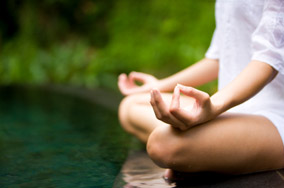
Today, cultivate aloneness

It’s very easy to avoid being alone – there are so many distractions. However, in one sense we are always alone in our experience…. Without solitary time there is no chance to reflect on your life and find wisdom.  My advice is to cultivate aloneness as a habit – even for just five or ten minutes a day.  See what it’s like.  Sit there and allow whatever intrigues or bores or scares you to arise. The energy you spend in fearful reaction to things is much greater than the energy it takes to look at them. Out of that time come amazing things: insight, creativity, courage, self-knowledge – and truth.  I promise. 

Susan Piver

First Steps in Mindfulness Day 9: Noticing thoughts as thoughts

“This is boring” or “This is not working”, or “I can’t do this”.

These are judgments. Actually they are just thoughts.

It is important to recognize them as judgmental thinking and remind yourself that the practice involves suspending judgment and just watching whatever comes up, without pursuing them or acting in any way

Jon Kabat Zinn

Its not in the future, but here today

Mindfulness encourages us to pay attention and rest in what is happening in the present moment.  However, we often prefer to be elsewhere, or that the present moment be other than what it actually is. What we learn through our practice is the key to finding contentment is to be fully present with whatever we are doing, no matter how ordinary. This realization that the fulness of our lives is right in front of us, and not to be found in the future, is an insight found in all wisdom traditions and leads to true contentment .

The everyday tedium of our lives is the desert we wander, looking for the Promised Land. Our relationships, our work, and all the little necessary tasks we don’t want to do are all the gift. We have to brush our teeth, we have to buy groceries. we have to do the laundry, we have to balance our checkbook. This tedium — this wandering in the desert — is in fact the face of God. Our struggles, the partner who drives us crazy, the report we don’t want to write — these are the Promised Land.

Charlotte Joko Beck

Being mindful of everything today

In our dally lives, we should be mindful. What does it mean to be mindful? It means to be fully aware right here, concentrating on what is going on inside. We are looking at something, for instance, and we try to concentrate on that; then a sound comes, and then a smell, then this and then that-distractions, changes. We say: ‘I can’t be mindful of this environment; it’s too confusing. I have to have a special environment where there are no distractions, then I can be mindful. If I go to one of those retreats, then I can be mindful; no distractions there-peace and quiet-noble silence! I can’t be mindful in Edinburgh or London – too many distractions. And I’ve got family, children, too much noise!’

But mindfulness is not necessarily concentrating on an object. Being aware of confusion is also being mindful. If we have all kinds of things coming at our senses-noises, people demanding this and that-we cannot concentrate on any one of them for very long. But we can be aware of the confusion, or the excitement, or the impingement; we can be aware of the reactions in our own minds. That is what we call being mindful. We can be mindful of confusion and chaos. And we can be mindful of peace and tranquillity.

Ajahn Sumeho

Heaven, Hell and Limbo

Contemplate beginning. When you think of birth you think of ‘I was born’, but that is the great birth of the body, which we can’t remember. The ordinary birth of ‘me’ which we experience, in daily life is ‘I want, I don’t want, I like, I don’t like.’ That’s a birth, or seeking to be happy. We contemplate the ordinary hell of our own anger, the anger that arises, the heat of the body, the aversion, the hatred we feel in the mind. We contemplate the ordinary heaven we experience, the happy states, the bliss, the lightness, the beauty in the here and now. Or just the dull state of mind, that kind of limbo, neither happy nor unhappy, but dull, bored and indifferent. In meditation we watch all these within ourselves.  So in practice we are looking at the universe as it is reflected in our own minds..

Ajahn Sumedho