Developing your Meditation Practice, Stage 1 continued

The first of these posts talked about placement – we consciously place our awareness on the breath, intentionally moving away from whatever activity we were doing before.  At the same time, just as we sit down to practice, we simultaneously form our intention. One Zen teacher once gave a conference speech in which he summed up the whole of meditation in two words – “intention” and “attention”. S o the first stage in meditation involves forming an intention, right at the start,  the moment one sits. Our intention should be something like, I will use this period to consciously observe the mind and get to know it better. In a sense, we set a gentle model for our activity over the next twenty or thirty minutes.
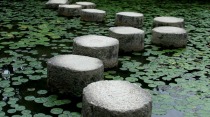
Why is this so important? Because if we rush into sitting without consciously being aware of changing our activity and forming our intention we can find the mind wandering very quickly. After a minute or two we find ourselves in the same daydreaming we were involved in for much of the day or continuing the activity we have just finished. We may very quickly fall into the activity of checking how we are doing in this meditation and comparing it to yesterday’s or to a model of meditation which we have in our heads.

So the first stage in meditation is focused on how we sit. It seems obvious but is of vital importance. If we start well there is a greater chance that our whole sitting will go well. In the next post we will look at stage two, how to work with thoughts.


Alone

Sometimes it is healthier to be alone. There are times in life when it is right to choose it – to move from the fear of being alone, to the ability to savour it. Mastering this ability is all about living a life in which we can feel whole and happy inside ourselves, and can take care of ourselves emotionally.

This capacity to be alone is one of the most important signs of maturity in emotional development. In Winnicott’s theory of the development of the self, our ability to be alone is formed through the awareness of a stable loving presence. When we are secure in the knowledge of being cared for, we develop the capacity to be by ourselves. If that knowledge was not formed fully when we were little, we can sometimes throw ourselves into relationships and activities in later life because we do not like being with ourselves. Being able to be alone is the best preparation for healthy relationships because it is founded on a security deep inside and we are not using the relationship to run away from our insecurities.

Therefore, the best model for later life is the child playing contently by itself. Maybe this is why sitting practice is so effective; through it we learn to sit with ourselves, allowing our fears and anxiety arise and pass away without giving them undue space. We can develop strong roots, content in ourselves, at home in the silence, not running, planted firmly.

Therapy is completed when a child can play alone
Winnicott

A soft day

In Ireland the term ” a soft day” is used to describe a day with very light rain. Traditionally people would say “It’s a soft day, thank God”, even if it had been raining for weeks and was miserably cold …which probably demonstrates that – or maybe explains why – the Irish are entirely mad. Today, there has been gentle snow falling all day, an alpine equivalent of the Irish soft rain. It falls gently, persistently, on top of the snow already lying on the garden, without a sound, snow on snow.

When we practice we try and take a light touch, not taking ourselves too seriously. We also try to lightly use the breath as an anchor, not thinking of the breath but gently dropping in on it, like the gentle touch of this soft snow. We also soften our posture as we sit, not needing to force or strain, as sitting is dropping into the natural and gentle calm that exists inside us. We just let ourselves settle gently.

It is good to work in this way; It is so easy to be harsh with ourselves, in practice and in life.

Stop Running

“Don’t turn away.
Keep your gaze on the bandaged place.
That’s where the light enters you.”

Rumi

This quote has been helpful regarding facing my fears. The earlier chapters of my book chronicle all of the disorders I experienced as a child and teenager-OCD, anorexia, substance abuse. I kept running away from the sadness and the depression, which would morph into these other illnesses. So when I finally sat tight long enough to feel the raw depression, that’s when I could begin to heal. As you know well, I think taking a moment of silence to pray or meditate or center ourselves everyday should be part of everyone’s treatment … because when we stop running, we are able to hear what we most need to be whole.

Therese Borchard, author of Beyond Blue: Surviving Depression & Anxiety and Making the Most of Bad Genes

Meditation and Insomnia

Meditation may be an effective behavioral intervention in the treatment of insomnia, according to research presented in June 2009. Results indicate that patients saw improvements in subjective sleep quality and sleep diary parameters while practicing meditation.

The study divided participants with chronic primary insomnia into two groups. Primary insomnia is sleeplessness that cannot be attributed to an existing medial, psychiatric or environmental cause. One group practiced yoga and meditation while the other group, the control group, didn’t. At the end of the two-month-long trial, the patients who practiced yoga/meditation experienced improved sleep quality and sleep time. Sleep latency, total sleep time, total wake time, wake after sleep onset, sleep efficiency, sleep quality and depression all improved in the patients who used meditation. “Results of the study show that teaching deep relaxation techniques during the daytime can help improve sleep at night,” said Ramadevi Gourineni, MD, director of the insomnia program at Northwestern Memorial Hospital in Evanston, Ill.

Ramadevi Gourineni, et al. “Effects of Meditation on Sleep in Individuals with Chronic Insomnia” American Academy of Sleep Medicine. Abstract ID: 0874.

Meditation

Sitting meditation is the most common kind of meditation, but we can also practice meditation in other positions, such as walking, standing, and lying down. When we wash clothes, chop wood, water the vegetables, or drive the car – wherever we are, whatever we are doing, in whatever position our body happens to be, if the energies of mindfulness, concentration, and insight are present in our mind and body, then we are practicing meditation.

We do not have to go to a temple, a church, or a meditation center to practice meditation. Living in society, going to work every day, looking after our family, are also opportunities for us to practice meditation. Meditation has the effect of nourishing and healing, body and mind. And it brings the joy of living back to the practitioner and to those in her life.

Thich Nhat Hahn