
The first snow

Last night the first snow of this winter fell, and this morning awoke cold and grey. Just ten days ago we were having unusually warm and sunny autumn. The change feels sudden and even though it was clear that winter was on its way, it can leave us feeling surprised. Frequently things that happen outside of us have an impact on how we view life and the weather is no exception. In this way it becomes an interesting teacher and metaphor for us. We can learn about our mind seeing how it responds to something new. The most important thing is not the weather but to see that the change is mostly inside us and not in the world around us. Things, like the weather, are a given; happiness – or unhappiness – comes from our response to that given.

One thing that strikes me is that sudden change is not unusual and is frequent in nature. However, we tend to see it as an interruption and try and hold on to things remaining the same. We seem to instinctively be always plotting  to make some moments last forever.  The weather teaches us that no matter how much we wish or try to control things, tomorrow may not look the same as today. Some things will change or end. People move away; relationships end; airports are closed. We can work with these events when they happen. But for the moment all we have is today. We try and make  living well, each moment,  our focus.

The second thing that strikes me is that our moods can change as suddenly as the weather does. Sometimes our days can seem dark and bleak and cold. And that can seem very bad to us. However, maybe some low moods can be just natural changes or periods of calm. Maybe our psyche or soul has need of some rest, for its own good reasons. It may not always be a problem that needs to be fixed but rather a period of growth that has its own lessons. Just as the seeds are growing under the snow-covered soil this morning, things are coming to birth whether we notice it or not. Our instinct and modern society tells us to move away from low periods and that life is equated with movement. Nature reminds us that life is not always obvious growth, and does not always have to be bright. There is a time to be patient as we wait for new life to blossom forth.
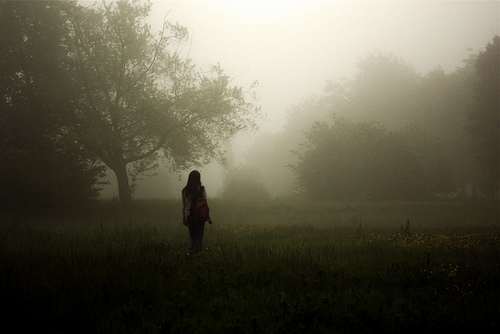

Can we get a bailout from our fear?

Was listening to the radio from Ireland earlier this evening. It is striking to note how economic uncertainty generates fear, and this fear can cause so much turmoil. It shows us how much we like the illusion of knowing where we are going  and get so anxious when we realize that so many things are outside our control. At times like this we can see people feeling  unprepared and scared in what they see as a harsh and hostile world.

Cetainly, when times are difficult it is only natural  to feel sorrow, fear, despair, confusion, discouragement, and so on. It is however, striking to note how quickly we move to think that something is wrong with us. We seem to think that it is our right to feel that things should go well for us, and that if we start to feel depressed, lonely, or inadequate, that something has gone wrong with the plan for our lives. True, it is natural to have  fears that arise from time to time in response to real situations. However what we notice is that an underlying presence of fear is often in the background  throughout our days and that seems to be something that we simply have to work with. We cannot turn to outside distractions to bail us out. Each day a lot of our time is often simply concerned with dealing with this presence. Our practice teaches us one way : to sit with these feelings and to see them, like other mental events, as passing through the mind, and stop them before they develop into the full-blown fear that makes practice difficult. We try to stay with the felt experience in our bodies, and separate that from the storylines which so easily arise. I know this in theory, and can do it today becaue the economic siutuation in Ireland does not affect me  as I no longer live there. However, in other matters, closer to home, I do not find it as easy. I get hooked too easily in the storyline and identify with it, believing its “truths” about me and my lack of strength, and get uncertain about my direction and my goals.

Fear spreads; it is our constant companion. It seems to be the default position of our minds. Our practice is essentially how to work with it and continually soften out hearts in the face of it. Wisdom comes from accepting that good times happen and bad times happen. We try to be present no matter what.

We cannot be in the present moment and run our story lines at the same time. Impermanence becomes vivid in the present moment; so do compassion and wonder and courage. And so does fear. In fact, anyone who stands on the edge of the unknown, fully in the present, without a reference point, experiences some fear. That’s when our understanding goes deeper, when we find that the present moment can be completely unnerving and completely tender at the same time.

Pema Chodron, Comfortable with Uncertainty

We see life from how we label our experience

Have you ever noticed that
when you get on the highway at rush hour
that it is everyone else who is the traffic,
never you?

Ajahn Armaro.

Watching the leaves float by

Our thoughts are always happening. Much like leaves floating down a stream…If you are standing by a river and a leaf floats by, you have your choice of following the leaf with your eye or keeping your attention fixed in front of you. The leaf floats out of your line of vision. Another leaf enters…and floats by. But as we stand on the bank of the river and the leaves float by, there is no confusion as to whether or not we are the leaves. Similarly, it turns out that there is a place in our minds from which we can watch our own mental images go by. We aren’t our thoughts any more than we are the leaves.

Ram Dass and Paul Gorman

the mind is always judging

The habit of judging our experience locks us into mechanical reactions that we are not even aware of and that often have no objective basis at all. These judgments tend to dominate our minds making it difficult to find any peace wihin ourselves.

It is as if the mind were a yo-yo going up and down on the string of our own judging thoughts all day long.

Jon Kabat Zinn

Practicing mindfulness in daily life 1.

One way of developing a more conscious approach to life is to create gaps during the day, short moments where we pause and pay more deliberate attention to what we are doing. This “informal mindulness” practice reduces  the mind’s tendency to over-analyze and compliments the formal practice we do when we are in sitting meditation.

A number of acticvities can be chosen to practice with. It is best to choose a repetitive simple task which you perform on a regular basis. One possibilitiy is taking a shower. While having the shower practice bringing your full attention to the sensations of what you are doing –  touch, taste, smell, sound,  sight – and stay close to being fully present at that level.

So. for example,  you can attend to the sound of the water, as it comes out from the shower, or the touch of it as it hits your body, the temperature of the water. You can be aware of the smell of the soap or shampoo, and the sight of the water drops on the walls or as it goes down the drain. You can focus on the steam rising. Finally, you can be as fully present as piossoible with the movement of the body and the arms.

As in formal practices, thoughts will arise. you simply touch them gently, without judging, and let them go, coming back to practice a greater awatreness of sensations, strengthening your capacity to distinguish between a sensation and a thought.

Peace is something that we can bring about if we can actually learn to wake up a bit more as individuals and a lot more as a species; if we can learn to be fully what we actually already are; to reside in the inherent potential of what is possible for us, being human.

Jon Kabat-Zinn