Meditation is pointless

A friend of mine – who ironically is starting a meditation retreat this week in the US – expressed the opinion not so long ago that sitting meditation was just pointless. I knew what she meant at the time, but knew also that she had to discover its real value for herself.  In one sense she was right – sitting practice is waste of time because it is a dedicated period of non-doing. On an outward level it appears to achieve nothing. Another aspect which she drew attention to was the fact that nothing really changes day to day: you sit, you get distracted, you return to the breath, you get distracted, day after day.

One difficulty in meditation is the the results are not immediately tangible while the actual practice can be difficult. The point to meditation, however, is precisely by doing “nothing” and slowing down, gaps are created between activities and we work on our capacity to be aware of what is going on. And it seems that when one is aware, things tend to fall as they should.

However, we can probably find scientific backing for stating that this “pointless” activity is, in fact, achieving something simply while we are sitting. It has been shown that people who meditate activate a different part of their brain that is associated with less anxiety and a better outlook on life. By not activating the anxious parts of the for dedicated periods of each day, our bodies are less likely to be tense, less likely to trigger well-conditioned patterns when faced with difficulties.

Daniel Goleman & Tara Bennett-Goleman*, suggest that meditation works because of the relationship between the amygdala and the prefrontal cortex. Simply put, the amygdala is the part of the brain that decides, among other things, if we should get angry or anxious, and the pre-frontal cortex is the part that makes us stop and think about things. However, the amygdala is prone to error, such as seeing danger or exaggerating anxiety where there is none. Because there is roughly a quarter of a second gap between the time an event occurs and the time it takes the amygdala to react, the slowing down practicing in meditation may allow us be able to intervene before an automatic response takes over, and perhaps even redirect it into more constructive or positive feelings. In other words, meditation seems to develop emotional brain fitness and therefore this pointless activity may not be pointless after all.

Bennett-Goleman, Tara, 2001. Emotional Alchemy: How the Mind can Heal the Heart, Harmony, (2001).

Mini-Movies and other strategies

We have a tendency to do anything to avoid our life as it actually is –  its unsatisfactory nature, its lack of clarity, the way it can give rise to anxiety. Our fear-driven instinct is to get away, to escape. One way we do this is by imagining a different future, a better place, a life with a better script. This is how Rich Hanson describes it , in his excellent book, Buddha’s Brain:

The brain produces simulations…even when they have nothing to do with staying alive. Watch yourself daydreaming  or go back over a relationship problem, and you’ll see the clips playing – little packets of simulated experiences, usually just seconds long. If you observe them closely, you’ll spot several troubling things:

  • By its very nature the simulation pulls you out of the present moment. There you are, following a presentation at work, running an errand or meditating, and suddenly your mind is a thousand miles away, caught up in a mini-movie. But its only in the present moment that we find real happiness, love or wisdom.
  • In the simulator,  pleasures seem pretty great, whether you are considering a second cupcake or imagining the response you will get to a report at work. But what do you actually feel when you enact the mini-movie in real life? Is it as pleasant as promised up there on screen? Usually not.
  • Clips in the simulator contain lots of beliefs…. In reality,  are the explicit and implicit beliefs in your simulations true? Sometimes yes, but often no. Mini-moives keep us stuck, by their simplistic view of the past and their defining out-of-existence possibilities for the future, such as new ways to reach out to others or dream big dreams.

In sum, the simulator takes you out of the present moment and sets you chasing after carrots that aren’t really so great.

Rich Handon, Ph.D, Buddha’s Brain: The practical neuroscience of happiness, love and wisdom, p., 44.

Sunday quote

Do not expect full realization;

Simply practice every day of your life.

Milarepa

Missing something?

In meditation we are not trying to fix anything about ourselves. It is not about producing change, although change can occur. In a fundamental sense,  it is about being with ourselves and our life as it is. It is not about looking out there, but at ourselves, now, in this moment. It is complete as it is, if we could just see it.

When we start on this path, no doubt we are going for something…. Eventually we realize that we’re actually operating with a very dissatisfied mind, a greedy mind, a hungry mind, that it’s reaching for something.

What is it reaching for? Well, something imagined. Something projected out there. It’s feeling an inadequacy, that somehow we’re missing something. But were we to just settle into what’s actually occurring now in this very moment, there isn’t any straining, or striving, or struggle that’s taking place. It is simply a slowly opening up, awakening to just what is occurring here.

Steve Hagen

Lessons learnt from a little kitten

The lesson of spiritual life is not about gaining knowledge, but about how we love. Are we able to love what is given to us, love in the midst of all things, love ourselves and others?

Jack Kornfield, After the Ecstasy, the Laundry

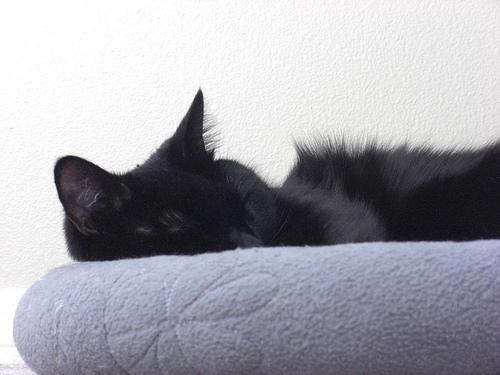
Our neighbours have a new little black kitten, who is just starting to explore her area.  “Minette” as she is called, comes bounding onto our terrasse, with no fear and pure playfulness. She trusts completely, plays easily and then runs away to scamper up the trees at the end of the garden, only to return two minutes later to start over again. She wanders into the house and out again to hide among the olive and geranium flower pots waiting to pounce. Everything is a wonder for her, a piece of string, a blade of grass.

It is so easy to be at ease with and love any creature when they are confident and without fear, when they approach without defenses.  We too were born that way, before our life’s experiences led us to develop caution and defenses.  What we try to do in our practice is to get in touch with the natural confidence and joy which is within us , and which is there before the spinning mind takes over. Meditation is simply learning to stay in that natural calm, moving away from the spinning stories by sitting with the here-and-now.

The last two days were lovely and sunny and I took more time for quiet practice, walking and reading. They were calm,  easy days. Today it rains, so walks outdoors are less an option, but the same calm remains, even with the noise of the heavy rain.  To help myself do this I am concentrating on having a view of this moment, as one that is not attached to any  outcome, just as the little kitten demonstrates. A sense of wonder in the newness of each experience, wonderful in itself, a whole world to discover. Jon Kabat Zinn reminds us that this moment is the only moment which we can be sure of. Whatever is happening in this moment is the best that is, with no need to seek for other outcomes. When I do not focus on an outcome,  I am in less danger of splitting into me and it, or me and them, making the world and my experience  dualistic, dependant on something outside me.

Normally when I am confused or frightened, it is a sign that I have moved from this moment into some story of them and me, good and bad, blame and feeling hurt. And in those moments I find it harder to trust and to love. Letting go of the storylines, however, means that I find it easier to respond to needs beyond my own. So they are all linked: touching into natural confidence leads to joy and joy leads to being able to love. As Jack Kornfields quote reminds us, for real wisdom to open, it has to rest in and demonstrate compassion.  It does not remove us from the fulness of life. Minette shows the way. She plays,  she trusts, she exists fully without always living in her self-centred mind. She is at ease. She loves.

Six Simple Strategies for a Stress-Free Summer, 5.

Allow yourself to be Bored

Summer sometimes marks a change from our usual routines. And even though we may have been looking forward to it, we can sometimes find that we have the thought “I am bored”. To most of us boredom feels uncomfortable and we try to avoid it. We immediately believe the thought and then ask ourselves “what else can I do?” and our head plans and looks for a different activity. This summer, try to notice when you are feeling bored and just sit with it.  Boredom is one of the more interesting thoughts to work with. It tries to draw us away from this moment by suggesting that our lives should be elsewhere. The secret to contentment is being in each moment fully. And sometimes our systems need to do nothing and feel the tension of transition from the rush of our normal lives to a deeper calm.