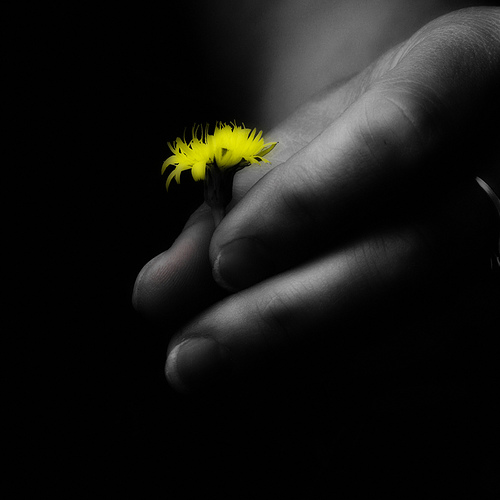
Working with our emotions 2: Stay open and look within

We may never find ourselves in situations of such danger that our lives are endangered; yet anguish and pain are undeniable aspects of our lives. None of us can build walls around our hearts that are invulnerable to being breached by life. Facing the sorrow we meet in this life, we have a choice: Our hearts can close, our minds recoil, our bodies contract, and we can experience the heart that lives in a state of painful refusal. We can also dive deeply within ourselves to nurture the courage, balance, patience, and wisdom that enable us to care.

Christina Feldman

Fear as a constant companion

One more post prompted by recent references to Adam and Eve. These ancient stories attempt to do justice to the fundamental truth of the human condition, using the language  of  those days. And we are told that after they ate of the tree of knowledge, Adam and Eve hid themselves. This simple fact – the need to hide and protect themselves, the existence of judgmental thoughts and guilty emotions – alerted God to the fact that something had changed. When he asked them why they were hiding, Adam replied “I was afraid because I was naked and I hid myself”

As I said, the writers were reflecting on what their own experience was. And it is similar to ours. We feel fear and that leads us to pull back and hide from others, because of the anticipation that we will get hurt. The openness and ease of the original days is not easy to find, even in the closest relationships. And most of us have been hurt along the way, from early childhood onwards. There is a relationship between how reliable things were in our childhood and how confused and difficult our relationships are as adults. So there can be an ongoing struggle between the part of us that loves and the part of us that fears, the part that wishes to be open and be seen and the part that want to protect itself and hide. And so all of us will struggle from time to time to keep believing in love, in allowing ourselves get close to others.

What we can learn from these ancient stories is that some undercurrent of fear has always been present in human history and will likely always be present in our lives. The difference between adulthood and childhood is that we do not have to allow it dominate. We can act in spite of our fears. Mindfulness is based on this same understanding that there are fears  at the heart of life, and that  does not mean there is anything wrong with our life, or with us,  just because we feel them. We do not have to turn this fact into a judgment about ourselves or others. We can choose not to hide. We can work through our fears.

Working with things we wish were different

When meditating I use an App on my phone as a timer. When the timer elapses it rings a bell and a phrase appears on the screen. So for the last two years I have been greeted at the end of my practice by the words Anyone who understands impermanence ceases to be contentious.  By this time I know the words of this ancient phrase very well.  However, I realize there is a big difference between knowing the words and knowing this in reality. Sure, I know that things change, the seasons come and go, and mental states change frequently. But I still have a strong investment in things staying as they are. And so I struggle. And whenever we struggle with how life actually is we suffer to some extent.  So it seems to me that we really need to experience change in a very real and personal way in order to learn what it means to accept it as a fundamental principle of life. And sometimes  this is forced upon us when we lose something or someone dear to us, when we have to deal with  illness or when we are with someone who is close to death.

Sooner or later we all have to work with things in our life that we wish were different.  And distinguishing when to fight for something and when to let go is not always easy.  However, ther are times when we have to accept the message from others or from life that there is nothing we can do. When this is the case  we allow ourselves feel the sadness which these situations provoke because that is only natural and the pain is often substantial.   And then we try to do what  the wisdom traditions teach :  the best response to things that are beyond our control is to work at not struggling with them.  It is not an easy lesson to learn, and I find that this learning it is always ongoing. But it is the big challenge in this life, to become a knower of change and to let it teach us.

The wounds in our hearts

At some level we will always be afraid. And the world we live in is very competitive one, which means that we do not always feel secure enough to reveal our true selves. So there is a lot of loneliness in the world, despite modern advances in communication and networking. A great value is placed on  achievement and appearance, and  strength and competency are appreciated. We can get the same message in a different way in our families as we are growing up. Maybe a parent does not have the emotional space at that time in their life to provide a consistent response to our moments of neediness. So we can come to believe that our acceptance by others is based on us being competent or strong in some way, or by us doing something for them. Then as we grow we can get many experiences that confirm and reinforce this; we are disappointed and we pull back. We armour the heart.

And yet, deep within us, we long for someplace where we can feel completely accepted. We want to be in front of someone, not to have to do something to be welcomed. We want to let out the parts that we have hidden away. We look for someone who is attuned to us and who can see us in our brokenness without turning away. We especially wish for that person to be able to contain us when we come up against moments which we take as more proof that there is something wrong with us. And we approach situations or relationships with the deep-down hope that this time our needs will be held and met, rather than finding the same disappointment as before. At moments like that the other person becomes the place where our history and our unconscious needs are played out. We look for someone who will not disappoint us now.

What I am slowly learning in mindfulness practice, is that the way to work with my fears is not to try to fix them but to open a space around them first and allow them to be. As Pema Chodron says:  This is the primary method for working with painful situations….. We can stop struggling with what occurs and see its true face without calling it the enemy. It helps to remember that our practice is not about accomplishing anything—not about winning or losing—but about ceasing to struggle and relaxing as it is. That is what we are doing when we sit down to meditate. That attitude spreads into the rest of our lives. It’s like inviting what scares us to introduce itself and hang around for a while.

And what I have noticed is that people often find hardest at the start of mindfulness practice the idea of a non-judgmental attitude towards themselves, to stop beating themselves up when they find it hard to meditate. And frequently people say to me that the most difficult element in the loving-kindness practice is extending kindness towards themselves.

And it seems to me that is what is needed in relationships also. What we are seeking is someone who can accept us, hold us in our weakness and fears, allow us to be as we are.  Most people, myself included, have tried the alternate strategy, returning again and again to the wounds and fears deep inside them,  trying to “fix” them.  But what I find is that some wounds are slow to change and we have to accept that we will always have some trace of our deepest fears, of old patterns that can be triggered in new guises.  We will always be wounded in some way. What we seek in relationships is not someone who appreciates us in our strengths and achievements , but  someone who can hold the fears which we feel, without panicking or taking it personally. It is not necessary to heal the wounds, but simply to be able to look at them without turning away.


Blue Monday again: Looking deeper

Supposedly, today is another “Blue Monday”, when we are more prone to depression. Or maybe just an ordinary Monday, when we find it hard to get going, and notice more the difficulties when they arise. Or simply another day when we struggle with the aspects of our life that feel are  stuck at this moment. One way or the other we have to deal with the ups and downs of life. Looking deeper and gaining insight into the overall nature of life may help.

The Buddha did not teach that life is constant misery, nor that you should expect to feel pain and unhappiness at all times. Rather, he proclaimed that suffering is an unavoidable reality of ordinary human existence that is to be known and responded to wisely. While you, like all beings, may try your hardest to experience only the good and avoid the bad, there is simply no way for any of us to escape unpleasant experiences. They are part of the dance, life being true to its own nature.

Philipp Moffitt, Dancing with Life

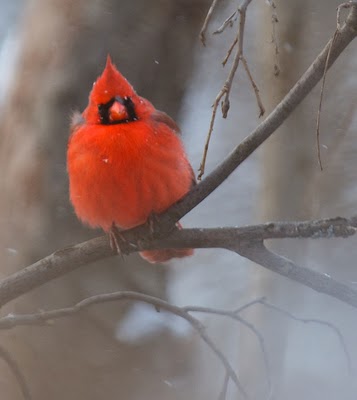
When your day is blue, or grey, look for red

The snow returned briefly yesterday, and today there is a bitter north wind.  When times are grey or cold, or if our mood is blue (as this week is purported to be) we need to consciously notice the moments of colour and warmth in our lives, explicitly savouring them a little longer. We have to let positive facts become positive experiences. Just as   Mary Oliver does when she pays attention to the red bird in this poem. What were  or are the moments of colour in your day today that you can be grateful for? Who or what brought warmth? Allow yourself  to feel good if you achieve something  however small,  if someone smiles or if you notice a good quality in yourself. As studies have shown, the more you take in the good in little details, the more your brain tilts towards the positive in an overall sense.

Still, for whatever reason —
perhaps because the winter is so long
and the sky so black-blue,

or perhaps because the heart narrows
as often as it opens —
I am glad

that red bird comes all winter,
firing up the landscape
as nothing else can do.