Fully involved

HappyChild

This quote comes from a different tradition than the meditation quote earlier, but is essentially saying the same thing. It is from Charlotte Selver, an extraordinary woman and one of the greatest influences on body-orientated psychotherapy today.  She lived a long life – was teaching still at age 101 – and  emphasized that we should being fully present in each moment, seeing it as completely new, being open to all the riches it could contain. This requires a full commitment, not standing on the fence, not watching the moments with tired eyes. She taught this by teaching movement in the body, being fully in touch which its action:

It is not first this, then this, then that – the whole person comes into motion.
There is nowhere where it stays as is, when I begin to allow movement.  

When you have to laugh, there’s nowhere where you don’t laugh.   Or you are only partly involved with laughing?
Nowhere, when you are crying, where it isn’t crying in you.  
Does that make sense?  
In other words, to give myself to something means not to go point by point.


Charlotte Selver

Sunday Quote: Meeting our limits

shadow333

The basic experience of everyone is the experience of human limitation.

Flannery O’Connor

Accepting, letting go, insight

File:AutumnLeaf2.JPG

In the deepest forms of insight we see that things change so quickly that we can’t hold onto anything,

and eventually the mind lets go of clinging.

Letting go brings equanimity. The greater the letting go, the deeper the equanimity.

In practice we work to expand the range of life experiences in which we are free.

U Pandita

photo brookie

Making meditation hard

ChangeWhen one composes one’s mind and looks inwards, there is a sense of coming to one point. If we are not caught in the thinking process, we can be aware of the here and now, the body, the breath, mental states, moods; we can allow everything to be what it is. The attitude of many people in meditation is that there is always a need to change something. There might be an attempt to attain a particular state or some kind of blissful experience they have had before, or even if they haven’t had anything like that, they might hope that if they continue to practise, they will. When we practise meditation with this idea of getting something, then even the idea of practice, even the word ‘meditation’, can bring up this conditioned reaction of: ‘There’s something I’ve got to do. If I’m in a bad mood I should get rid of that mood. I’ve got to concentrate my mind.’ If the mind’s scattered and we’re all over the place, ‘I should make it one-pointed; I’ve got to concentrate.’ And so we make meditation into hard work and there is a great deal of failure in it because we’re trying to control everything through these ideas

Ajahn Sumedho, Developing an Attitude toward Meditation

Always wanting more

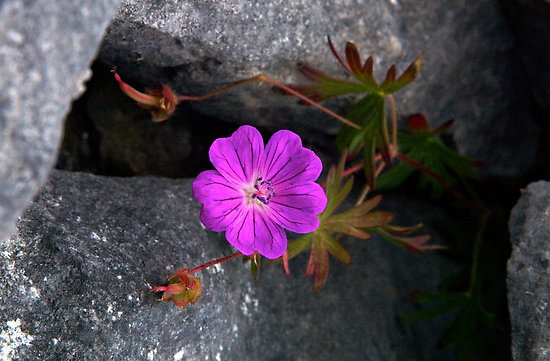
flower in rocks

I do not talk of the beginning or the end. 

There was never any more inception than there is now, 
Nor any more youth or age than there is now, 
And will never be any more perfection than there is now, 
Nor any more heaven or hell than there is now. 

Urge and urge and urge, 
Always the procreant urge of the world.

Walt Whitman, Song of Myself

A bell tower

File:TourGlendalough.jpg

Quiet friend who has come so far,
feel how your breathing makes more space around you.
Let this darkness be a bell tower
and you the bell. As you ring,

what batters you becomes your strength.
Move back and forth into the change.

Rilke, Sonnets to Orpheus II, 29

photo Glendalough, County Wicklow ,Ireland by cqui