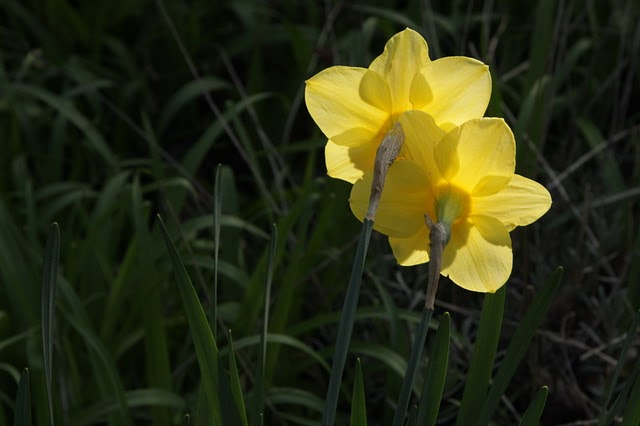
Spring: The Narrative reappears

It might be liberating to think of human life as informed by losses and disappearances just as much as by gifted appearances, allowing a more present participation and witness to the difficulty of living. What is real can never be fully taken away; its essence always remains. It might set us a little freer to believe that there is no path in life – in the low valley, … or abroad in the mountain night, that does not lead to some form of heartbreak when the outer narrative disappears and then reappears in a different form. If we are sincere, every good marriage or relationship will break our hearts in order to enlarge our understanding of our self and that strange other with whom we have promised ourselves to the future. Being a good parent will necessarily break our hearts as we watch a child grow and eventually choose their own way, even through many of the same heartbreaks we have traversed. Following a vocation or an art form through decades of practice and understanding will break the idealistic heart that began the journey and replace it, if we sidestep the temptations of bitterness and self-pity, with something more malleable, compassionate and generous than the metaphysical organ with which we began the journey. We learn, grow and become compassionate and generous as much through exile as homecoming; as much through loss as gain, as much through giving things away as in receiving what we believe to be our due.

David Whyte, The Poetic Narrative Of Our Times

Some things in life we just don’t know

When we handle things with ease we are changing the way we usually relate. The mind wants to know everything. Even if it doesn’t understand, it will have some belief. It will form an opinion or view and hang on to that just to fill up the space of not knowing. It wants to be on top of things. But this whole method of investigation and inquiry depends upon not knowing. It depends upon us being open and ready to not know. It depends upon us allowing mystery and letting the knowing arise out of that. It depends on our not being threatened…. from the point of view of the heart, the unconditioned mind, the unknown is mysterious . . . but it is beautiful. You don’t have to fill up the unknown with a belief or a concept or idea. You can leave it as mysterious because 99% of it will be mysterious anyway. There is no way that we can understand it all. So the heart’s response to that mystery is faith – a trust in the fundamental orderliness of the universe.

Ajahn Amaro, Open to Any Possibility

Appreciate the goodness within

When you relax more and appreciate your body and mind, you begin to contact the fundamental notion of basic goodness in yourself. So it is extremely important to be willing to open yourself to yourself. Developing tenderness towards yourself allows you to see both your problems and your potential accurately. You don’t feel that you have to ignore your problems or exaggerate your potential. That kind of gentleness towards yourself and appreciation of yourself is very necessary. It provides the ground for helping yourself and others.

Chogyam Trungpa, Shambhala: Sacred Path of the Warrior

And letting go of our habitual fears

The sense of splendidness arises from feeling our wealth. We have confidence in our inherent goodness — the beating heart of each individual and all humanity… The energy of splendidness comes from being fully present in whatever we do. My father, Chögyam Trungpa,  put it this way: “You are not hiding anywhere.” Hiding means our splendidness is obscured by embedded habitual patterns. One characteristic of hiding is that we are always self-observing. Self-observing comes from not trusting our inherent goodness, and therefore keeping the reins tight on our mind. It is different from awareness or introspection because in observing ourselves this way, we are not really sensing or feeling the moment. We lack the lucidity to simply be splendid, so we tighten up and hide. We have half-thoughts and half-emotions. When we do experience something wholly and completely, it is disconcerting and disorienting.

Sakyong Mipham Rinpoche, Let it Shine!

Not getting locked in

Each time you stay present with fear and uncertainty, you’re letting go of an habitual way of finding security and comfort. All those brain studies about meditation – where they place people in MRI machines or put electrodes on their heads – show us that each time you dare to remain where you are and do something completely fresh, unconventional and non-habitual, you open up new pathways in the brain. You experience that as strength, and it builds your capacity to be open the next time round. [However] it’s not like if you get it right once, if you overcome your jealousy or your anger once, then it’s smooth sailing for the rest of your life. There will be reruns. That means you will have lots and lots of chances to rouse yourself and let go. No need to exaggerate an emotional pattern, fixate on it, fuel it with more thoughts, or go into a tailspin. When you feel the shakiness, when the thoughts start to arise, when the tailspin is beginning, another rerun is in progress. You simply rouse yourself and let yourself be there.

Pema Chodron

A simple practice for working with difficult moments (and people)

Difficult situations or difficult relationship often give rise to a sense of fear in us, leading to blame, withdrawal or self-judgement. Here is a simple practice to use in such times, to extend kindness, firstly towards ourselves and then towards others or the situation

Sitting with your spine erect, breathe deeply, placing your finger tips over the center of your chest,  if you like.

As you inhale extend compassion to yourself by silently saying as you breathe out,  “May compassion awaken”. Inhale and exhale for several breaths, focusing on the center of your chest.

Then you may wish to picture a person to whom you wish to extend compassion. Again, as you exhale, silently say, “May compassion awaken”. Inhale and exhale for several breaths, focusing on the center of your chest.

Recalling the person [or the situation], silently say “May whatever clouds compassion be healed” Repeat this cycle with the phrase “May this moment be experienced, exactly as it is” and finally, “May compassion be extended to all”

Adapted from Elizabeth Hamilton