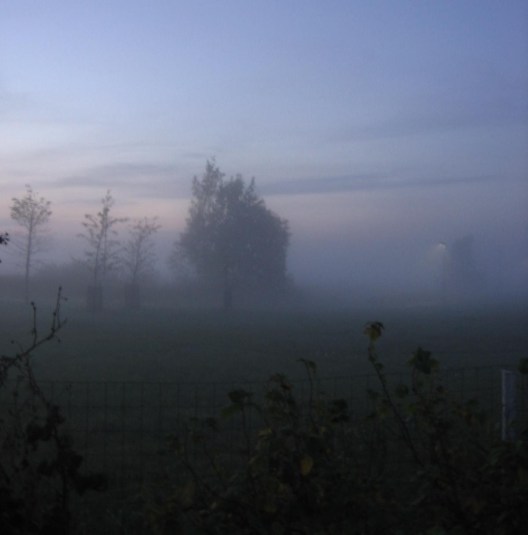
Seeing our tendency to blame

When you check your own mind properly,

you stop blaming others for your problems

Lama Thubten Yeshe, Your mind is your religion

Allow them to come, allow them to go

If we can allow some space within our awareness and rest there, we can respect our troubling thoughts and emotions, allow them to come, and let them go.

Our lives may be complicated on the outside, but we remain simple, easy, and open on the inside.   

Tsoknyi Rinpoche

Sunday Quote: Infused

The soul becomes dyed with the colour of its thoughts.

Marcus Aurelius, Meditations, Book 5, v 16

Our masks

 Only with patience can we come to see through the fear-based stories and excuses which so often run our lives. Hiding behind them, or living restricted because of them, we risk not being truly there  for most of our lives. Again, the challenge is to work fully with what is present in our day and not hide from it: 

Year after year —
on the monkey’s face
a monkey’s mask.

Basho, 17th Century Japanese poet

When routine blinds us

From one of my favourite writers…

Yesterday morning I was going through the routine. I was by the door, and since I knew that it would take the little angel some time to get into the car, I told her to get a head start. I pushed the button to open the door of the minivan, and went back to get the other kids pushed out of the house. By the time I came back outside, my little girl was in the car, in her booster seat.

In one smooth motion, I jumped in, slammed the door, buckled myself in, and was ready for the … driving routine to school. When I looked back in the rear view mirror, I saw my little girl in tears.

Slammed on the break. “Honey, what is wrong?” The sweet girl mentioned, “You didn’t notice it.”
My mind is racing. “Didn’t notice what, my love?”
She softly repeated, “You didn’t notice it.”
My mind is racing more, “I just want to want to get you all to the school before you are more late. You are in the car. I am in the car. We are all in the car. Do we really need to talk about this now?”

I park the car. I turn around, and face her fully, “Jan-am (“my soul”), what did I not notice?” She softly answered: “The door.”

I came out of the car, and circled the car. I didn’t see anything. No dents, no scratches. I looked at her beautiful brown eyes, and she softly repeated, but with a smile this time: “Your door.”

So I went over to my own door, the same one that I had slammed in my rush. And there it was.

The door, in fact the whole car, was covered in morning dew. And then, written onto the morning dew, in the handwriting that can only come from the fingers of a beautiful little girl filled with love, were the three most magical, most powerful words of all:

I love you

Under the sentence was a picture she had drawn into the morning dew of herself, a beautiful smiling girl, with the most magical long hair.

There is love, and it is real. I am loved. She wanted me to know that in the midst of all this chaos, I am loved.

Sometimes it is written in dew. It is here for a few minutes, and then gone. The love behind it lingers, onto eternity. So often I’ve been told to stop and smell the roses. If only. Roses linger for a while. They start out in a perfect little bud, slowly slowly opening, into that perfect form, before wilting while scattering every last bit of their scent. Sometimes their essence is preserved and lingers. There is a beauty, profound beauty there in the rose. But sometimes beauty is written in the morning dew. It is a beauty that you have to be present to, A beauty to witness A beauty to welcome.

It is as transient as a smile on the face of a child who wants to know if her Baba is paying attention.

May angel, May I always be present Fully

To catch your love poems

Written in dew.

Omid Safi, Love Written in Morning Dew

I wish it was different

Unusually long and hot weather spell in Ireland these last weeks, after our harshest winter in decades,  The land is getting quite parched and water restrictions are in place. So we, who normally complain about the lack of sun in the Summer, now complain of its presence. Another example of the either/or dynamic which pops up so frequently in our thoughts and of the constant daydreaming that things should be different. This famous koan from the 9th Century Chan Master Dongshan challenges us to be completely with whatever is happening,  without always placing it beside an alternative: 

A monk asked Dongshan, “When the cold visits us, how can we avoid it?”
Dongshan said, “Why not go where there is no cold?”
The monk asked, “Where is the place without cold?”
Dongshan said, “When it is cold, let the cold kill you. When it is hot, let the heat kill you.”

Blue Cliff Record Case 43: Dongshan’s Cold and Heat