
The return of Spring

I do not live happily or comfortably
with the cleverness of our times.
The talk is all about computers,
the news is all about bombs and blood.
This morning, in the fresh field,
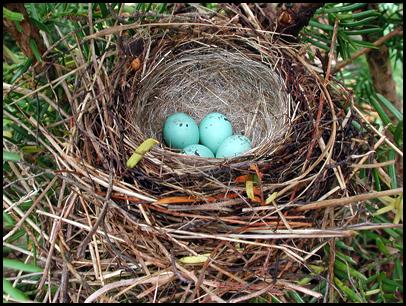
I came upon a hidden nest.
It held four warm, speckled eggs.
I touched them.
Then went away softly,
having felt something more wonderful
than all the electricity of New York City.

Mary Oliver, With thanks to the Field Sparrow, whose voice is so delicate and humble


Changing our attitude towards ourselves

Here – as always in his wise and clear way – Ajahn Sumedho gives us the practical way of working each day with this desire to fix ourselves. Not investing energy in our self-obsessive patterns is the best way of removing their hold on us:

We may not be the way we would like. There are many things about my personality that I can be very critical of. I don’t like myself that much or approve of myself on a personal level. I now see that as part of the path, not as an obstruction. So no matter what way you are right now – no matter how critical you might be, or how inadequate you might feel – change the attitude to one of learning from the way you are right now. Rather than trying to become something – rather than trying to get rid of the negativity, restlessness and confusion because you think these are flaws or defects that block you from enlightenment – just don’t believe any of that. Your conditioned mind will say anything, it is completely untrustworthy. That which we can really trust is the awareness.

Ajahn Sumedho, The Sound of Silence

Letting go our story lines

The essence of practice is always the same:
instead of falling prey to a chain reac
tion
of revenge or hatred,
we gradually learn to catch the emotional reaction
and drop the story lines.

Pema Chodron

Holding the boundary

Mindfulness holds a boundary so that we don’t get overwhelmed, shut down or react to the feelings that we have; then with full awareness, we get the whole of it, how that impression arises and what it does. We may then understand: ‘this feeling or impression is based upon this perception and thought, and it subsides when that thought or perception is removed.’ ‘This negative impression arises with that perception or that memory and it subsides when I practise loving-kindness, or even when I can just sit with it and let it subside.’ Together mindfulness and full awareness acknowledge what is going on, and where it stops. They don’t bring ‘I am,’ ‘I should be’ into it.

If we establish these skills of attention, they free the mind from acting on or reacting to the results of the past. If we attend to the present impressions, the present moods and sensations, and cut off the proliferations and projections, we’re not living in the fog of resentment, fantasy, romance, or other biases. This means that our attention, and consequently, our moods, actions and speech, are going to be clearer and brighter

Ajahn Sucitto, Bright Kamma: Support for Attention

Continual Partial Attention

Two observations, from different perspectives. One from Linda Stone, who used to work at Apple and who now writes on the effect of the internet and other technologies on our overall wellbeing. The other from Thomas Merton, the Catholic monk, reflecting on the effect of noise. Written over 40 years apart, with different epistemologies, they come to similar conclusions.

We pay continuous partial attention in an effort NOT TO MISS ANYTHING. It is an always-on, anywhere, anytime, any place behavior that involves an artificial sense of constant crisis. We are always in high alert when we pay continuous partial attention. This artificial sense of constant crisis is more typical of continuous partial attention than it is of multi-tasking. 

Linda Stone, Writer and Consultant, 2009

Now let us frankly face the fact that our culture is one which is geared in many ways to help us evade any need to face this inner, silent self. We live in a state of constant semiattention to the sound of voices, music, traffic, or the generalized noise of what goes on around us all the time. This keeps us immersed in a flood of racket and words, a diffuse medium in which our consciousness is half diluted: we are not quite ‘thinking,’ not entirely responding, but we are more or less there. We are not fully present and not entirely absent; not fully withdrawn, yet not completely available. It cannot be said that we are really participating in anything and we may, in fact, be half conscious of our alienation and resentment. Yet we derive a certain comfort from the vague sense that we are ‘part of’ something – although we are not quite able to define what that something is – and probably wouldn’t want to define it even if we could. We just float along in the general noise. Resigned and indifferent, we share semiconsciously in the mindless mind of Muzak and radio commercials which passes for ‘reality.’

Thomas Merton, Cistercian Monk, 1915 – 1968
Giving full attention to each thing today

Attention means focus, it means simplicity, it means giving your attention to one thing, one person at one time. Not in a fixated compulsive addictive way, but to be able to really give yourself, at that moment, to the person you are with. Learning to meditate is learning to pay attention. It is the art of attention in the simplest purest most immediate way. When you sit to meditate you let go of all the 1001 different things that are going on in the head. But don’t underestimate how distracted you are. It’s not easy, so don’t expect it to be easy. But it is simple. And because it is simple, anyone can do it who really wishes to do it, and is humble enough to keep coming back to it and learn, day by day, little by little, how to pay attention.

Laurence Freeman,  Benedictine monk