How to meditate: very simple instructions

When a thought arises that’s strong enough to take your attention away from the breath, simply note it as not breath. Whether it’s the most beautiful thought in the world or the most terrible, one you would never disclose to another soul, in this meditation, it’s simply not breath. You don’t have to judge yourself. You don’t have to get lost in making up a story about what triggered the thought or its possible consequences. All you have to do is recognize that it is not a thought. Some of your thoughts may be tender and caring, some may be boring and banal; all that matters is that they are not the breath. See them, recognize them, very gently let them go, and bring your attention back to the feeling of the breath.


Sharon Salzberg, Real Happiness: The Power of Meditation

The hidden work that is essential for growth

The ladder whose ascent implies spiritual progress has a long pedigree.  Hebrews, Greeks and Christians all gave special value to the heights, and Western morality tends to put all better things up high and worse things down low. By the last century growth became inexorably caught in this ascensionist fantasy. Darwin’s thesis The Descent of Man became, in our minds, the ascent of man. Each immigrant moved upward in social class as buildings moved upwards with their elevators to more expensive levels. By now the upward idea of growth has become a biographical cliché. To be an adult is to be a grown-up. Yet this is merely one way of speaking of maturity, and an heroic one at that. For even tomato plants and the  tallest trees send down roots as they rise toward the light. Yet the metaphors for our lives see mainly the upward part of the organic motion.

James Hillman, The Soul’s Code

Keeping things light

There is a difference between being aware of a thought and thinking a thought. That difference is very subtle; it is primarily a matter of feeling or texture. A thought you are simply aware of with bare attention feels light in texture; there is a sense of distance between that thought and the awareness viewing it. It arises lightly like a bubble, and it passes away without necessarily giving rise to the next thought in that chain. Normal conscious thought is much heavier in texture. It is ponderous, commanding, and compulsive. It sucks you in and grabs control of consciousness. By its very nature it is obsessional, and it leads straight to the next thought in the chain, apparently with no gap between them.

Bhante Henepola Gunaratana, Mindfulness in Plain English

A mind that looks and does not think

One must have a mind of winter
To regard the frost and the boughs
Of the pine-trees crusted with snow;

And have been cold a long time
To behold the junipers shagged with ice,
The spruces rough in the distant glitter

Of the January sun; and not to think
Of any misery in the sound of the wind,
In the sound of a few leaves,

Which is the sound of the land
Full of the same wind
That is blowing in the same bare place

For the listener, who listens in the snow,
And, nothing himself, beholds
Nothing that is not there and the nothing that is.

Wallace Stevens, The Snow Man

A Path with Heart

A path is only a path, and there is no affront, to oneself or to others, in dropping it if that is what your heart tells you . . . Look at every path closely and deliberately. Try it as many times as you think necessary. Then ask yourself alone, one question . . . Does this path have a heart? If it does, the path is good; if it doesn’t it is of no use.

Carlos Casteneda.

We set out on the road to freedom when we no longer let our compulsions or passions govern us. We are freed when we begin to put justice, heartfelt relationships, and the service of others and the truth over and above our own needs for love and success or our fears of failure and of relationships. To be free is to know who we are with all that is beautiful, all the brokenness in us; it is to love our values, to embrace them, and to develop them; it is to be anchored in a vision and a truth but also to be open to others and so, to change. Freedom lies in discovering that the truth is not a set of fixed certitudes, but a mystery we enter into, one step at a time. It is a process of going deeper and deeper into an unfathomable reality.

In this journey of integrating our experiences and our values, and of what we might learn as we listen to others, there may be a period of anguish. We need to find links between the old and the new, links that will permit the integration of new, consciousness-expanding truths into what we already know and are living –  our existing certitudes. As human sciences develop and the world evolves, we are called to grow into a new and deeper understanding of the Source o the universe and of life. As we participate in this, our sense of the true expands. Freedom is to be in awe of this Source, of the beauty and diversity of people, and of the universe. It is to contemplate the height and breadth of all that is true.

Jean Vanier, Becoming Human

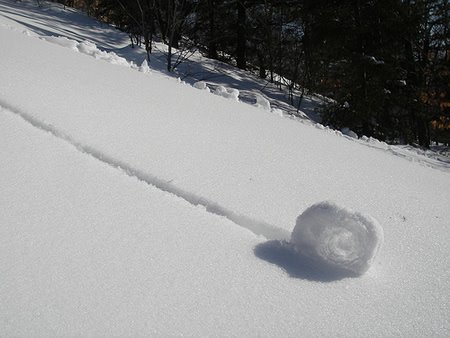
Like a snowball gathering speed

To start the new year, back to basics….A lovely text on how the mind proliferates on the basis of a simple feeling and makes a whole story out of it. We will probably get a lot of opportunity to practice with this  as we return to work this week and the holiday excitement fades. So this Monday, like every day, we start over again….. becoming more and more aware of this process, and creating a gap.

The outflowing of the mind is what one is witnessing in meditation when the mind surges off into sights and sounds, opinions, thoughts or feelings. It is most important to get acquainted with what that is like for the mind: the attention pouring out into different things. One can see how, first of all, there is just a vague thought of a memory, or a shape that you notice, and it is quite ephemeral; there is nothing very much there, you just remember some event. Then it catches our attention and, as the mind goes into it, suddenly what was just a vague and insubstantial thing comes to life – and our attention has brought it to life. We have breathed life into that thought with the act of attention.

As we give attention to it and it comes to life, then the whole flow of feeling along with that increases and develops – whether the feeling is pleasant or painful or whatever. If there is no mindfulness, then that feeling conditions self-centered desire; if it is a pleasant feeling, a desire for more of it; if it is a painful feeling, a desire to get away from it. Then that desire turns into attachment and the attachment turns into what is called ‘becoming’   – like a wave gathering strength.  Then, as the attachment and the becoming increase, we find ourselves thoroughly caught up with some melodrama and carried away on the whole cycle of birth and death. We are born into a memory, a hope or a worry, born into a piece of music or a feeling; and if we are born into it then we die with it when it comes to an end. Suddenly we find ourselves stranded and lost in another world.

If there is wisdom then we realise – “This is a feeling” –  and we follow it as it goes through its cycle of life. Then, as the feeling fades, there is nothing there creating more momentum around it. The feeling fades like a sound and then there is silence.

Ajahn Amaro, Silent Rain.