Becoming one who sees

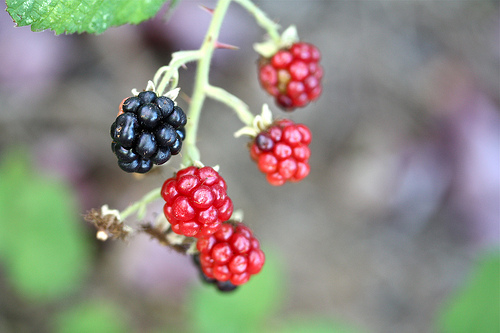
Despite the incredibly warm weather, the berries have appeared on the bushes in the garden. They reminded me of this quote,  and its encouragement to see into the heart of things, happening in each moment of the day. Sometimes we are just to preoccupied and hurried to notice.  We let life – and heaven – pass by,  unnoticed.

Earth’s crammed with heaven,
And every common bush afire with God:
But only he who sees, takes off his shoes…

Elizabeth Barrett Browning, Aurora Leigh


Noting, rather than reacting

Buddhadasa Bhikkhu said, “If there was to be a useful inscription to put on a medallion around your neck it would be ‘This is the way it is’.” This reflection helps us to contemplate: wherever we happen to be, whatever time and place, good or bad, ‘This is the way it is.’ It is a way of bringing an acceptance into our minds, a noting rather than a reaction.

The practice of meditation is reflecting on ‘the way it is’ in order to see the fears and desires which we create. This is quite a simple practice. Many methods of meditation are very very complicated with many stages and techniques – so one becomes addicted to complicated things.  However, the more simple we get, the more clear, profound and meaningful everything is to us.

So with the breath of the body, the weight of it, the posture of it, we are just witnessing and nothing, observing how it is, now, in this moment. The mood of the mind, whether we feel bright or dull, happy or unhappy, is something we can know – we can witness. And the empty mind, empty of the proliferations about oneself and others, is clarity. It’s intelligent, and compassionate. The more we really look into the habits we have developed, the more clear things become for us.

Ajahn Sumedho, The Way it is

Noticing what we see

Another English writer to help us, maybe not as literary as Wordsworth, but just as insightful.

“Holmes you see everything!”  Watson exclaimed.

“I see no more than you,

but I have trained myself to notice what I see“, said Holmes.

Sir Arthur Conan Doyle, The Adventure of the Blanched Soldier

Being genuine

The ancients used to say that God was “simple”, in the sense of wholeness, without parts, just simply being. We strive for that, trying to be coherent and consistent in our words and deeds, and not divided, but fully present in our attention to others.  Here is a nice story from the Zen tradition which shows what it would be like to be genuine in our words and relationships.

When Zen master Bankei died, the old blind man who used to sit outside the temple said how sad he was. ‘You see, since I am blind I cannot watch people’s faces, so I judge their character by the sound of their voices. And it is this way. When most people are given the news of another person’s good fortune or success they, of course, congratulate the fortunate person, but virtually always beneath the words of gladness, I hear another note, a secret note of envy, envy that it is not they themselves who have been so fortunate. Again, when most people are given the news of some calamity that has befallen another person they, of course, express their sorrow towards the afflicted person, but virtually always, beneath the words of sorrow, I hear another note, a secret note of pleasure and satisfaction that it is not they themselves upon whom the calamity has fallen. With Bankei, however, it was not so. When he expressed gladness at another’s good fortune all you heard was gladness. When he expressed his sorrow, all you heard was ­sorrow.’

Being held

It took a long time for the analytical world to look at the importance of the way a baby is held, and yet when you come to think of it, this is of primary importance. The question of holding brings up the whole issue of human reliability.   Winnicott

I love the sense of natural movement in this poem by Rilke, and the delicate gentleness of the last line. We change, are shaken and fall, as nature does, and this can seem frightening at times. It can agitate us as it goes against the security we have when things are firm. To give us confidence we need some sense of being held. Because, as Winnicott reminds us, a person’s  most formative experiences comes from the way their caregivers “hold” them, as that allows them feel grounded in the face of the uncertainties of life. Meditation practice allows us create that security within, and develop an inner stability, which is hard to shake, no matter what comes up. We trust and can let our lives unfold gently, lightly, each breath and each moment floating and falling, held in awareness.

The leaves are falling, falling as if from afar,
as if withered in the distant gardens of heaven;
with nay-saying gestures they fall.

And in the nights falls the heavy earth
from all the stars into loneliness.

We all are falling. This hand there falls.
And look at the others: it is in all of them.

And yet there is one, who holds all this falling
with infinite gentleness in his hands.

Rainer Maria Rilke, Autumn

Asleep

In essence,  mindfulness is about wakefulness.

Our minds are such that we are often more asleep than awake

to the unique beauty and possibilities of each present moment as it unfolds.

Jon Kabat Zinn