Keeping distracted

phones subway

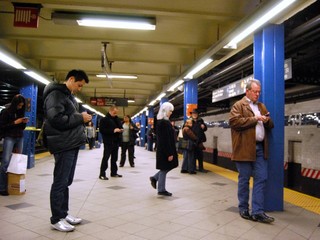
The best-adjusted person in our society is the person who is not dead and not alive, just numb. When you are fully alive you are constantly saying “No” to many of the processes of society, the racism, the polluted environment, the nuclear threat,  the arms race, drinking unsafe water and eating carcinogenic foods. Thus it is in the interest of society to promote those things that take the edge off, keep us busy with our fixes, and keep us slightly numbed-out and zombie-like. In this way our modern consumer society itself functions like an addict.

Anne Wilson Schaef, When Society Becomes an Addict

The myth of lives without challenges

File:Rocky path on the Ben Nevis climb - geograph.org.uk - 856611.jpg

Pain is inevitable; lives come with pain. Suffering is not inevitable. If suffering is what happens when we struggle with our experience because of our inability to accept it, then suffering is an optional extra.

Sylvia Boorstein, It’s Easier than you Think

The common myth that is perpetuated in society is that the normal person is happy, balanced and integrated – otherwise there is something wrong with them; maybe they’re mentally unstable. We’re even alarmed by unhappy people. Everyone in the media is smiling and cheerful. The politicians are all smiling, cheerful. confident; funeral homes even make the corpses up to look smiling, cheerful and confident…… Unhappiness in Western culture is often treated as a sign of failure.

Ajahn Sucitto, Turning the Wheel of Truth

photo Stephen Sweeeney

Sunday Quote: Wherever you are….

File:Newgrange Entrance Stone.jpg

God is a circle whose center is everywhere

and circumference nowhere.

Voltaire

photo:  carved spiral design on passage tomb entrance at Newgrange, Co Meath, Ireland

Not too big or too small

File:Glacier scratched pebble.JPG

Modern science is finding out that a lot can be learned from contemplative traditions, both in the East, as seen in Ajahn Sucitto’s quote this morning, and in the West, as can be seen in monastic orders like the Cistercians both here at Bolton Abbey in Ireland or all around the world. They both emphasize the health benefits of sitting still, which has effects on brain function, even in small doses.

The claim…that stillness of body leads to stillness of mind is not the exclusive preserve of Indian traditions: the desert fathers maintained that simply sitting still, preferably on or close to the ground, would greatly aid their attempts to keep the mind focused and thus resist the distracting chatter of demons. To sit still is to be present, and fully attentive to what is. How often do we really give our undivided attention to the things we do, or the people we are with? To be present is to accept what is,  as it is, without wishing things were otherwise, or imagining that if only they were, then everything would be so much better. It is to be able to pick up a pebble and see that it is perfect – just as it is – neither too big or too small. 

Nicholas Buxton, Tantalus and the Pelican

photo b navaz : basalt pebble scratched by glacier erosion
A firmer place

File:Women sitting on beach.jpg

The simple practice of sitting still or steady walking bring you to a firmer place in yourself, your still centre. This is because “mind” is a mixture of heart and brain functions, in which the heart is predominantly involved with the steady receptivity we call mindfulness and clear comprehension. The heart is not just a metaphor for emotions and perceptions. So when we “tune in” to a still body or to the rhythm of breathing, the message we receive is that things are fine and the brain quietens down. This is the often overlooked function of the heart: it is a major contributor to direct experience (rather than figured out, learned or abstract knowledge).

Ajahn Sucitto, Meditation, A Way of Awakening

Travelling light

File:Berlin hauptbahnhof drei rollkoffer 15.04.2011 15-07-46.JPG

There is an old story of a famous rabbi living in Europe who was visited one day by a man who had traveled by ship from New York to see him. The man came to the great rabbi’s dwelling, a large house on a street in a European city, and was directed to the rabbi’s room, which was in the attic. He entered to find the master living in a room with a bed, a chair, and a few books. The man had expected much more.  After greetings, he asked, “Rabbi, where are your things?” The rabbi asked in return, “Well, where are yours?” His visitor replied, “But, Rabbi, I’m only passing through,” and the master answered, “So am I, So am I.”

This is not a lesson to be put off. One great teacher explained it this way: “The trouble with you is that you think you have time.” We don’t know how much time we have. What would it be like to live with the knowledge that this may be our last year, our last week, our last day? In light of this question, we can choose a path with heart.

Jack Kornfield,  A Path With Heart

photo dirk ingo franke