A hidden beauty

…You come, dreaming of ferns and flowers

and new leaves unfolding

upon the brash turnip-hearted skunk cabbage…

…Your kneel beside it. The smell

is lurid and flows in the most

unabashed way…

…but these are the woods you love,

where the secret name

of every death is life again – a miracle…

…What blazes the trail is not necessarily pretty.

Mary Oliver, Skunk Cabbage

Going deeper on this journey

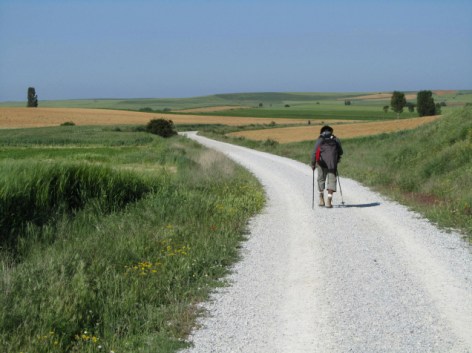
SM: Pilgrim on the Camino

Every step we take, can be filled with peace, joy, and serenity. The question is whether or not we are in touch with it. We need only to be awake, alive in the present moment.

Thich Nhat Hanh

In this part of the world there are not so many English Speaking Retreats available, besides the excellent ones offered all year round at Gaia House in the UK. Therefore, deepening practice through an extended period of silence can be difficult to organize without the extra expense of long travel.  For this reason I am delighted to be able to post that James Baraz, the author of the well-known book and programme Awakening Joy, will be leading a Mindfulness Retreat,   from June 27 – July 5, in the lovely retreat center at Götzis, Austria, just across the border from Switzerland. The title of the retreat is Being Present for Your Life and the emphasis is on quieting the mind, opening the heart, and developing loving-kindness, clarity and depth of practice.  Because the format includes periods of silent sitting and walking meditation along with discussion and mindful movement, this is a great place to start one’s retreat experience, with an excellent teacher. It would be very suitable for all who have completed the MBSR programme and who wish to deepen their practice. More details can be found by clicking on the link : http://www.arbor-seminare.de/being-present-your-life

Here in France,  the 4th International Forum on Buddhism and Medicine will be held at the end of May in Lerab Linn near Montpellier, with a range of international speakers coming.  Again, details can be found by clicking the link  http://2013.buddhismandmedicine.org/en/

Finally, since this is a practical post, the blog had its 200,000 visitor last week, one year after we reached our first 100,000, which took over two and a half years.   I want to thank everyone of you  who stops by for your readership and comments, and all who follow the Blog for your support, practice and presence on this journey.

…. being and doing

File:Bucegi Romania feet.jpg

Music is pleasing not only because of the sound but because of the silence that is in it: without the alternation of sound and silence, there would be no rhythm. If we strive to be happy by filling in the silences of life with sound, productive by turning all life’s leisure into work, and real by turning all our being into doing, we will only succeed in producing a hell on earth. If we have not silence, God is not heard in our music. If we have not rest, God does not bless our work. If we twist our lives out of shape in order to fill every corner of them with action and experience, God will seem silently to withdraw from our hearts and leave us empty.

Thomas Merton, No Man is an Island

photo : jon rawlinson

Balance…

File:Arc-en-ciel sur l'île d'Hoëdic.jpg

Happiness is not a matter of intensity,

but balance

Thomas Merton

photo Stephanie de Nadai

Whatever the weather

Appreciation is a relaxing and peaceful state of mind. It creates a space in which we can accommodate the vicissitudes of life. Complaint, on the other hand, is frustrating and painful. There’s an element of anger and fixation involved. We are believing our thoughts, taking them to be real. Our attachment to the concept of how we want things to be is stressful, because that concept is always disintegrating. What we wanted to happen is not happening. We think complaining is going to get the world back on our track, but really it results in our being deaf, dumb and blind to the present moment. When we complain, we’re saying that the world needs to change in order for us to be okay. If only our parent or partner would behave differently, if only the food were better, if only there were less traffic, if only the service were quicker—then we’d be happy.

Sakyong Mipham Rinpoche, No Complaints

More how than why

window dirt

The way of Wisdom is not the way of why, but the way of what. The Hebrew word [for wisdom] “chochma”  can be read as choch mah, “what is”. Wisdom will not tell you why things are the way they are, but will show you what they are and how you can live in harmony with them

Rabbi Rami Shapiro, The Divine Feminine in Biblical Wisdom Literature